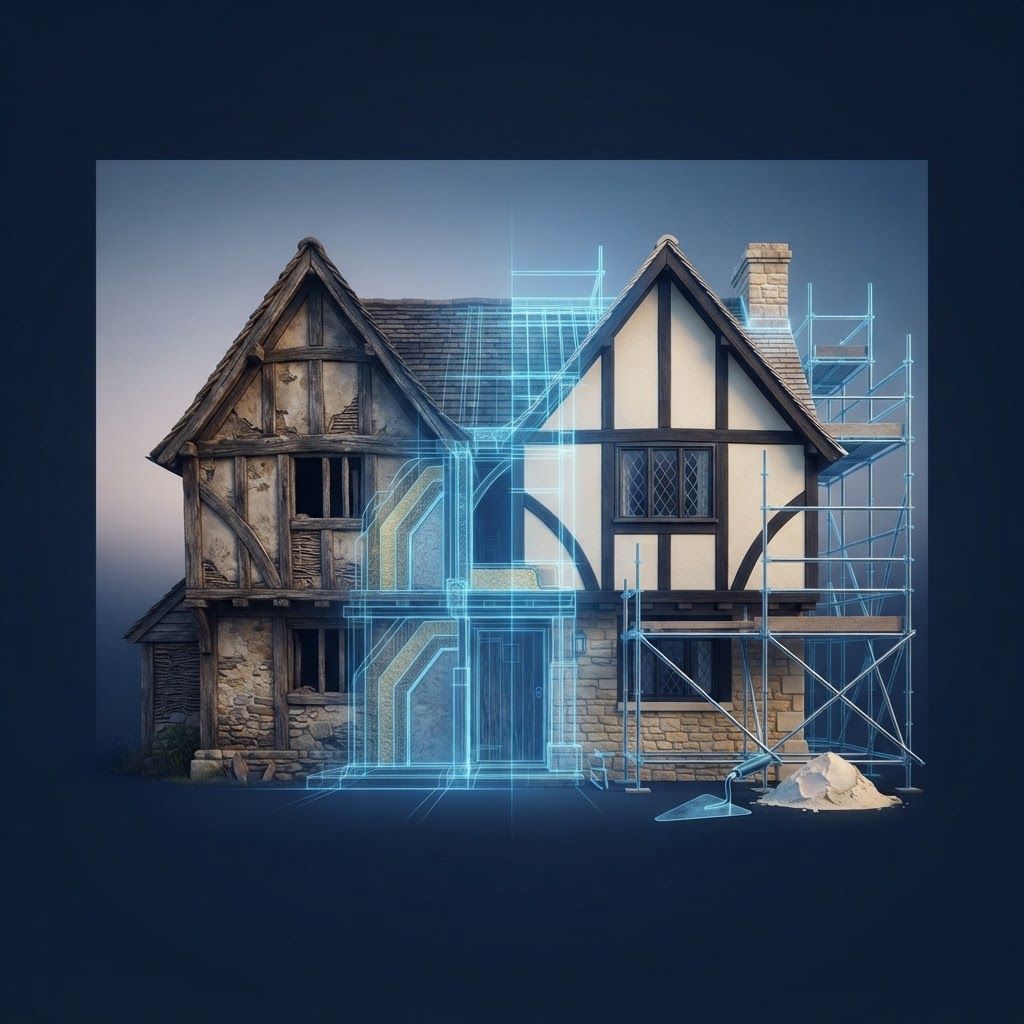
Herefordshire: A County Built for Renovation
Few English counties have a housing stock as old and as architecturally distinctive as Herefordshire's. The black-and-white trail through Weobley, Pembridge and Eardisland showcases some of the finest surviving timber framing in Britain. Add Georgian townhouses in Ledbury and Ross-on-Wye, Victorian terraces in Hereford, red sandstone farmhouses, converted oast-style buildings, cider barns and stone cottages, and the renovation market becomes the dominant construction activity in much of the county.
Renovating these buildings is a specialist discipline. Solid stone and timber-framed walls need to breathe, which means modern impermeable materials such as cement render, gypsum plaster and closed-cell foam insulation can trap moisture and cause structural decay. Successful Herefordshire renovation contractors understand vapour-open construction, lime mortars and plasters, wood fibre and hemp insulation, and the careful sequencing of repair before upgrade.
What Good Renovation Practice Looks Like
A strong renovation contractor begins with diagnosis rather than demolition. That means moisture surveys, timber inspection for beetle and rot, structural assessment of frames and roof trusses, and understanding where previous unsympathetic interventions have caused damage. Only then should a specification be written.
Consent management is equally important. Listed building consent, conservation area rules and Article 4 directions all apply across Herefordshire, and unauthorised work on a listed structure is a criminal offence. Reputable contractors work openly with conservation officers and heritage consultants and will advise clients against work that risks enforcement action.
Finally, good renovators are honest about cost uncertainty. Opening up an old building reveals surprises. Contractors who build a contingency into the plan and use a transparent provisional sums structure are far easier to work with than those who quote a fixed price they cannot honestly hold.
The Top 10 Renovation Contractors in Herefordshire
1. Border Oak. Beyond new oak-framed homes, Border Oak undertakes extensions, barn conversions and repairs to historic timber-framed structures. Its in-house framing yard and design team make it a natural first call for anyone renovating a period timber building in Herefordshire.
2. Herefordshire heritage building specialists. A recognised group of conservation-accredited builders across Leominster, Weobley and Bromyard focuses exclusively on listed and traditional structures, offering lime plastering, wattle and daub repair, oak splicing and traditional roofing. Their craft skills are the reason many of the county's black-and-white buildings survive.
3. Speller Metcalfe. For larger renovation and refurbishment projects, including public buildings, schools, churches and commercial conversions, Speller Metcalfe brings structured project management, strong heritage credentials and a sustainability-led approach to retrofit.
4. E G Carter & Co. This regional contractor undertakes substantial refurbishment and conversion contracts, including occupied-building works. Clients value its planning discipline, quality control and experience of phasing complex renovation programmes.
5. Local barn conversion specialists. Herefordshire's agricultural decline has left a rich supply of stone and brick barns suitable for conversion. Specialist contractors in this niche handle structural stabilisation, insulated linings, large glazing installations and package treatment plant drainage while retaining agricultural character.
6. Retrofit and energy upgrade contractors. A growing set of PAS 2035-aligned retrofit firms in the county delivers whole-house energy improvement: internal wood fibre insulation, secondary glazing, airtightness improvement, heat pumps and mechanical ventilation. For solid-wall Herefordshire homes, this approach avoids the damp problems caused by generic insulation schemes.
7. Joinery-led renovation firms. Bespoke joinery workshops in and around Hereford undertake full renovation projects where windows, doors, staircases and fitted furniture drive the quality of the result. Their advantage is control over the elements most visible in a finished period interior.
8. Kitchen and bathroom renovation specialists. For homeowners whose project centres on internal reconfiguration rather than structural repair, dedicated renovation firms in Hereford and Ross-on-Wye deliver design-and-install packages covering plumbing, electrics, tiling and finishes with a single point of responsibility.
9. Cross-border Welsh Marches contractors. Firms based in Monmouthshire and Powys work extensively in south and west Herefordshire on farmhouse renovations and rural extensions. Their stone-working and roofing skills suit the sandstone and slate traditions of the border country.
10. Small directly managed local builders. Across the county, established small builders with long-standing local reputations handle extensions, loft conversions, re-roofing and internal refurbishment. For most homeowners these firms represent the best combination of value, accountability and practical experience, and they usually come recommended through word of mouth.
Renovation Trends in Herefordshire
Energy retrofit is the strongest trend. Rising heating costs and off-grid oil dependency in rural Herefordshire have made insulation and heat pump upgrades financially compelling. The critical nuance is that breathable retrofit methods must be used on traditional buildings, and awareness of this is now much higher than it was a decade ago.
Second, multi-generational and flexible living is reshaping briefs. Annexes, garden studios, home offices and reconfigured ground floors are common, driven by remote working and family care needs. Third, material reuse is gaining traction: reclaimed sandstone, salvaged oak, reused clay tiles and locally sourced timber both reduce carbon and produce more authentic results on period property.
Practical Guidance for Homeowners
Commission a survey before you commission a builder. A conservation-competent surveyor or structural engineer will identify the real priorities, which are often invisible: failing lintels, spreading roofs, cement render trapping damp, or historic beetle damage. Sequence work correctly by fixing water ingress and structure before touching finishes.
Use a written contract even for modest projects, with a clear schedule of works, payment stages tied to completed milestones, and a defects period. Ask for evidence of insurance covering work to existing structures, which is not always included in standard contractor cover. And resist the temptation to compress the programme. Lime mortars and plasters need drying time, and rushing them undermines the whole investment.
Conclusion
Renovation in Herefordshire is a craft as much as a construction service. The county's best contractors combine traditional skills with modern building physics knowledge, allowing older homes to become warm and efficient without being damaged in the process. Choosing a contractor who genuinely understands that balance is the difference between a renovation that lasts a century and one that creates problems within five years.
Want your brand featured in front of decision-makers? Publish a guest post or get a link insertion in our guides through AAMAX's guest post and link insertion service.
Helpful Links
 SponsoredAAMAX — Full-Service Digital Agency
Write for Us
Share your expertise with our readers. We welcome guest contributions from industry specialists.
Pitch your idea