

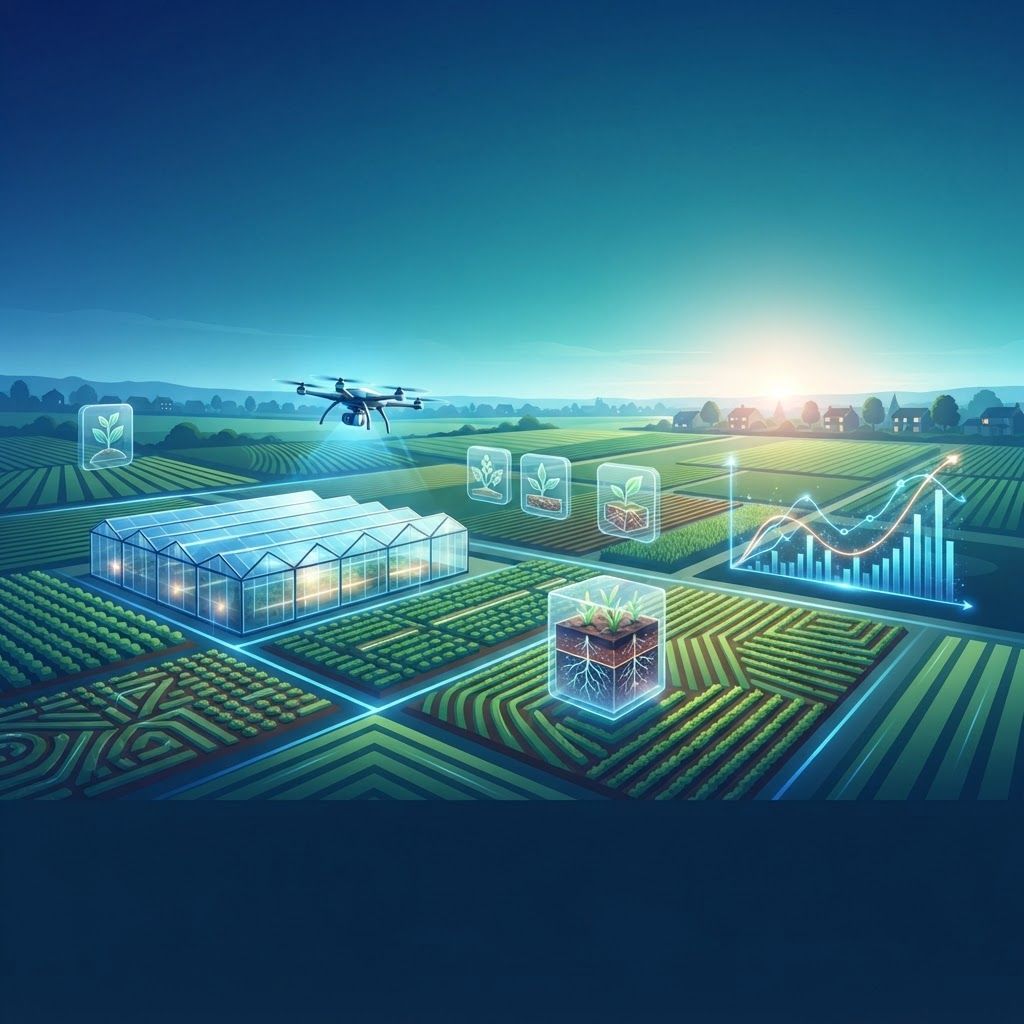
Farming on the Edge of London
Kingston upon Thames sits at the point where suburban London gives way to the Surrey countryside. Beyond Chessington and Malden Rushett the landscape opens into green belt land where working farms, equestrian holdings, nurseries and market gardens continue to operate. This peri-urban agriculture is commercially distinctive: land values are high, field sizes are often modest, and proximity to millions of consumers makes direct selling, leisure and education viable alongside conventional production.
The result is a farming sector in and around the borough that leans heavily towards high-value horticulture, livestock grazing on marginal land, farm shops, pick-your-own operations and community food growing. Large-scale arable production is limited, but the economic contribution through food retail, hospitality and land management is significant.
What Peri-Urban Farming Looks Like
Farms near Kingston typically diversify to survive. A single holding might combine grazing, hay production, livery stabling, a farm shop, a café and event hire. Diversification spreads risk and captures more of the retail margin, but it also means these businesses operate as much in hospitality and retail as in agriculture. Regulatory demands are broad, spanning animal welfare, food hygiene, planning and public liability.
Growing under protection is another characteristic. Glasshouses and polytunnels allow salad crops, soft fruit and ornamentals to be produced close to market with short delivery distances, which supports freshness claims that imported produce cannot match.
Ten Farming Companies and Organisations Connected to the Borough
1. Chessington Nurseries is a long-standing horticultural business on the borough's southern fringe, combining plant production with retail garden centre operations. It exemplifies the peri-urban model where growing expertise is paired with direct consumer sales.
2. Hobbs Cross and comparable Surrey mixed farms operating in the surrounding countryside supply livestock and forage while providing grazing management for green belt land. Their role in maintaining open landscape around the borough is as important as their output.
3. Garsons Farm, based nearby in Esher, is one of the best known pick-your-own and farm shop operations in the region. Kingston residents form a substantial part of its customer base, and its seasonal fruit and vegetable picking has become a fixture of the local food calendar.
4. Priory Farm in Surrey demonstrates how farm diversification into retail, food and leisure can sustain a working holding. Its combination of produce, plants and hospitality is a template many smaller farms in the area have followed.
5. Copse Farm and similar equestrian and forage enterprises around Malden Rushett focus on hay, haylage and livery services. Demand from London's equestrian community makes forage production and stabling a reliable income stream on land unsuited to intensive cropping.
6. Surrey Docks Farm and comparable city farm organisations, while outside the borough boundary, work closely with Kingston schools on agricultural education. Their contribution is largely social, teaching food origin, animal husbandry and horticulture to urban children.
7. Kingston Community Growing Projects, including allotment associations and community orchards across Surbiton and New Malden, collectively manage a meaningful area of productive land. They supply local food, support biodiversity and provide practical horticultural training.
8. Hogsmill Valley land management partnerships combine conservation grazing with habitat restoration along the river corridor. This model uses livestock as a land management tool, improving grassland ecology while producing meat.
9. Riverford and comparable organic box schemes serve the borough extensively, aggregating produce from certified organic growers and delivering directly to households. They have become a major route to market for organic farms across southern England.
10. Local artisan producers and micro-farms, including microgreen growers, urban mushroom producers and small-scale honey enterprises, supply Kingston restaurants and markets. Their small footprint suits an urban borough and their premium positioning supports viable margins on limited land.
Trends Shaping Agriculture Near Kingston
Regenerative practice is gaining ground. Cover cropping, reduced tillage, rotational grazing and hedgerow restoration improve soil health and water retention while supporting biodiversity commitments. For farms close to a large population, these visible environmental practices also strengthen the consumer relationship.
Controlled environment agriculture is expanding. Vertical farming and hydroponic production suit high-value leafy crops and can operate within industrial units rather than on farmland, making them well matched to urban boroughs where land is scarce and demand for ultra-fresh produce is high.
Public payment for environmental outcomes is changing farm economics. Support increasingly rewards habitat creation, water quality improvement and public access rather than production volume alone, which favours the kind of mixed, environmentally focused holdings found on London's fringe.
Direct-to-consumer selling continues to grow. Farm shops, box schemes, farmers' markets and restaurant supply allow producers to capture retail margin and build brand loyalty, insulating them from commodity price pressure.
Challenges and Opportunities
The pressures are real. Development pressure on green belt land, high input costs, labour availability and unpredictable weather all weigh on margins. Public access brings litter, dog-related livestock issues and trespass. Yet the opportunities are equally clear: an affluent, food-conscious population within a few miles, strong appetite for local and traceable produce, and growing interest in agricultural education and farm-based leisure.
For anyone looking to work with local producers, whether as a restaurant, retailer or school, the practical advice is to plan seasonally, commit to volumes in advance where possible, and value consistency over the lowest price. Small producers can deliver exceptional quality but need predictable demand to plan planting and stocking.
Final Thoughts
Farming around Kingston upon Thames is small in area but rich in variety and significance. It maintains the borough's green setting, supplies genuinely local food, and connects an urban population to how that food is produced. As environmental policy and consumer expectations continue to shift towards sustainability and traceability, these peri-urban farming businesses are well placed to thrive by doing what distant large-scale agriculture cannot.
Want your brand featured in front of decision-makers? Publish a guest post or get a link insertion in our guides through AAMAX's guest post and link insertion service.
Helpful Links
 SponsoredAAMAX — Full-Service Digital Agency
Write for Us
Share your expertise with our readers. We welcome guest contributions from industry specialists.
Pitch your idea

