

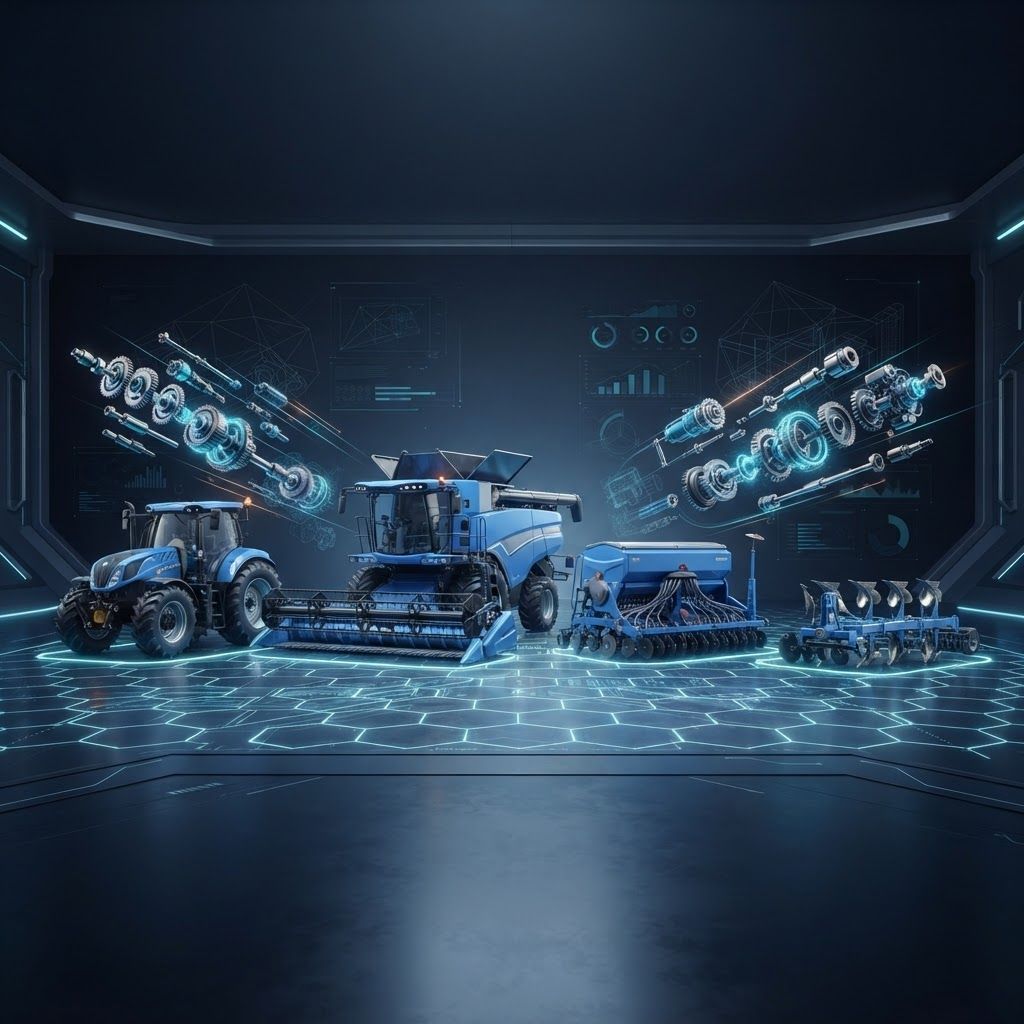
Machinery Choices That Shape a Farming Business
For a Huntingdonshire arable farm, machinery represents one of the largest capital commitments on the balance sheet. A combine harvester, a high-horsepower tractor or a self-propelled sprayer can each cost as much as a substantial house, and the decision carries consequences for a decade. Brand choice is therefore not a matter of loyalty or badge preference but a careful assessment of capacity, reliability, resale value and, above all, local support.
That last point deserves emphasis. In the district's tight harvest windows, where a spell of settled weather may last only days, a breakdown that takes forty-eight hours to resolve can cost more than the price difference between two machines. Farmers here consistently report choosing brands on the strength of the nearest dealer's parts stock and engineer availability rather than on specification alone.
Ten Leading Agricultural Equipment Brands
1. John Deere holds a commanding position across the district's larger arable units. Its reputation rests on drivetrain durability, an exceptionally mature precision farming ecosystem covering guidance, documentation and machine connectivity, and strong residual values. For farms already invested in its data platform, staying within the ecosystem carries genuine operational logic.
2. New Holland is deeply established in the eastern counties and particularly respected for combine harvesters. Its threshing systems have a long-standing reputation for handling high-yielding wheat and for coping with the awkward, damp harvest conditions that English weather regularly produces. Cab comfort and driver visibility are frequently praised during long harvest days.
3. Case IH is favoured for high-horsepower tractors and heavy cultivation work on Huntingdonshire's clay soils. Its articulated and large wheeled tractors deliver the sustained drawbar power that deep cultivation and large drilling combinations demand, and its harvesting range is well regarded on large acreages.
4. Fendt occupies the premium tier and has built a devoted following among farms prioritising efficiency and operator experience. Its continuously variable transmission technology, refined cab design and fuel efficiency appeal particularly to businesses running high annual hours where operating cost outweighs purchase price.
5. Massey Ferguson retains strong loyalty across mid-sized family farms. It offers dependable, mechanically approachable machinery at sensible price points, with a broad range covering everything from compact yard tractors to substantial field units. Straightforward serviceability is often cited as a deliberate advantage.
6. Claas is highly respected for harvesting and forage equipment. Its combines and forage harvesters are engineered for throughput, and its mowers, tedders and balers serve the district's grassland and straw operations. Straw is a valuable secondary crop locally, and baler reliability matters commercially.
7. Kuhn leads in implements rather than tractors, supplying ploughs, power harrows, seed drills, fertiliser spreaders and sprayers. Farms often pair a tractor of one brand with implements from specialists such as this, and consistency of work quality across varying soil conditions is the key purchasing criterion.
8. Vaderstad has a strong presence in the district's drilling and cultivation work. Its high-output seed drills and cultivators suit large arable areas where establishment speed determines whether a crop goes in during the optimal window, and its systems adapt well to reduced-tillage approaches now widely adopted locally.
9. JCB dominates materials handling on farms. Telescopic handlers have become genuinely indispensable for grain, bale, fertiliser and general yard work, and the brand's combination of reach, stability and service backup has made it the default choice on many Huntingdonshire holdings. Its Fastrac tractors also serve high-speed haulage and spraying roles.
10. Grimme and specialist vegetable machinery brands are critical to the fenland vegetable sector. Potato planters, harvesters, graders and handling equipment engineered specifically for root crops determine both yield recovery and produce quality. Given how much damage a poorly set harvester can inflict on a marketable crop, specialist expertise here is essential.
Technology Redefining Farm Machinery
Satellite guidance has moved from novelty to necessity. Real-time kinematic correction delivers centimetre accuracy, enabling controlled traffic farming that confines wheelings to permanent tramlines and protects soil structure across the rest of the field. On Huntingdonshire's compaction-prone soils, this has measurable yield benefits.
Variable-rate application is now widely practised. Combining soil mapping, historical yield data and live crop sensing, machinery adjusts seed and fertiliser rates continuously across a field. This reduces input cost while improving crop uniformity, and it directly supports the environmental compliance farms increasingly need to evidence.
Telematics and remote diagnostics have quietly transformed support. Dealers can identify fault codes before an engineer leaves the depot, ensuring the correct part travels with them. During harvest this capability alone can justify a brand choice.
Autonomy is advancing, though gradually. Fully driverless field operations remain limited in commercial practice, but automated steering, headland turn sequences, implement control and machine-to-machine coordination during grain carting are already reducing operator fatigue and improving consistency.
Buying, Leasing or Contracting
Ownership is no longer the automatic answer. Many Huntingdonshire farms lease core machinery to manage capital and guarantee warranty coverage during the years of highest use. Others buy operations outright from contractors, gaining access to current, high-capacity equipment without any capital exposure.
Machinery sharing between neighbouring farms has also grown, particularly for equipment used intensively but briefly. A shared drill or baler can halve the cost per hectare, though it demands clear agreements about scheduling priority and maintenance responsibility.
Conclusion
The agricultural equipment brands respected in Huntingdonshire earn that standing through a combination of engineering quality, technological maturity and dealer support that responds within hours rather than days. As precision technology deepens and environmental requirements tighten, machinery decisions are becoming as much about data capability as about horsepower. For the district's farms, the brands above continue to represent the most dependable choices available.
Want your brand featured in front of decision-makers? Publish a guest post or get a link insertion in our guides through AAMAX's guest post and link insertion service.
Helpful Links
 SponsoredAAMAX — Full-Service Digital Agency
Write for Us
Share your expertise with our readers. We welcome guest contributions from industry specialists.
Pitch your idea

