

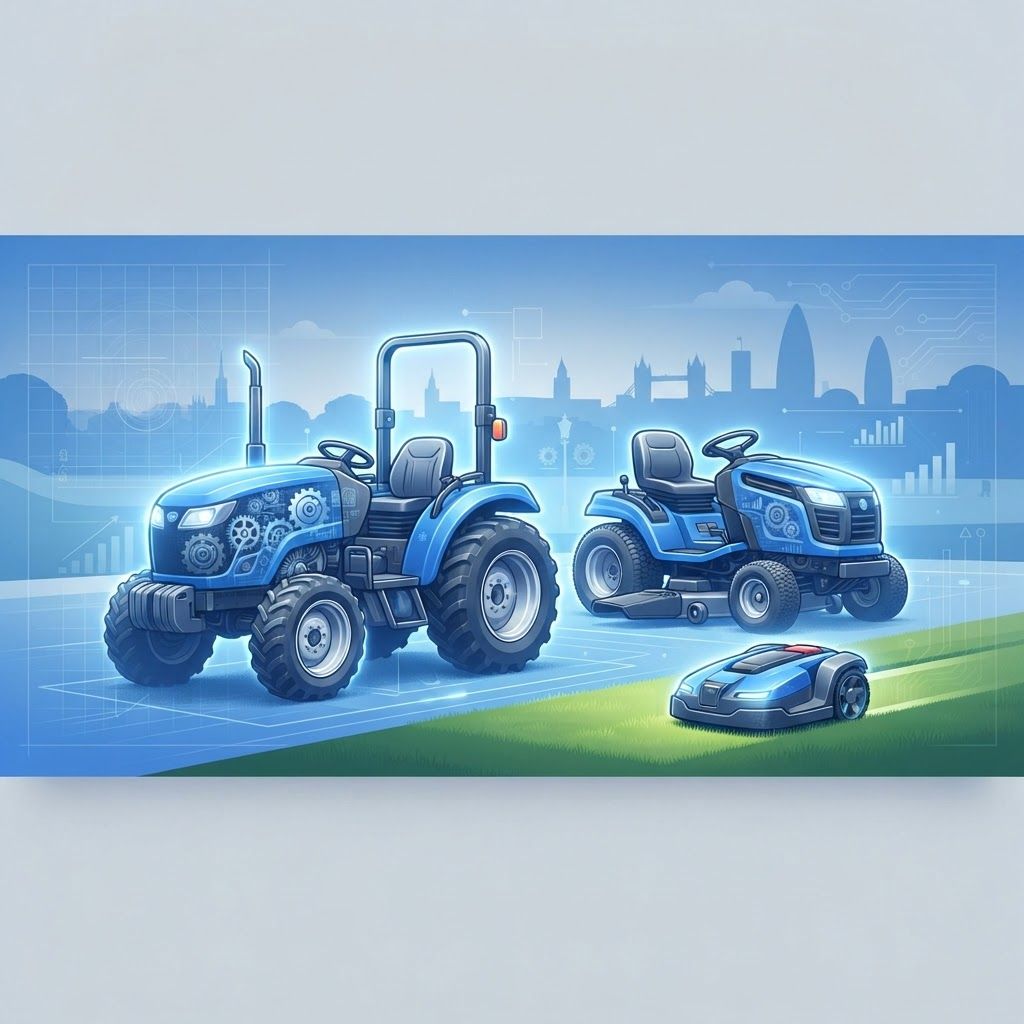
Agricultural Equipment in an Urban Borough
Agricultural equipment in Hammersmith and Fulham serves a different purpose than it does on a rural holding. There are no combine harvesters here. Instead there are parks teams maintaining sports pitches and formal gardens, community growing projects working intensive vegetable beds, indoor farms running hydroponic systems, landscaping contractors managing commercial grounds, and schools maintaining outdoor learning spaces. Each needs durable, appropriately scaled machinery, and each faces urban constraints that rural operators do not.
Those constraints are specific. Noise limits apply near residential property. Emissions requirements affect which engines can operate. Storage space is minimal, so compact and stackable equipment wins. Access is often through gates and paths rather than field gateways. And operators are frequently part-time staff or volunteers rather than trained machinery specialists, which makes safety design and ease of use genuinely important rather than merely desirable.
1. John Deere
John Deere is among the most recognised agricultural machinery brands globally, and its compact utility tractors, commercial mowers and groundscare equipment are widely used in parks and sports turf management. The brand's reputation for build quality and long service life matters where equipment is used intensively across a season. Its investment in precision technology, including GPS guidance and machine data, has also filtered into commercial groundscare, improving consistency and reducing input waste.
2. Kubota
Kubota has particular relevance in urban settings because of its strength in compact machinery. Compact tractors, mini excavators and ride-on mowers designed for confined spaces suit parks, cemeteries, school grounds and landscaping work where a full-size machine simply cannot manoeuvre. Reliability and straightforward serviceability are consistent themes in operator feedback, and the brand's diesel engine engineering is well regarded.
3. Husqvarna
Husqvarna covers handheld and robotic equipment, including chainsaws, brushcutters, hedge trimmers and autonomous mowers. Its robotic mower range has been adopted widely in urban grounds maintenance because it operates quietly, works outside disruptive hours and reduces labour on repetitive tasks. Battery-powered handheld tools have also improved substantially, addressing noise and emissions constraints in residential areas.
4. Stihl
Stihl is a benchmark brand for professional handheld equipment, particularly chainsaws, blowers and cutting tools. Durability under commercial use is the core proposition, and its battery product lines now perform well enough for most urban applications. For tree work and vegetation management across the borough's streets and parks, Stihl equipment is a common professional standard.
5. New Holland Agriculture
New Holland produces tractors and equipment across a wide capacity range, including smaller models suitable for grounds and estate work. The brand has invested notably in alternative fuel development, including methane-powered tractors, which points toward how machinery may operate in emission-restricted urban environments in future.
6. Massey Ferguson
Massey Ferguson has a long-established reputation and a broad tractor range with strong dealer support networks. For organisations managing larger green spaces or estate land, availability of parts and service capability is often more important than specification differences between competing models. The brand's simplicity and serviceability are frequently cited advantages.
7. Toro
Toro specialises in turf maintenance and irrigation, making it directly relevant to sports facilities and formal landscapes in the borough. Precision mowing equipment and efficient irrigation control systems address two of the most significant operational costs in turf management. Water efficiency has become an increasingly important consideration as summer restrictions become more common.
8. Claas
Claas is known for harvesting machinery and tractors with strong engineering credentials. While large harvesters have no urban application, the brand's technology development in machine control and efficiency influences the wider sector, and its smaller equipment appears in estate and grounds contexts.
9. Case IH
Case IH produces tractors and agricultural equipment with a focus on power and durability, and has been active in developing automation and precision farming systems. Its relevance locally is mainly through contractors who operate across both rural and urban contracts and standardise their fleets accordingly.
10. Fendt
Fendt sits at the premium end of the tractor market, known for advanced transmission technology, operator comfort and precision systems. Where equipment is used intensively and operator fatigue affects productivity, that engineering investment can be justified. The brand also demonstrates where machinery technology is heading, particularly in automation and electrification.
Technology Trends in Agricultural Equipment
Electrification is the most visible shift. Battery-powered handheld tools have largely displaced petrol equivalents for light urban work, and compact electric machinery is emerging for grounds applications. The drivers are regulatory as much as environmental, with noise and emissions rules tightening in built-up areas.
Automation is the second trend. Robotic mowers are established, and autonomous weeding and monitoring equipment is developing quickly. In urban contexts where labour costs are high and tasks are repetitive, automation has a clear economic case. Third, precision technology continues to spread downward from large agriculture into groundscare, allowing targeted application of water, fertiliser and treatment rather than blanket coverage. That reduces both cost and environmental impact.
Choosing Equipment for Urban Use
Buyers should begin with access dimensions and storage constraints rather than performance specifications, because a machine that cannot reach or be stored on site is worthless regardless of capability. Noise and emissions compliance should be verified against the specific locations of use. Operator skill level must inform the choice, favouring simple controls and strong safety features where staff turnover is high or volunteers are involved.
Service support deserves as much attention as purchase price. Downtime during a growing or playing season is expensive, and a slightly more costly machine with responsive local service usually outperforms a cheaper one without it. For equipment used infrequently, hire arrangements often make more financial sense than ownership, particularly given urban storage costs.
Final Thoughts
Agricultural and horticultural equipment brands serving Hammersmith and Fulham are judged on compactness, quiet operation, reliability and ease of use rather than raw scale. The brands above represent the strongest combinations of engineering quality and practical urban suitability. Matching equipment carefully to site constraints, operator capability and service availability produces better outcomes and lower total cost than specification-led buying ever does.
Want your brand featured in front of decision-makers? Publish a guest post or get a link insertion in our guides through AAMAX's guest post and link insertion service.
Helpful Links
 SponsoredAAMAX — Full-Service Digital Agency
Write for Us
Share your expertise with our readers. We welcome guest contributions from industry specialists.
Pitch your idea

