

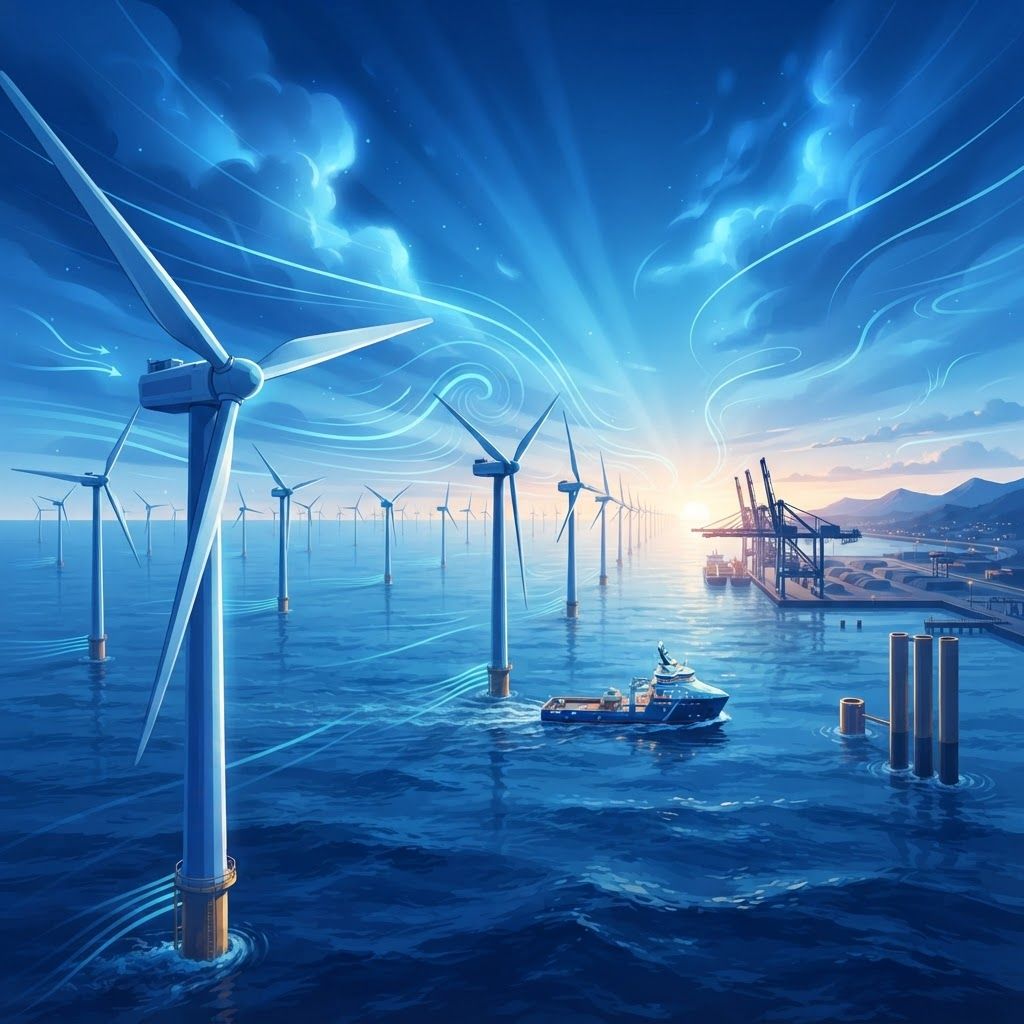
Why Teesside Matters to Offshore Wind
Offshore wind is the backbone of the United Kingdom's electricity decarbonisation, and the North Sea off the North East coast contains some of the most productive wind resources in Europe. Turning that resource into power requires enormous industrial capability: steel foundations weighing thousands of tonnes, blades longer than a football pitch, specialist installation vessels, subsea cabling and decades of ongoing maintenance.
Redcar and Cleveland offers precisely the conditions this industry needs. Deep-water quays on the Tees can handle components too large for road transport. Extensive flat brownfield land supports manufacturing and pre-assembly. The regional workforce has generations of experience in heavy fabrication, welding, lifting and offshore working. Freeport status has added further investment incentives.
The Wind Energy Value Chain
Understanding the sector requires seeing it as several distinct businesses. Manufacturing covers monopiles, transition pieces, blades, nacelles and cables. Port and logistics services handle storage, pre-assembly and load-out. Installation involves specialist heavy-lift and cable-lay vessels. Operations and maintenance covers inspection, blade repair, turbine servicing and crew transfer, and typically runs for twenty-five years or more per project. Supporting services include survey, geotechnical work, environmental monitoring, certification and training.
Ten Leading Wind Energy Companies and Specialists
1. SeAH Wind
Operates a large-scale monopile manufacturing plant on the Teesworks site, producing the vast steel foundations used in offshore wind farms. One of the most significant industrial investments the area has seen in decades.
2. JDR Cable Systems
Manufactures subsea cables used to connect offshore turbines to each other and to shore, with production facilities established on the Tees. Cable supply has been a key bottleneck in offshore wind delivery.
3. Teesworks Offshore Manufacturing Campus
Provides the serviced industrial land, quayside access and infrastructure enabling offshore wind manufacturers to establish operations at scale on the south bank of the Tees.
4. Northern Offshore Wind Installation Services
Supports installation campaigns with project management, marine coordination and specialist lifting expertise for foundations and turbine components.
5. Redcar Wind Operations and Maintenance
Delivers long-term servicing, inspection and repair for operating wind farms, including scheduled maintenance and unplanned fault response, providing stable long-term local employment.
6. Tees Blade Repair Specialists
Focuses on composite blade inspection and repair, including leading edge erosion treatment and structural repairs carried out both onshore and at height offshore using rope access techniques.
7. Coastal Crew Transfer and Marine Services
Operates vessels and marine logistics supporting technician transfer, survey work and offshore support during both construction and operational phases.
8. Cleveland Onshore Wind Development
Works on smaller onshore turbine projects and repowering of existing sites, handling planning, grid connection and community engagement.
9. Northern Wind Sector Training Academy
Provides the safety and technical certifications required for offshore wind work, including working at height, sea survival, first aid and turbine-specific technical training.
10. Tees Valley Offshore Survey and Inspection
Delivers geotechnical survey, subsea inspection, remotely operated vehicle services and condition monitoring for offshore wind assets throughout their lifecycle.
Industry Trends
Turbine size continues to increase, with the largest machines now exceeding heights that would have been considered implausible a decade ago. Larger turbines reduce the cost per unit of energy but demand heavier foundations, bigger vessels and upgraded port infrastructure, reinforcing the advantage held by deep-water industrial ports like those on the Tees.
Floating offshore wind is the emerging frontier, allowing deployment in deeper waters previously inaccessible to fixed foundations. This creates opportunities for fabrication of floating platforms and mooring systems, which suits existing heavy engineering capability in the region.
Operations and maintenance is becoming increasingly data driven, with condition monitoring, drone inspection and predictive analytics reducing unplanned downtime. This is creating demand for digital and data skills alongside traditional engineering trades.
Supply chain localisation is also a policy priority, with content commitments encouraging developers to source components and services domestically. That directly benefits regional suppliers able to meet quality and certification requirements.
Opportunities for Local Businesses
Entering the offshore wind supply chain requires preparation. Quality management accreditation, robust health and safety systems and relevant technical certifications are generally prerequisites. Procurement cycles are long and tender documentation is demanding, so smaller firms often start as subcontractors to established tier one suppliers before bidding directly.
For individuals, the sector offers structured career paths from apprenticeship through to senior technician and project roles, with skills that transfer readily from oil, gas, steel and chemical backgrounds.
Environmental and Community Considerations
Offshore wind development is subject to extensive environmental assessment covering marine ecology, benthic habitats, bird migration routes, fisheries and underwater noise during piling operations. Mitigation measures such as soft-start piling, noise abatement systems and seasonal restrictions are now standard, and monitoring continues throughout operation. Onshore, cable landfall points and substation locations attract scrutiny from communities concerned about construction disruption and landscape impact.
Coexistence with fishing interests is a long-running issue along this coastline, and developers increasingly negotiate access arrangements and compensation frameworks rather than simply excluding vessels. Ports handling offshore components must also manage heavy vehicle movements, dust and lighting in ways that limit impact on nearby residential areas. Handling these matters transparently has become a commercial necessity as well as a regulatory one, because consenting delays caused by poor community engagement are among the most expensive risks in the sector.
Conclusion
Wind energy has become central to the economic future of Redcar and Cleveland, bringing manufacturing, installation and long-term maintenance activity to a coastline that was previously defined by steel. The companies operating here range from enormous foundation and cable manufacturers to specialist repair, survey and training providers. Together they represent one of the most credible industrial regeneration stories in the country.
Want your brand featured in front of decision-makers? Publish a guest post or get a link insertion in our guides through AAMAX's guest post and link insertion service.
Helpful Links
 SponsoredAAMAX — Full-Service Digital Agency
Write for Us
Share your expertise with our readers. We welcome guest contributions from industry specialists.
Pitch your idea

