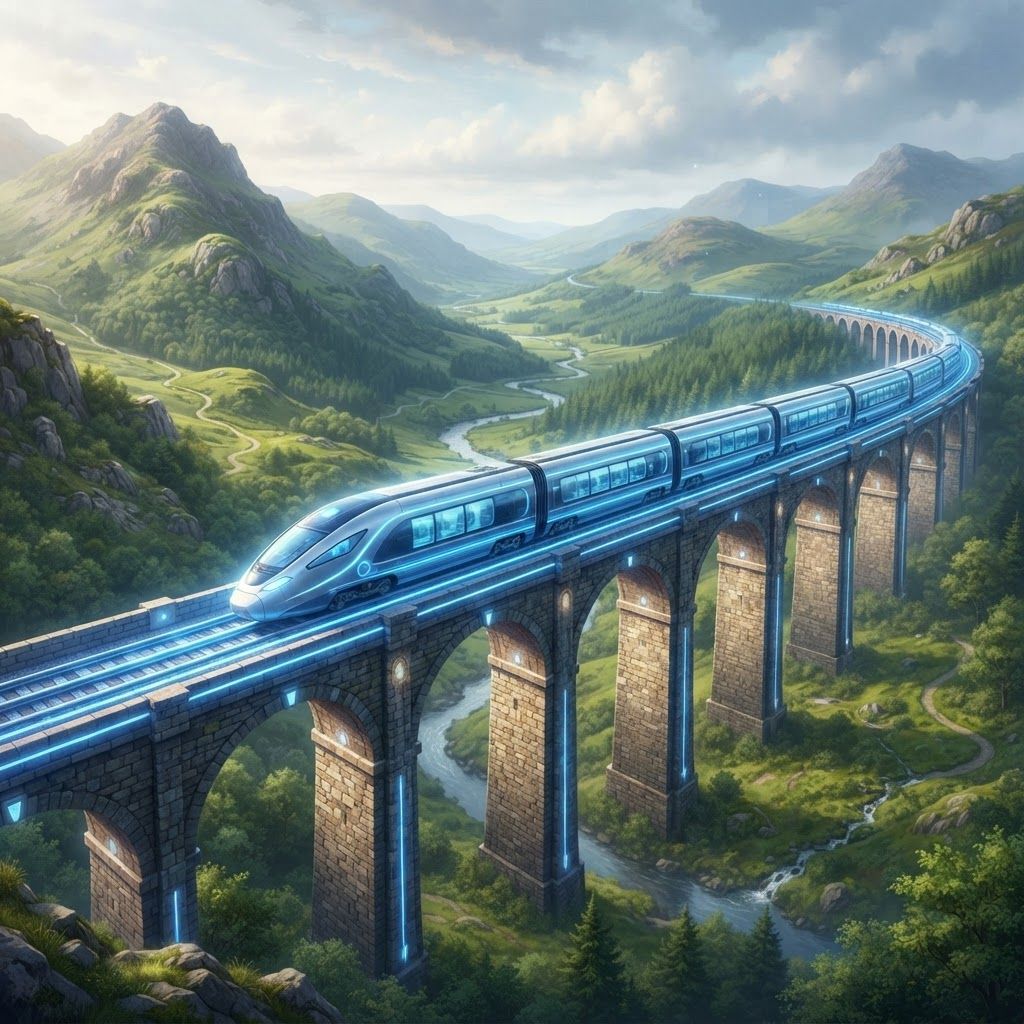
Railways Across Mid Wales
Railways in Powys are unlike those almost anywhere else in Britain. There is no intercity main line, no electrified route and no busy commuter corridor. Instead the county is crossed by a small number of long, slow, spectacularly scenic lines that were built in the Victorian era to connect mid Wales with the English border and the coast, survived closure proposals that removed many comparable routes, and now carry a mixture of local passengers, tourists and enthusiasts.
Alongside the national network sits an extraordinary concentration of heritage railways. Mid Wales has more preserved narrow gauge lines per head of population than any comparable region, a legacy of slate, timber and mineral extraction combined with decades of dedicated volunteer preservation.
Ten Railway Operators Serving Powys
1. Transport for Wales. The principal passenger operator across the county, running services on both the Cambrian and Heart of Wales lines. Its investment in new rolling stock has improved comfort and reliability substantially, and it provides the essential connections from Powys towns to Shrewsbury, Birmingham, Swansea and the Welsh coast.
2. The Heart of Wales Line services. Running from Shrewsbury through Knighton, Llandrindod Wells, Builth Road, Llanwrtyd Wells and on to Llanelli and Swansea, this is one of the great rural railways of Britain. It crosses the Cynghordy Viaduct, passes through remote countryside with request stops serving tiny communities, and functions simultaneously as a lifeline service and a tourist attraction.
3. The Cambrian Line services. Connecting Shrewsbury with Welshpool, Newtown, Caersws, Machynlleth and then the coast at Aberystwyth and Pwllheli, this route carries the bulk of Powys rail passengers. It serves commuters, students, shoppers and visitors, and was among the first lines in Britain to use the European Rail Traffic Management System signalling technology.
4. Welshpool and Llanfair Light Railway. A narrow gauge heritage line running from Welshpool to Llanfair Caereinion through the Banwy valley. Operated substantially by volunteers, it uses historic locomotives from Britain and overseas and offers one of the most characterful heritage journeys in Wales.
5. Talyllyn Railway. Just beyond the county boundary but inextricably linked with mid Wales rail heritage, the Talyllyn was the first railway in the world to be preserved by volunteers, establishing the model that saved dozens of lines across Britain. It remains a benchmark for heritage operation.
6. Brecon Mountain Railway. A narrow gauge line climbing into the Brecon Beacons from the southern side, carrying passengers alongside a reservoir and into national park scenery. It combines steam operation with modern visitor facilities and is among the most popular family attractions in the region.
7. Vale of Rheidol Railway. Running from Aberystwyth into the hills toward Devil's Bridge, this steam-operated narrow gauge line serves visitors arriving in mid Wales and connects directly with the Cambrian line, making a car-free day trip genuinely practical.
8. Network Rail. Not a passenger operator, but the infrastructure manager responsible for track, signalling, structures and stations across the county's national network routes. Its maintenance of remote lines, Victorian viaducts and embankments through challenging terrain is what keeps services running at all.
9. Freight operating companies using Welsh routes. Rail freight through and near Powys carries timber, aggregates and occasional heavy loads. While volumes are modest compared with the main English corridors, rail freight remains a meaningful part of moving bulk materials out of mid Wales.
10. Charter and excursion train operators. Specialist companies run steam and heritage diesel charters over the Heart of Wales and Cambrian lines several times a year. These excursions attract substantial numbers of visitors and provide a significant economic boost to the small towns along the routes.
Travelling by Train in Powys
Rail travel here rewards a particular mindset. Journeys are slow by design, with the Heart of Wales line taking around four hours end to end for a distance a car would cover in half that. Frequencies are limited, typically a handful of services each day on the rural routes, and Sunday provision is reduced.
Many stations are request stops. Passengers must signal clearly to the driver to board and inform the conductor to alight. Several stations have minimal facilities, no ticket machines and no staff, so buying tickets on board or in advance through an app is standard practice.
Connections require planning. Shrewsbury is the principal interchange for services to Birmingham, Manchester and north Wales. Swansea connects the Heart of Wales line to south Wales and London services. Machynlleth is the junction for coastal services. Missing a connection on a route with four trains a day has serious consequences, so generous margins are essential.
Why These Lines Matter
For residents, the railway provides access to hospitals, colleges, employment and retail centres that would otherwise require a long drive. For communities with limited bus provision, the train is the only public transport link to the wider world.
For the local economy, the lines deliver visitors directly into small towns. Walkers use the Heart of Wales line to access sections of long-distance paths, returning by train rather than needing two vehicles. Cyclists use the Cambrian line to reach the coast or the mountains. Heritage railways employ staff, support volunteers and draw families into areas with few other attractions.
For the landscape, rail offers a perspective unavailable by road. The lines climb, curve and cross valleys on viaducts built in the nineteenth century, passing through terrain where no road goes.
Practical Advice
Book longer journeys in advance where advance fares are available, and consider rail rover tickets covering Wales, which can be exceptional value for a week of exploring. Check engineering work before travelling, since rail replacement bus services on rural routes significantly lengthen journeys. Confirm cycle reservation policies, as space is limited on the smaller trains and demand is high in summer. Take refreshments, because catering on rural services is limited and stations are often far from shops.
The Future of Rail in the County
Several developments are encouraging. Investment in new rolling stock has improved the passenger experience considerably. Proposals to reinstate rail links that were closed in the twentieth century, including the long-discussed reconnection of Carmarthen to Aberystwyth through parts of mid Wales, continue to be studied. Station improvements, better integration with bus services and simplified ticketing are gradually making car-free travel in the county more realistic.
Conclusion
The railways of Powys are both practical transport and something rarer: a way of experiencing one of Britain's most beautiful counties at a pace that allows it to be seen properly. Whether you need to reach a hospital appointment in Shrewsbury, a walk on the Beacons, or simply want one of the finest scenic journeys in these islands, the county's rail network delivers something no road can match.
Want your brand featured in front of decision-makers? Publish a guest post or get a link insertion in our guides through AAMAX's guest post and link insertion service.
Helpful Links
 SponsoredAAMAX — Full-Service Digital Agency
Write for Us
Share your expertise with our readers. We welcome guest contributions from industry specialists.
Pitch your idea