

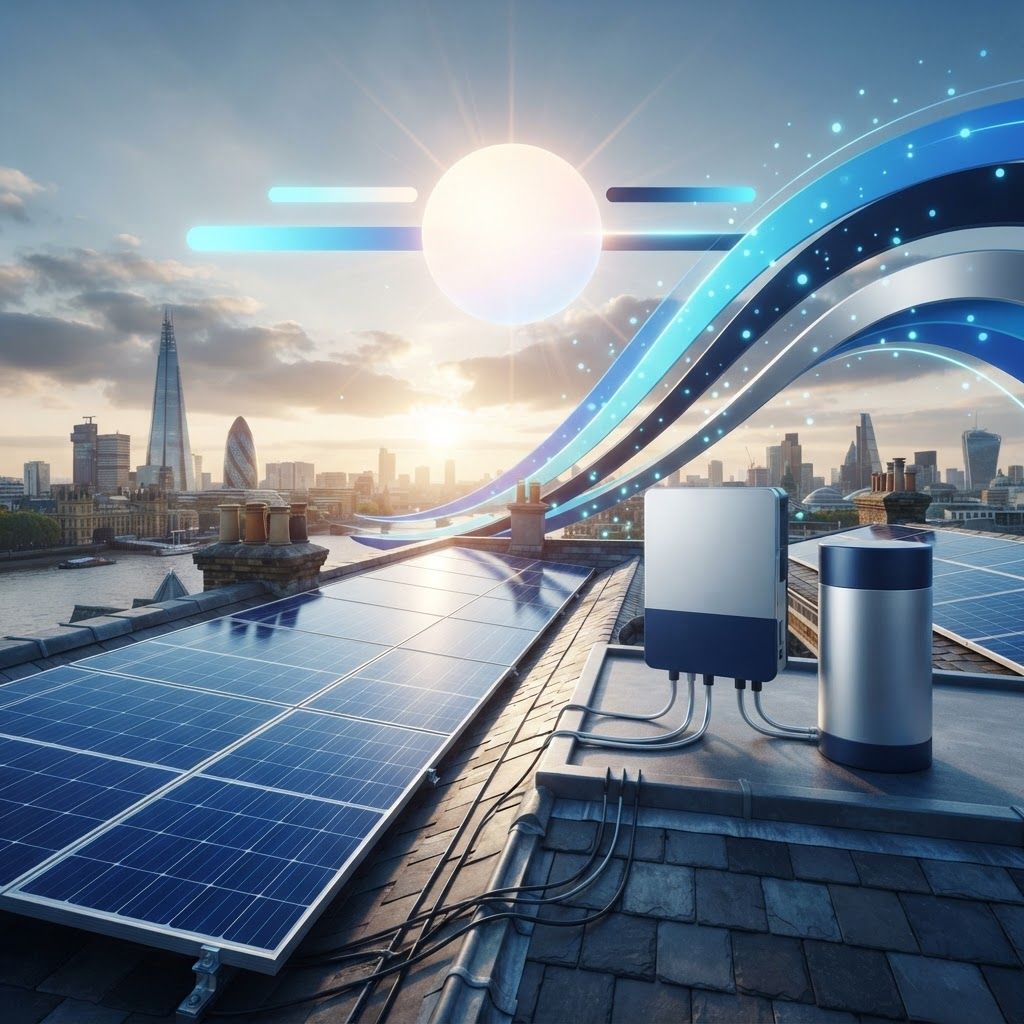
Does Solar Really Work in Camden?
The most persistent myth about solar power in London is that there is insufficient sunlight. In practice, photovoltaic panels respond to total daylight rather than direct heat, and London receives enough annual irradiation to make well-designed systems worthwhile. Panels also operate more efficiently at moderate temperatures, so the capital's climate is not the disadvantage people assume.
The real constraints in Camden are architectural rather than meteorological. Roofs are often small, steeply pitched, shaded by neighbouring buildings or trees, subject to conservation area restrictions, or shared between multiple leaseholders. These issues are solvable, but they require survey-led design rather than standard packages, which is why the borough's better installers spend considerable time on assessment before quoting.
How These Companies Were Assessed
Selection considered accreditation and installer certification, quality of shading and structural analysis, honesty of generation modelling, workmanship standards, warranty terms, aftercare and monitoring, and experience with the specific roof types common in Camden. Companies willing to advise against installation where a roof is unsuitable were rated more highly than those quoting for every enquiry.
1. Kentish Town Solar Installations
A specialist photovoltaic contractor with extensive experience of pitched slate roofs, flat roof ballasted arrays and communal buildings. Kentish Town Solar Installations conducts on-roof surveys, structural checks and shading modelling before design, and it manages the freeholder and planning permissions required in multi-occupancy properties.
2. Camden Solar and Storage
Providers of combined solar and battery systems designed around household consumption patterns. Camden Solar and Storage analyses smart meter data to size the array and battery correctly, avoiding the common error of installing generation capacity that is exported cheaply rather than used on site.
3. Bloomsbury Photovoltaic Engineering
Focused on commercial and institutional rooftop arrays: schools, offices, laboratories and warehouses. Bloomsbury Photovoltaic Engineering handles structural loading assessments, roof warranty coordination, distribution network applications and half-hourly generation modelling against building load profiles.
4. Euston Heritage Solar Specialists
A niche contractor working on listed buildings and conservation areas, using in-roof mounting, slate-integrated modules, all-black low-profile panels and discreet cable routing. Euston Heritage Solar Specialists prepares the design and heritage documentation needed to obtain consent where visible panels would be refused.
5. King's Cross Solar Thermal Systems
Specialists in solar water heating rather than electricity generation, serving buildings with high and consistent hot water demand such as care homes, gyms, hotels and student accommodation. King's Cross Solar Thermal Systems integrates collectors with existing cylinders and heat pump systems.
6. Somers Town Community Solar
A community energy organisation installing arrays on schools, community halls and social housing blocks, financed through local investment and grant funding. Somers Town Community Solar directs a share of income into energy advice and bill support for households in fuel poverty.
7. Regent's Park Solar Maintenance
A service-only provider covering panel cleaning, inverter replacement, string testing, performance diagnostics, bird proofing and electrical safety inspection. Regent's Park Solar Maintenance addresses a widespread problem in London, where many older arrays underperform because faults go undetected for years.
8. Primrose Hill Solar Design Consultants
Independent consultants providing feasibility studies, yield modelling, financial appraisal, tender specification and installer selection without selling equipment. Primrose Hill Solar Design Consultants suits managing agents and larger property owners who want impartial technical advice before procurement.
9. Holborn Solar Carports and Canopies
Designers of structural solar canopies for car parks, courtyards, walkways and terraces, often combined with electric vehicle charging. Holborn Solar Canopies creates generation capacity where roof space is unavailable, a useful option for institutional sites in the borough.
10. Camden Rooftop Energy Solutions
Focused on flat roofs and podium decks with ballasted and east-west configurations, alongside green roof integration. Camden Rooftop Energy Solutions specialises in maximising output from the flat commercial and residential roofs common in the borough's post-war blocks.
Designing a System That Actually Performs
Three technical decisions determine outcomes. Orientation and pitch affect total yield, though east-west layouts on flat roofs often suit household consumption better than a south-facing peak because they spread generation across the day. Shading management matters more in dense urban areas than panel efficiency; module-level electronics or careful string design prevent one shaded panel from dragging down an entire array. Inverter sizing and quality determine long-term reliability, since inverters are the component most likely to require replacement.
Self-consumption is the economic key. Electricity used on site is worth considerably more than electricity exported, so systems paired with batteries, hot water diverters, timed appliance use or electric vehicle charging deliver much better returns than generation alone.
Costs, Returns and Practicalities
Solar economics depend on installation complexity, scaffolding requirements, roof condition and whether storage is included. In Camden, access and scaffolding costs are frequently higher than in suburban locations because of narrow streets and party wall arrangements. Payback improves as electricity prices rise, and export payments provide additional income, though rates vary considerably between suppliers.
Practical points are worth checking early. Confirm the roof has sufficient remaining life, because replacing tiles under an installed array is expensive. Check whether planning permission is needed, which is likely in conservation areas or on listed buildings. In leasehold flats, obtain freeholder consent in writing before ordering equipment.
Trends in Solar Technology
Panel efficiency continues to improve, with modern modules generating more output from the same area than those installed a decade ago, which is particularly valuable on small London roofs. Bifacial modules, solar tiles and building-integrated products have widened the options for heritage-sensitive sites. Hybrid inverters that manage solar, battery and grid interaction in one unit have simplified installations, and smart tariffs now allow batteries to charge cheaply overnight and support the grid at peak times, adding a second revenue stream to a domestic system.
Final Thoughts
Solar remains one of the most accessible steps a Camden property owner can take toward lower bills and lower emissions, provided the design is survey-led and matched to how the building actually uses electricity. The borough has installers experienced in heritage roofs, communal buildings, flat decks and commercial arrays, along with independent consultants and maintenance specialists to keep systems performing over their full lifetime.
Want your brand featured in front of decision-makers? Publish a guest post or get a link insertion in our guides through AAMAX's guest post and link insertion service.
Helpful Links
 SponsoredAAMAX — Full-Service Digital Agency
Write for Us
Share your expertise with our readers. We welcome guest contributions from industry specialists.
Pitch your idea

