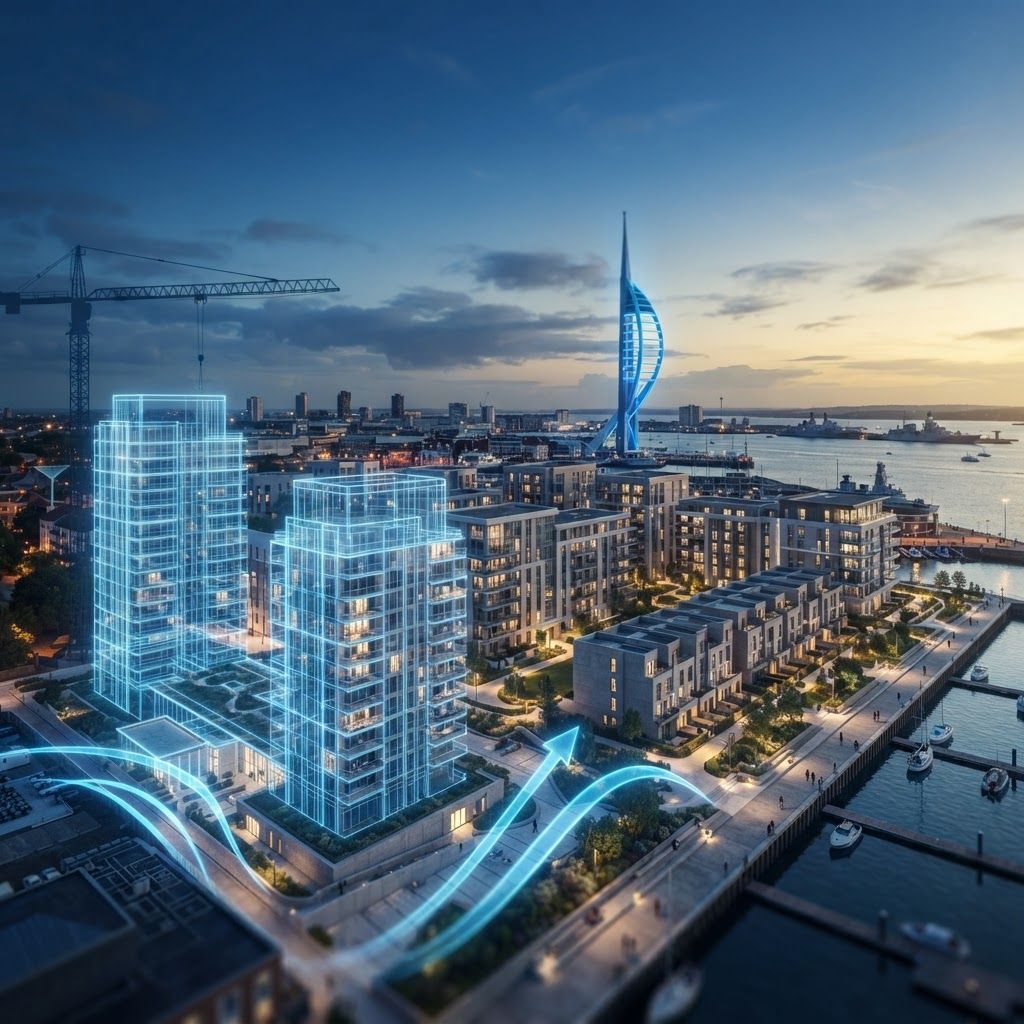
Building Homes on an Island City
Portsmouth is one of the most densely populated cities in the United Kingdom, and almost all of it sits on Portsea Island. That single geographical fact defines residential development here. With very little greenfield land available, growth depends on brownfield regeneration, infill sites, conversion of redundant commercial buildings and carefully considered height. Developers working in the city cannot simply replicate suburban estate models used elsewhere in Hampshire; they must design for constrained plots, existing neighbours and complex ground conditions close to the water table.
The result is a development market that rewards technical skill and local knowledge. Successful schemes in Portsmouth typically demonstrate sensitivity to the city's naval and maritime character, strong public realm design, realistic parking strategies in areas with permit pressure, and mitigation for flood risk and coastal change. Nutrient neutrality requirements affecting the Solent catchment have added a further layer of complexity, requiring developers to offset nitrogen and phosphorus impacts before consent.
What Makes a Strong Residential Developer
Buyers and stakeholders should look beyond marketing imagery. Build quality evidence comes from customer satisfaction records, warranty provision, snagging resolution processes and the willingness of a developer to return after handover. Financial stability matters because part-built schemes damage neighbourhoods and leave buyers exposed. Planning track record is another indicator, since developers who consistently secure and deliver consent tend to have credible design teams and honest viability assessments.
Increasingly, energy performance is a decisive factor. Air source heat pumps, mechanical ventilation with heat recovery, fabric-first insulation and photovoltaic provision have moved from premium extras to expected specification, driven by the Future Homes agenda and by buyers who understand running costs. Developers who can evidence low as-built energy demand, rather than only design-stage calculations, hold a real advantage.
The Top 10 Residential Developers Active in Portsmouth
1. Solent Living Developments
Focused on brownfield regeneration across Portsea Island, Solent Living Developments has built a reputation for mid-rise apartment schemes with genuinely usable communal space. Its projects are noted for careful daylight modelling, robust materials suited to a coastal environment and a pragmatic approach to cycle storage in car-limited locations.
2. Harbour Homes Group
Harbour Homes Group specialises in waterfront and near-waterfront residential schemes, where flood resilience and marine-grade detailing are essential. The company works closely with drainage and coastal engineers, and its developments typically incorporate raised thresholds, resilient ground-floor uses and sustainable drainage systems.
3. Spinnaker Urban Regeneration
Larger mixed-tenure regeneration is this developer's core business, combining private sale, shared ownership and affordable rent within single schemes. Spinnaker Urban Regeneration is recognised for structured community consultation and for phasing that keeps existing residents in place during redevelopment where possible.
4. Southsea Heritage Restoration
Portsmouth's Victorian and Edwardian stock is a defining asset, and Southsea Heritage Restoration concentrates on sensitive conversion and refurbishment of period buildings into high-specification apartments. Its strength is conservation-compliant retrofit, improving thermal performance without destroying original fabric or character.
5. Meridian Residential Partners
Working primarily on infill and small-site development, Meridian Residential Partners delivers terraced houses, mews schemes and small apartment blocks on awkward plots that larger builders overlook. This niche makes a measurable contribution to supply in a city with limited large sites.
6. Gunwharf Quarter Developments
Positioned at the premium end of the market, Gunwharf Quarter Developments produces design-led apartments with high specification interiors, concierge provision and strong emphasis on views and acoustic performance. Its schemes appeal to downsizers and to professionals working across the wider South Coast economy.
7. Island City Build-to-Rent
Build-to-rent has grown significantly in Portsmouth, supported by the student and young professional population. Island City Build-to-Rent delivers professionally managed rental buildings with amenity space, on-site maintenance and longer tenancy options, offering an alternative to fragmented private landlord provision.
8. Coastline Affordable Housing Developments
Working with registered providers and the local authority, Coastline focuses on affordable and social rent delivery, including accessible and adapted homes. Its work is characterised by durable specification designed for long-term management costs rather than short-term sales appeal.
9. Fratton Modular Housing
Offsite manufacture reduces programme length and neighbourhood disruption, both valuable in dense urban settings. Fratton Modular Housing uses volumetric and panelised systems for apartment and family housing schemes, with consistent factory quality control and reduced on-site waste.
10. Portsmouth Student Living Developments
With a large university population, purpose-built student accommodation plays an important role in easing pressure on family housing. This developer delivers managed student schemes with study space, secure access and integrated bill packages, and increasingly designs buildings capable of future conversion.
Trends Shaping Portsmouth Development
Density with quality is the dominant theme. Because outward expansion is impossible, the debate has shifted to how tall and how dense schemes can be while maintaining daylight, privacy and street-level vitality. Retrofit is rising in importance as the city works to decarbonise existing homes, creating opportunities for developers with refurbishment skills. Nutrient and biodiversity requirements are pushing offsetting and green infrastructure into scheme budgets from the outset.
Advice for Buyers and Investors
Inspect completed developments rather than show homes, and speak to residents who have lived in a building for at least a year. Ask for as-built energy performance, service charge history and details of the management company. For apartments, understand the lease structure, ground rent provisions and cladding or fire safety documentation. For investors, examine rental depth in the specific micro-location, since demand varies sharply between Southsea, the city centre, Fratton and North End.
Portsmouth's development market is demanding, but the constraints have produced a cohort of developers with genuine expertise in building well on difficult land.
Want your brand featured in front of decision-makers? Publish a guest post or get a link insertion in our guides through AAMAX's guest post and link insertion service.
Helpful Links
 SponsoredAAMAX — Full-Service Digital Agency
Write for Us
Share your expertise with our readers. We welcome guest contributions from industry specialists.
Pitch your idea