

A County Built for Renewable Energy
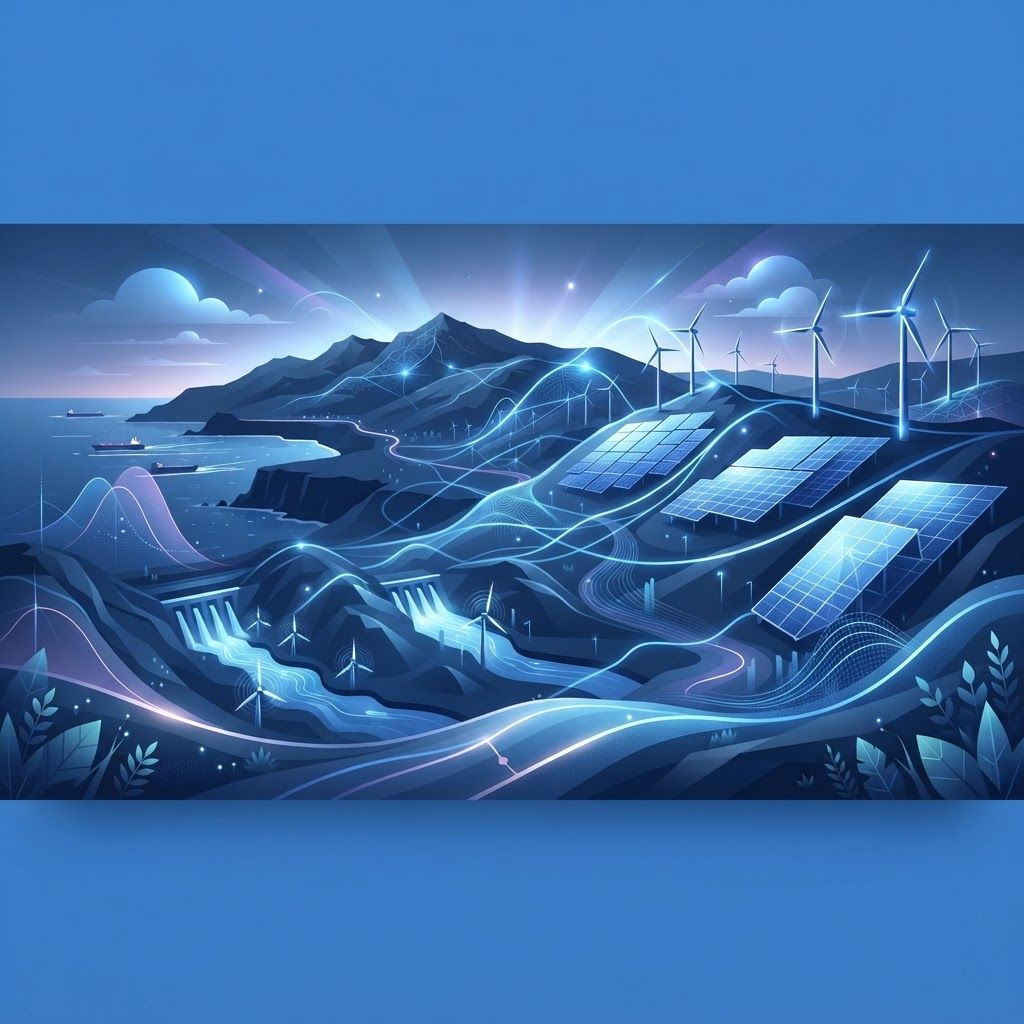
Few places in the United Kingdom have Gwynedd's natural energy resources. Steep mountain catchments and high rainfall support hydroelectric generation. The Irish Sea coastline offers strong and consistent wind, with offshore development accelerating in the wider region. Tidal streams around the North Wales coast attract marine energy developers. Even solar, often dismissed in a wet climate, performs well on south-facing slopes and rooftops during long summer days.
The county also has energy heritage. Ffestiniog pumped storage has operated in the Snowdonia mountains for decades, and the region has hosted major generation infrastructure for generations. That history means local supply chains, technical skills and planning experience already exist, which is a meaningful advantage for new projects.
The Renewable Mix in Gwynedd
Hydro remains distinctive here. Dozens of small run-of-river schemes operate across Snowdonia and the surrounding valleys, many community or farm owned. Onshore wind is present but constrained by national park designation across much of the county. Offshore wind is the largest growth area, with developments in the Irish Sea creating supply chain and port opportunities. Solar is expanding rapidly on domestic and commercial rooftops. Biomass, heat pumps and battery storage complete the picture, with storage increasingly central to managing intermittency.
The Top 10 Renewable Energy Companies and Organisations in Gwynedd
1. Ynni Ogwen
A community energy co-operative in the Ogwen valley operating a hydroelectric scheme with profits reinvested locally. It is one of the best-known examples of community ownership in Wales and demonstrates how local shareholding keeps value in the area.
2. Ynni Padarn Peris
Another community hydro initiative in the Llanberis area, harnessing mountain water resources and directing surplus income into community projects. Schemes like this have become a template for rural Welsh energy development.
3. Cwmni Ynni Cymunedol and Local Community Energy Groups
A network of community energy organisations across Gwynedd develops hydro, solar and efficiency projects, often supported by share offers from local residents. Their strength is public consent, because communities support projects they partly own.
4. Menter Môn Morlais and Marine Energy Projects
Menter Môn leads marine energy development in North West Wales, including tidal stream demonstration zones. This work positions the region as a testing ground for technologies that could scale significantly.
5. Ffestiniog and Dinorwig Pumped Storage Operations
The pumped storage facilities in the Snowdonia mountains provide rapid-response grid balancing at national scale. They remain among the most important flexibility assets in the British electricity system and are central to integrating variable renewables.
6. Offshore Wind Developers Active in the Irish Sea
Major developers progressing fixed and floating offshore wind in the Irish Sea create construction, operations and maintenance opportunities for North Wales ports and supply chain businesses, with skills demand extending inland to Gwynedd.
7. Local Solar Installation Companies
A well-established network of MCS-certified installers across Gwynedd delivers domestic and commercial solar photovoltaic systems, increasingly paired with battery storage and electric vehicle charging.
8. Heat Pump and Low Carbon Heating Specialists
Installers specialising in air source and ground source heat pumps serve a county with many off-gas-grid properties, where heat pumps and biomass frequently outperform oil heating on both cost and carbon.
9. Energy Efficiency and Retrofit Providers
Companies delivering insulation, ventilation and whole-house retrofit work address Gwynedd's older, often stone-built housing stock. Reducing demand is consistently the most cost-effective decarbonisation measure.
10. Renewable Energy Consultancies and Grid Specialists
Consultants advising on feasibility, planning, grid connection, environmental assessment and financial modelling support landowners, farms and businesses evaluating generation projects.
Community Ownership as a Welsh Strength
Wales has one of the strongest community energy sectors in the United Kingdom, and Gwynedd is central to it. Community schemes typically raise capital through share offers open to local residents, operate as co-operatives or community benefit societies, and distribute surplus to local causes such as insulation grants, youth projects and Welsh language initiatives. Beyond the financial return, this model changes the politics of energy development, replacing opposition to external developers with local pride in shared assets.
Grid Capacity: The Central Constraint
The largest obstacle to renewable deployment in rural North Wales is not resource or willingness, but grid capacity. Many parts of the network are constrained, meaning new generation cannot export at full output without reinforcement. Connection queues can extend for years. Practical responses include co-locating batteries to smooth export, designing schemes for local private wire supply to nearby demand, and sizing projects to available capacity rather than theoretical resource. Anyone considering a project should check connection feasibility before spending on design.
Planning and Environmental Considerations
Much of Gwynedd lies within Eryri National Park or areas of high landscape sensitivity, and development is assessed accordingly. Hydro schemes require abstraction licences and careful attention to fish passage, flow regimes and protected habitats. Wind development faces landscape and visual assessment. Solar on agricultural land raises land use questions. Early engagement with the planning authority, Natural Resources Wales and local communities materially improves outcomes.
What This Means for Households and Businesses
For property owners, the practical opportunities are rooftop solar, battery storage, heat pumps and efficiency measures, all of which reduce exposure to volatile energy prices. Farms and estates with land or water resources may have generation potential worth assessing. Businesses can use on-site generation to reduce operating costs and meet customer sustainability requirements, which increasingly appear in tender processes.
Final Thoughts
Gwynedd has the resources, the heritage and, unusually, the community structures to benefit substantially from the energy transition rather than simply hosting it. The projects that succeed here tend to combine genuine local ownership, realistic grid planning and sensitivity to a landscape that is itself a major economic asset.
Want your brand featured in front of decision-makers? Publish a guest post or get a link insertion in our guides through AAMAX's guest post and link insertion service.
Helpful Links
 SponsoredAAMAX — Full-Service Digital Agency
Write for Us
Share your expertise with our readers. We welcome guest contributions from industry specialists.
Pitch your idea

