

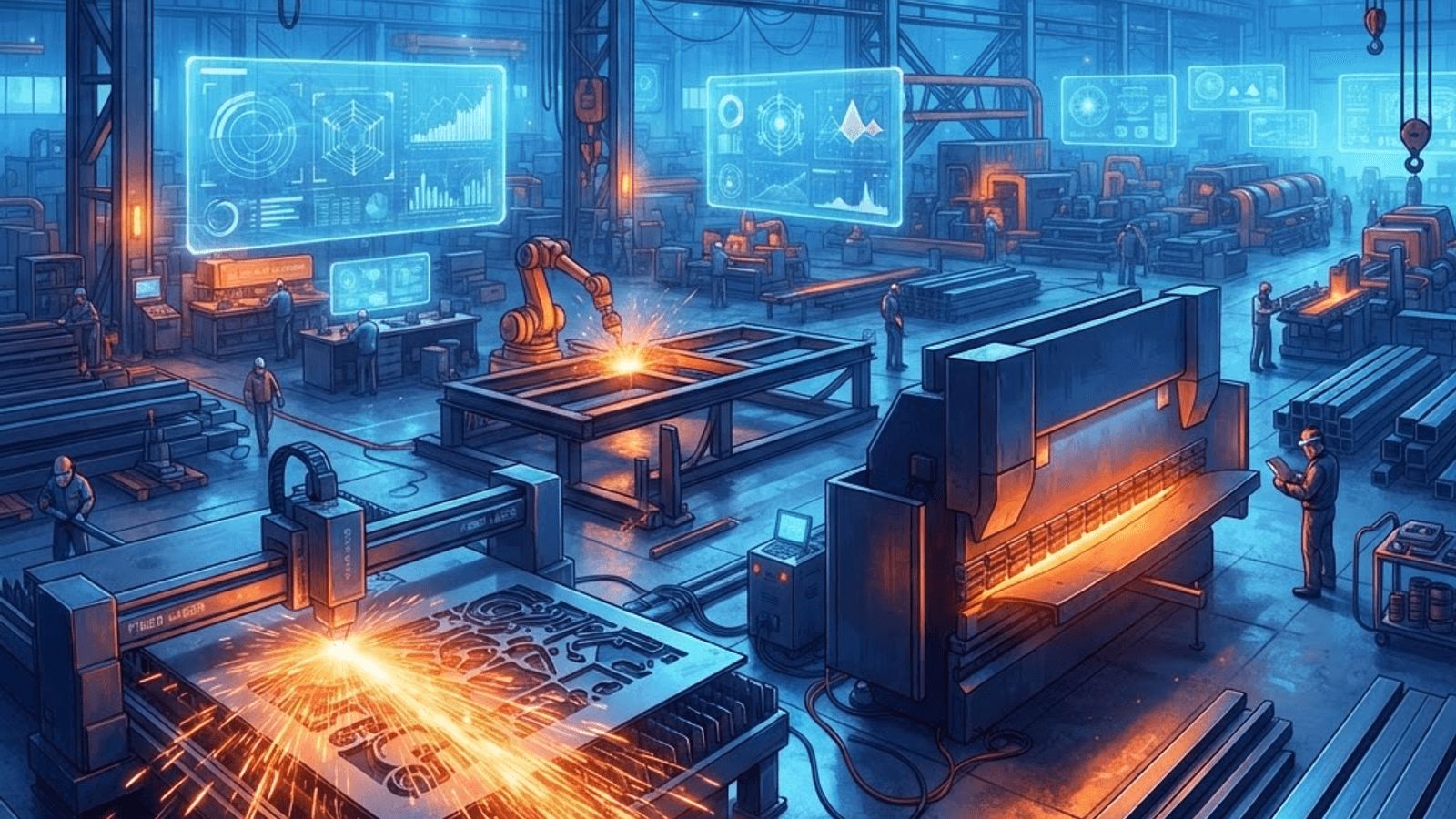
Metalworking in the Heart of the Midlands
Metalworking is embedded in Staffordshire's industrial DNA. The county sits at the edge of the Black Country, historically the most concentrated metal trades region in the world, and that legacy survives today in a dense network of fabricators, machinists, foundries, press shops and surface treatment specialists. East Staffordshire benefits directly from this ecosystem.
Local demand comes from several directions. Construction and agricultural building requires structural steelwork, cladding rails and handrails. Food and beverage production needs stainless steel tanks, pipework, platforms and guarding manufactured to hygienic standards. Machinery manufacturers require precision machined components, weldments and sheet metal enclosures. Distribution centres need racking, mezzanines, loading bay equipment and safety barriers.
Ten Metalworks Companies Relevant to the Borough
1. Hadley Group
Hadley Group is a major cold roll-formed steel products manufacturer supplying construction, automotive and industrial markets. Cold roll forming produces consistent, high-strength profiles efficiently and underpins much of modern light steel framing and building systems.
2. voestalpine Metsec
Metsec manufactures cold rolled steel sections, light steel framing, purlins and cable management systems. Its products appear throughout industrial and commercial buildings across the Midlands, including the large distribution units characteristic of the A38 and A50 corridors.
3. Barrett Steel
Barrett Steel is one of the UK's largest independent steel stockholders, supplying sections, tubes, plate and bar with processing services such as cutting, drilling and shot blasting. Stockholders are the practical starting point for most fabrication projects.
4. Caunton Engineering
Caunton Engineering designs, fabricates and erects structural steelwork for industrial, commercial and distribution buildings. Structural steel contractors combine design capability, factory production control and site erection, which is essential for larger frame projects.
5. Billington Structures
Billington Structures delivers structural steel frames for warehousing, manufacturing, retail and public buildings. The company's scale suits projects where programme certainty and integrated design coordination are priorities.
6. William Hughes
Specialising in springs, wire forms and formed wire assemblies, William Hughes serves automotive, furniture and industrial customers. Wire forming is a niche but essential capability supporting furniture manufacturing and vehicle production in the wider region.
7. Brandauer
Brandauer is a precision press tooling and stamping specialist producing high-volume metal components to tight tolerances. Press work of this type supports electrical, automotive and medical device supply chains.
8. Alucast
Alucast is an aluminium foundry producing sand, gravity and pressure die castings for automotive and industrial applications. Casting remains fundamental for complex geometries and lightweighting, both increasingly important in vehicle manufacture.
9. PP Control & Automation
Operating in the manufacturing outsourcing space, this type of business builds electromechanical assemblies, control panels and complete machine sub-assemblies combining metalwork with electrical integration. Machinery builders outsource to such partners to focus on design and final commissioning.
10. Wedge Group Galvanizing
Surface treatment determines how long steelwork survives outdoors. Wedge Group provides hot dip galvanizing across multiple UK plants, protecting structural steel, agricultural equipment, street furniture and fabrications from corrosion for decades.
Core Metalworking Processes
Laser and plasma cutting profile flat material quickly and accurately from digital files, with laser offering the finer edge quality on thinner sections. Press braking folds sheet into three-dimensional forms and depends heavily on accurate bend allowance calculation. Welding joins components, with selection among manual metal arc, metal inert gas, tungsten inert gas and robotic processes driven by material, thickness, appearance and volume.
Computer numerically controlled machining removes material to produce precise features, with turning for cylindrical parts and milling for prismatic ones. Multi-axis machines reduce the number of setups, improving accuracy and shortening lead times. Fabrication shops often combine several of these processes, while specialists focus on one and subcontract the rest.
Materials and Finishes
Mild steel is economical and easily welded but requires protective coating. Stainless steel resists corrosion and is mandatory for food, beverage and pharmaceutical contact applications, with different grades offering varying resistance; the choice between common austenitic grades depends on exposure to chlorides and cleaning chemicals. Aluminium offers light weight and natural corrosion resistance but requires different welding technique and filler selection.
Finishing options include hot dip galvanizing for long-term outdoor protection, powder coating for durable coloured finishes, wet painting for large structures, electropolishing for hygienic stainless applications and anodising for aluminium. Specify the finish at enquiry stage, as it affects design details such as drainage holes for galvanizing and masking requirements for machined faces.
How to Brief a Fabricator
Provide dimensioned drawings with tolerances, material grade and specification, weld symbols and requirements, finish specification, quantity and delivery expectations. Supply three-dimensional models where available, as most shops can import them directly into programming software, reducing errors and quotation time.
Be explicit about which dimensions are critical and which are nominal. Blanket tight tolerances across an entire drawing inflate cost substantially with no functional benefit. Discuss design for manufacture: standardising hole sizes, using available material thicknesses, allowing generous bend radii and minimising the number of separate operations all reduce price.
Quality and Certification
Structural steelwork for buildings requires factory production control certification and execution class compliance appropriate to the structure. Welding procedures and welder qualifications should be documented for load-bearing work. Pressure equipment carries its own regulatory regime. For precision machined parts, agree an inspection regime covering first article inspection and ongoing sampling, and request measurement reports where tolerances are critical.
Final Thoughts
Metalworks companies serving East Staffordshire provide capability ranging from one-off repairs to major structural frames and high-volume precision components. Clear drawings, realistic tolerances, early design for manufacture discussion and correctly specified finishes will produce better parts, faster delivery and lower cost from any of them.
Want your brand featured in front of decision-makers? Publish a guest post or get a link insertion in our guides through AAMAX's guest post and link insertion service.
Helpful Links
 SponsoredAAMAX — Full-Service Digital Agency
Write for Us
Share your expertise with our readers. We welcome guest contributions from industry specialists.
Pitch your idea

