

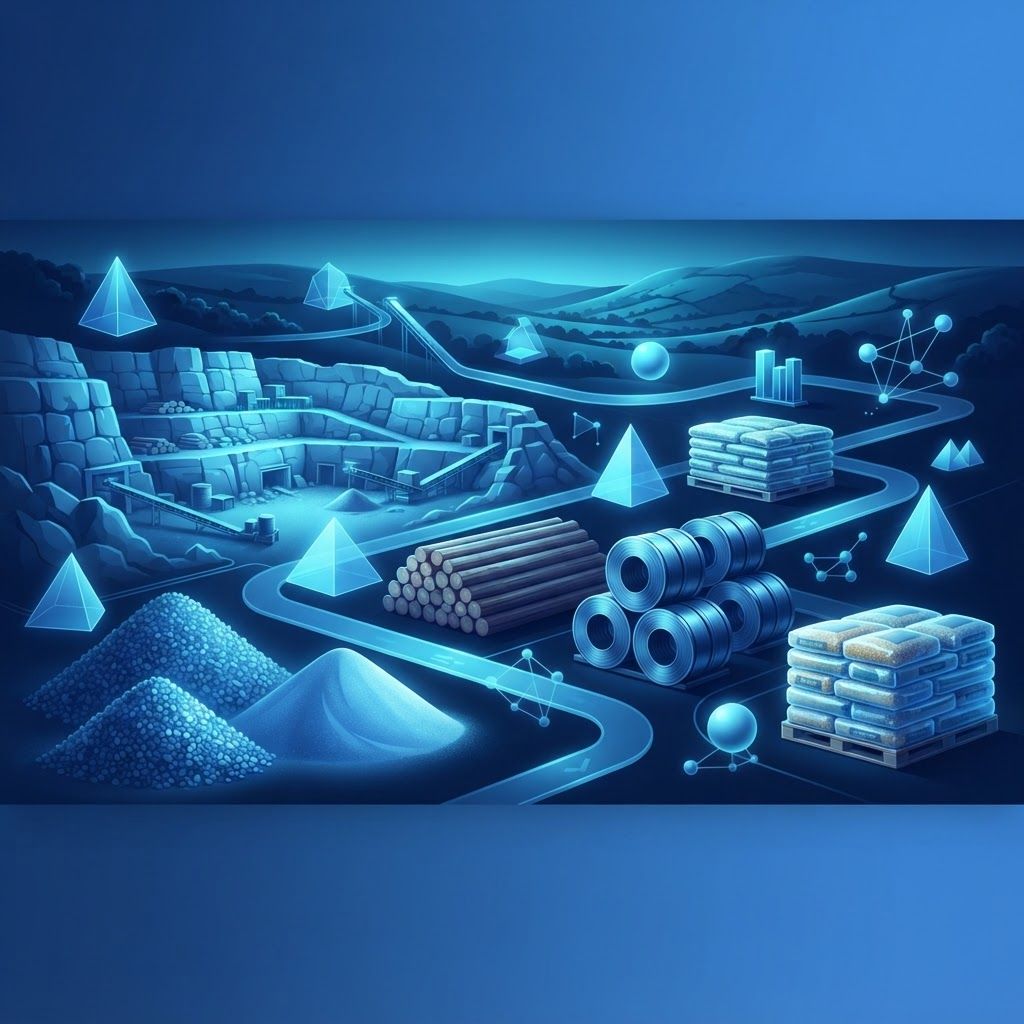
Where Manufacturing Actually Begins
Every manufactured product and every construction project starts with raw material, and the reliability of that supply determines whether businesses can quote confidently, deliver on time and control costs. In Carmarthenshire, raw material supply has particular character because the county is genuinely resource-rich in some categories and entirely dependent on inbound logistics in others.
The county has substantial mineral resources. Limestone, sandstone and sand and gravel deposits support quarrying operations that feed construction across South and West Wales. Managed woodland in the river valleys and forestry plantations provide timber. Agricultural land produces wool, hides, milk and grain that feed processing industries. Coastal and estuarine areas yield sand and shell material.
Conversely, metals, polymers, industrial chemicals and speciality compounds arrive from elsewhere, making distribution capability and stockholding the critical factors. The suppliers who succeed are those who hold buffer stock locally, understand their customers' production rhythms and can provide documentation that satisfies increasingly demanding compliance requirements.
Categories of Raw Material Supply
Aggregates and minerals include crushed rock, sand, gravel, limestone, decorative stone and manufactured sands used in concrete, asphalt, drainage and landscaping.
Cement and binders cover cement, lime, cement replacements, plasters and mortars.
Timber and wood products span sawn softwood and hardwood, sheet materials, board products and wood fibre.
Metals comprise structural steel sections, plate, sheet, bar, tube, stainless, aluminium and non-ferrous alloys.
Polymers and resins include virgin and recycled pellets, masterbatch colourants, sheet, film and composite resins.
Industrial chemicals cover solvents, adhesives, coatings, water treatment chemicals, lubricants and process additives.
Agricultural inputs include fertiliser, lime, animal feed ingredients, seed and bedding materials.
Textile and natural fibres encompass wool, hides and plant fibres feeding local processing and craft industries.
Ten Leading Raw Material Suppliers in Carmarthenshire
1. Carmarthenshire Quarry Products — Crushed stone, sub-base materials, sands, decorative aggregates and asphalt supplied in bulk to contractors and civils projects. Weighbridge tickets, declared performance characteristics and reliable bulk haulage are its practical strengths.
2. Tywi Timber and Sawmilling — Sawn softwood and hardwood, cladding, fencing components and air-dried boards from locally managed woodland, with kiln drying and pressure treatment on site and chain-of-custody certification.
3. Llanelli Metals Stockholding — Structural sections, plate, sheet, bar, tube, stainless and aluminium held in stock with cutting, sawing and profiling services, plus mill certification supplied as standard for traceable fabrication work.
4. Cross Hands Polymer Supply — Distribution of virgin and recycled polymer pellets, masterbatch colourants and engineering compounds to moulders and extruders, with technical guidance on grade selection and recycled content substitution.
5. Ammanford Industrial Chemicals — Solvents, adhesives, coatings, cleaning chemicals and process additives supplied in drums, intermediate bulk containers and bulk, with full safety data sheet provision and compliant storage advice.
6. Gwendraeth Cement and Binders — Cement, hydraulic lime, cement replacement materials, screeds and mortars in bagged and bulk silo formats, including lower-carbon blended cements for projects with embodied carbon targets.
7. Dinefwr Agricultural Inputs — Fertiliser, agricultural lime, seed, feed ingredients and bedding materials, with soil testing and nutrient planning support that helps farms comply with nutrient management requirements.
8. Teifi Natural Fibres — Wool, fleece and natural fibre supply to textile manufacturers, insulation producers and craft makers, offering traceable Welsh provenance that supports strong product storytelling.
9. Burry Port Marine Aggregates — Marine-dredged and estuarine sands and shell material for construction, filtration and landscaping applications, supplied with appropriate grading analysis.
10. Cothi Recycled Materials — Recycled aggregates, crushed concrete, reclaimed timber and reprocessed polymer feedstock, helping customers meet recycled content targets while reducing material cost and landfill diversion obligations.
Certification, Testing and Traceability
Raw material documentation is not administrative padding; it is the foundation of product liability defence and regulatory compliance.
Aggregates supplied for construction require declared performance against harmonised standards, covering grading, resistance to fragmentation, freeze-thaw performance and, where relevant, alkali-silica reactivity. Factory production control certification demonstrates ongoing consistency. Concrete producers rely on this data, so incomplete aggregate documentation propagates problems downstream.
Metals require mill certificates confirming chemical composition and mechanical properties, traceable by heat or cast number. For structural applications, the certificate type matters; inspection certificates with independent verification carry more weight than simple test reports. Substituting an unverified grade in structural steelwork is a serious matter.
Timber must be strength graded for structural use and carry chain-of-custody documentation where sustainability is claimed. Due diligence obligations under timber regulation require importers and first placers to assess legality risk, which means asking questions about species, origin and harvest legality.
Chemicals fall under registration, evaluation and authorisation requirements, with duties around registration, safety data sheets, classification and labelling, and workplace exposure control. Suppliers should provide current safety data sheets in the correct format, and buyers must complete their own workplace exposure assessments.
Polymers need grade confirmation, and food contact applications require declarations of compliance covering migration limits. Recycled polymer feedstock for food contact carries additional authorisation requirements that should never be assumed.
Trends Affecting Raw Material Supply
Embodied carbon has become a genuine commercial factor rather than a reporting exercise. Public sector procurement in Wales increasingly assesses whole-life carbon, driving demand for cement replacements, recycled aggregates, timber structures and lower-carbon steel. Environmental product declarations are now routinely requested at tender stage.
Supply chain resilience remains front of mind. The volatility of recent years taught manufacturers that single-sourcing critical materials is risky, and many now maintain dual-sourced arrangements and higher buffer stocks despite the working capital cost.
Circular material flows are expanding. Recycled aggregate from demolition, reclaimed timber, reprocessed polymer and secondary metals all reduce cost and carbon simultaneously, and quality has improved enough that they now compete on performance rather than only on price.
Price volatility has become structural rather than exceptional. Energy costs feed directly into cement, steel, polymer and glass production, and buyers have adapted with indexation clauses, shorter quotation validity and more frequent price reviews.
Local sourcing is gaining value for reasons beyond sustainability. Shorter supply lines reduce lead time risk, cut haulage cost on heavy materials where transport dominates delivered price, and support social value criteria in public contracts.
Practical Advice for Buyers
Specify performance, not just product name. Stating the required strength class, grading envelope, moisture content or grade designation prevents well-meaning substitutions that fail in service.
Understand delivered cost properly. For heavy materials, haulage frequently exceeds material value. A quarry twenty miles closer can beat a cheaper distant source comfortably. Confirm whether quotations include delivery, minimum loads and waiting-time charges.
Plan storage before ordering bulk. Aggregates need hard standing and separation to avoid contamination. Cement degrades in damp conditions. Timber must be stacked and covered to stay stable. Chemicals require bunded, ventilated and correctly segregated storage.
Retain all documentation systematically. Delivery tickets, mill certificates, declarations of performance and safety data sheets should be filed against jobs. Reconstructing this evidence years later during a defect investigation is nearly impossible.
Build relationships rather than chasing spot pricing. Suppliers allocate scarce material to reliable, communicative customers during shortages. Sharing forecast volumes helps them plan production and usually earns better terms.
Finally, audit critical suppliers. For materials where failure would be serious, visit the site, review their quality system and understand their own supply chain. It is time well spent.
Final Thoughts
Carmarthenshire's raw material suppliers combine genuine local resources — quarried stone, timber, wool and agricultural inputs — with distribution capability in metals, polymers and chemicals. That mix gives local manufacturers and contractors real advantages in lead time and delivered cost. Buyers who specify performance precisely, insist on complete certification and invest in supplier relationships will build supply chains that hold together even when markets do not.
Want your brand featured in front of decision-makers? Publish a guest post or get a link insertion in our guides through AAMAX's guest post and link insertion service.
Helpful Links
 SponsoredAAMAX — Full-Service Digital Agency
Write for Us
Share your expertise with our readers. We welcome guest contributions from industry specialists.
Pitch your idea

