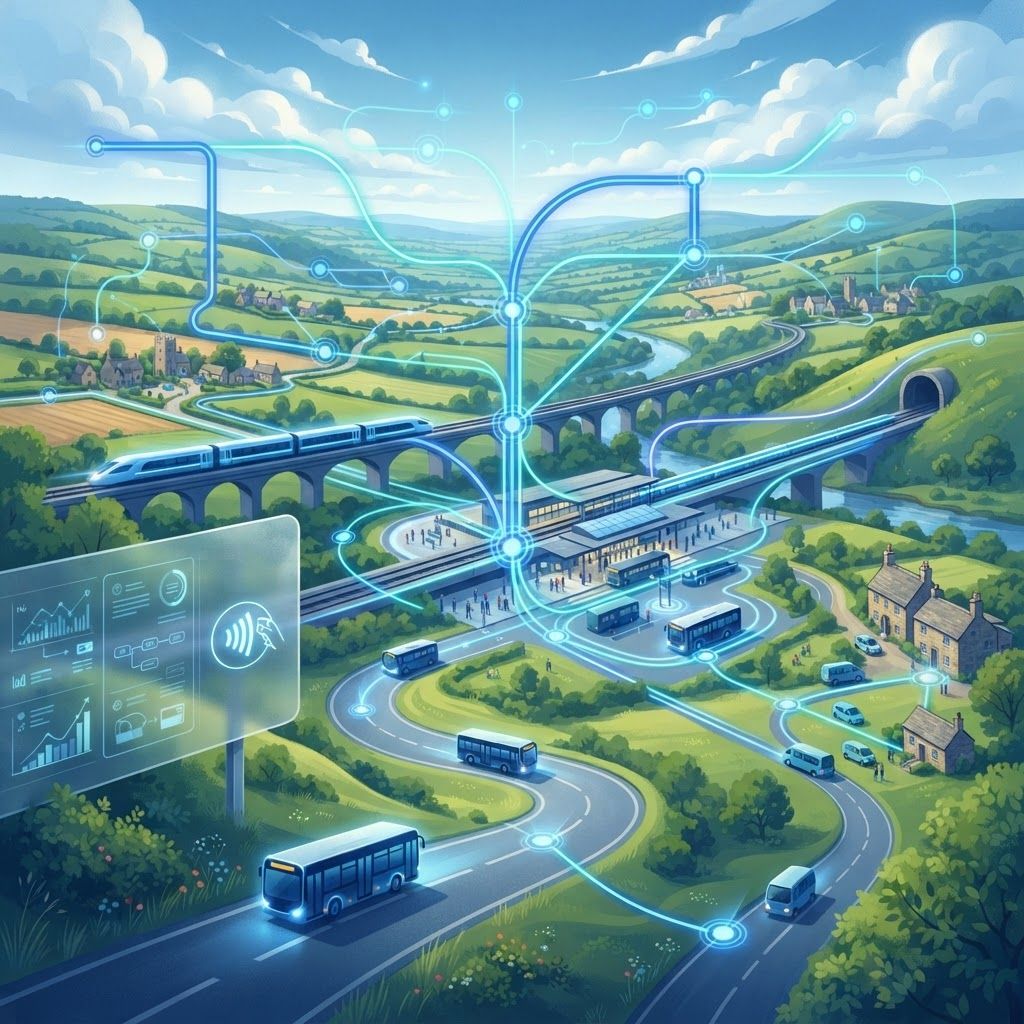
The Shape of Public Transport in Broadland
Public transit in Broadland is best understood as three overlapping layers. The first is the frequent suburban bus network serving Sprowston, Thorpe St Andrew, Hellesdon, Taverham and Drayton, where population density supports near-urban service levels. The second is the rail network, with the Wherry Lines running east through Brundall, Lingwood and Acle, and the Bittern Line running north through Salhouse and Wroxham. The third is the rural layer of less frequent bus routes, community transport and demand-responsive services covering villages where fixed timetables cannot be commercially sustained.
All three layers converge on Norwich. The city is the employment, retail, education and healthcare centre for the district, and the network is built around reaching it. That radial structure works well for commuting but less well for village-to-village travel, which remains difficult without a car.
The Key Services and Providers
Greater Anglia operates all scheduled rail services through the district, and its modern fleet has substantially improved comfort, accessibility and reliability on the Wherry and Bittern Lines.
First Bus Norfolk and Suffolk runs the majority of high-frequency suburban routes linking Broadland's urban fringe with Norwich city centre, carrying the largest passenger volumes in the district.
Konectbus provides important links between Norwich and Norfolk's towns and villages, valued for modern vehicles and consistent operation.
Sanders Coaches covers the northern part of the district including Aylsham, Cawston and Reepham, with onward connections towards Holt, Cromer and the north Norfolk coast.
Norfolk County Council supported bus services maintain routes that would not survive commercially, and these remain essential for residents in smaller parishes.
Norfolk Flexibus and demand-responsive transport schemes allow passengers in rural areas to book journeys within a zone rather than relying on fixed routes, and this model has expanded significantly in recent years.
Norwich Park and Ride sites, including facilities on the district's approaches, let drivers leave vehicles outside the city and complete journeys by frequent bus, reducing congestion and parking cost.
Community transport and dial-a-ride organisations across Norfolk provide accessible door-to-door journeys for residents who cannot use conventional buses, often operated with volunteer drivers.
Bure Valley Railway adds a heritage dimension, linking Aylsham and Wroxham along a narrow-gauge line that also functions as a genuine visitor transport option.
National Express and Megabus coach services from Norwich extend the network nationally, providing low-cost links to London, airports and the Midlands.
Using the Network Effectively
For commuters, rail is generally the strongest option where a station is convenient. Brundall, Acle, Wroxham and Salhouse all offer quick journeys into Norwich without traffic delay, and onward mainline connections to London Liverpool Street make longer-distance commuting viable.
For suburban residents, frequent bus services are often faster and cheaper than driving into Norwich once parking is factored in. Contactless payment with daily fare capping has removed much of the complexity that previously deterred occasional users.
For rural residents, demand-responsive services are the most important development. These require registration and advance booking, and awareness remains lower than it should be. Residents in villages with sparse timetables should investigate what is available in their zone, since the service often exists but is under-used.
For visitors, combining rail with cycling is particularly effective. Trains carry bicycles, Broadland is almost entirely flat, and stations such as Wroxham and Salhouse open up substantial areas of the Broads without a car.
Accessibility and Inclusion
Accessibility has improved markedly. Modern trains provide level boarding and dedicated wheelchair spaces, while low-floor buses with ramps are standard on most routes. Concessionary travel passes for older and disabled residents are heavily used across the district, reflecting Norfolk's demographic profile.
Rural station accessibility varies, and some smaller stops retain limited facilities. Community transport fills genuine gaps here, providing assisted door-to-door travel for medical appointments, shopping and social activity that conventional services cannot cover.
Challenges Facing the Network
Rural bus economics remain difficult. Low population density, rising operating costs and driver shortages have pressured services across England, and Broadland has seen frequency reductions on some routes. Evening and Sunday provision is the weakest part of the network and limits the ability of residents without cars to participate in employment, education and social life.
Integration between modes is improving but imperfect. Bus and rail timetables are not always coordinated, and through-ticketing across operators, while available, is not universally understood by passengers.
Funding uncertainty affects planning. Supported services depend on local authority budgets, and long-term investment decisions are harder when funding operates on short cycles.
Positive Trends
Fleet decarbonisation is progressing, with electric buses entering Norfolk operations and new trains offering far better environmental performance than their predecessors. Digital information has improved dramatically, with real-time tracking apps now covering most services.
Active travel integration is being taken seriously, with cycle parking at stations, improved walking routes and promotion of combined journeys. The Broadland Northway has also enabled bus priority improvements and better orbital connectivity around Norwich.
Community Rail Partnerships on both the Wherry and Bittern Lines have successfully promoted leisure use, station adoption and local pride, and they represent a genuinely effective model for sustaining rural railways.
Practical Advice
Plan journeys in advance using real-time apps rather than relying on printed timetables, and check last-service times carefully, especially for evening travel. Register with demand-responsive schemes before you need them. Consider park and ride for Norwich trips rather than driving into the centre.
Broadland's public transport will never match a city network, but for a rural district it offers a genuinely usable combination of rail, bus and flexible services. Residents and visitors who understand its radial structure and book rural services in advance can travel across most of the district without needing a car.
Want your brand featured in front of decision-makers? Publish a guest post or get a link insertion in our guides through AAMAX's guest post and link insertion service.
Helpful Links
 SponsoredAAMAX — Full-Service Digital Agency
Write for Us
Share your expertise with our readers. We welcome guest contributions from industry specialists.
Pitch your idea