

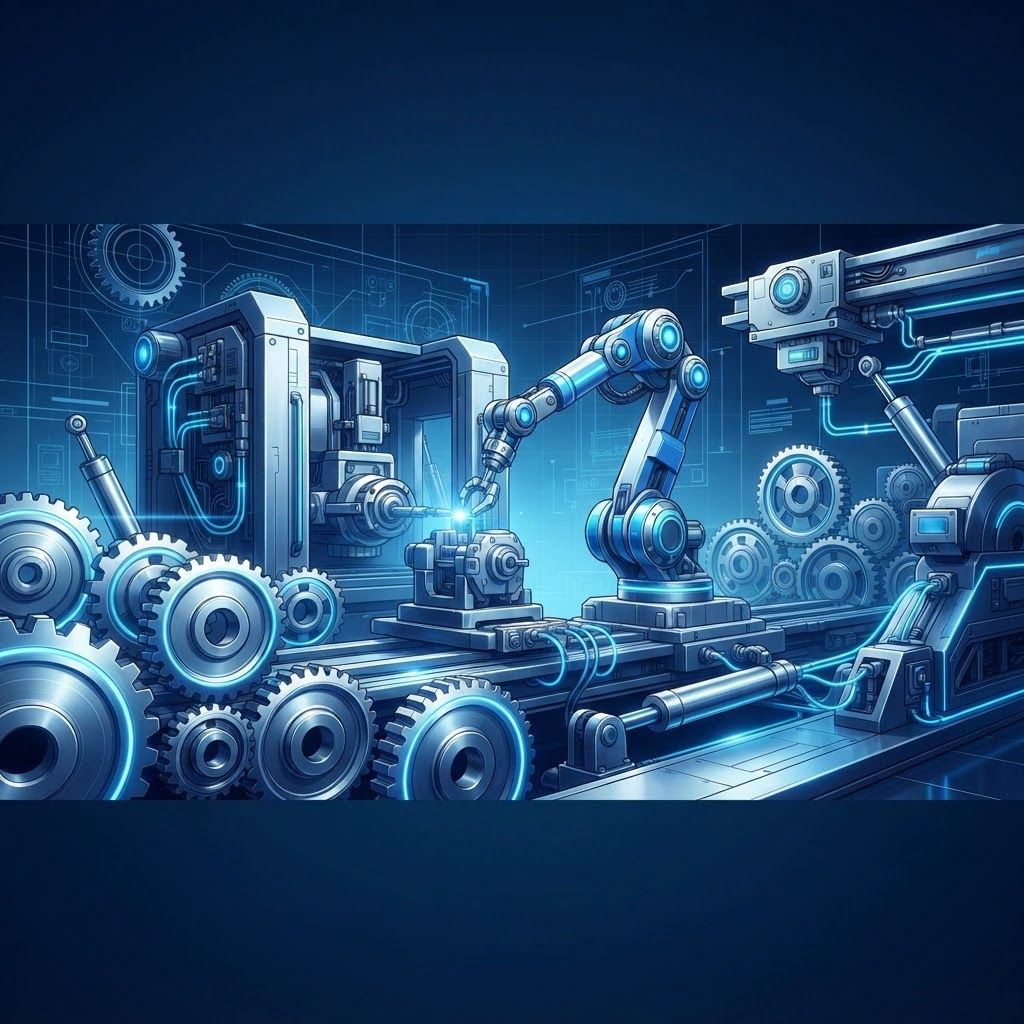
Machinery Manufacturing in Test Valley
Machinery manufacturing rarely attracts attention, yet it quietly enables almost every other industry. In Test Valley, the sector spans a wide range: agricultural equipment serving the borough's extensive farmland, food processing machinery supporting regional producers, packaging and handling systems for distribution operations, precision automation for electronics and pharmaceutical customers, and general engineering serving maintenance and repair needs across Hampshire.
The borough's industrial estates around Andover, Romsey and the Nursling corridor provide the workshop space this activity requires, while its position on the A34 and M27 supports the movement of large and heavy equipment.
The Nature of the Work
Machinery manufacturing is characterised by low volumes and high complexity. Many machines are effectively one-offs, designed around a specific customer process. This demands mechanical design capability, electrical and control engineering, fabrication, machining, assembly and commissioning, often within the same organisation. It also demands strong project management, because a delayed machine can halt a customer's entire production line.
Ten Machinery Manufacturers Serving Test Valley
1. Test Valley Machinery Systems
Designs and builds bespoke production machinery, from single workstations to integrated lines. Known for thorough specification workshops before design begins, which reduces costly changes later.
2. Anton Precision Engineering
Provides CNC machining, turning and milling services alongside sub-assembly manufacture. Serves both machine builders and end users needing replacement components for existing equipment.
3. Stockbridge Agricultural Machinery
Manufactures and modifies farm equipment including handling attachments, trailers, crop processing equipment and specialist implements suited to chalk downland conditions.
4. Romsey Food Processing Equipment
Builds hygienic stainless steel machinery for food and beverage producers, covering conveying, filling, washing and packaging, with attention to cleanability and regulatory compliance.
5. Meridian Automation and Robotics
Integrates industrial robots, vision systems and programmable controls into automated cells. Focuses on helping smaller manufacturers adopt automation incrementally rather than through disruptive wholesale change.
6. Broadlands Materials Handling
Produces conveyors, lifting equipment, palletisers and warehouse handling systems for the borough's substantial logistics sector.
7. Valley Park Hydraulics and Pneumatics
Manufactures and services hydraulic power packs, cylinders and pneumatic systems, including on-site repair for machinery downtime emergencies.
8. Harewood Special Purpose Machines
Builds test rigs, assembly jigs and inspection machines for engineering customers, frequently combining mechanical design with instrumentation and data capture.
9. Test Valley Fabrication Works
Provides heavy fabrication, welding, sheet metal work and surface finishing, supplying frames, guards, enclosures and structural elements to other machine builders.
10. Abbotswood Machine Maintenance
Specialises in refurbishment, retrofit and upgrade of existing machinery, extending asset life through control system modernisation, safety compliance upgrades and mechanical overhaul.
Industry Trends
Automation adoption among smaller manufacturers is accelerating, driven by labour availability rather than cost alone. Collaborative robots that work safely alongside people have lowered the entry threshold considerably. Digital monitoring is becoming standard, with sensors and connectivity enabling predictive maintenance that prevents breakdowns rather than reacting to them. Energy efficiency is now a design requirement, as customers scrutinise the running cost and carbon footprint of capital equipment. Modular design is spreading, allowing machines to be reconfigured as product ranges change rather than replaced. And safety standards continue to tighten, making compliant guarding, risk assessment and documentation an integral part of every build.
Choosing a Machinery Manufacturer
Specify the problem rather than the solution. The best builders will propose approaches you had not considered, but only if given the underlying process requirements, throughput targets and constraints. Check references from installations of similar complexity and ask specifically about commissioning experience, which is where projects most often overrun. Clarify who provides electrical design, safety assessment and documentation. Establish spare parts availability and support response times before ordering, not afterwards. Agree acceptance testing criteria in writing at the contract stage, including throughput, reject rates and uptime.
Managing a Machinery Project
Appoint a single internal owner with authority to make decisions, as ambiguity on the customer side causes as many delays as supplier issues. Freeze the specification at an agreed point and manage changes formally. Plan for installation logistics early, including access, foundations, services and downtime windows. Budget for operator training, which is consistently underestimated and strongly affects how quickly a machine reaches rated output.
Safety and Compliance Obligations
Anyone commissioning or supplying machinery carries legal responsibilities. New machines must be designed to recognised safety standards, with risk assessment documented, guarding specified appropriately, emergency stop circuits correctly rated and a technical file compiled. Where a business substantially modifies an existing machine, it may itself become the manufacturer in legal terms, inheriting those duties. This is a frequent and expensive surprise for companies that upgrade equipment informally. Engaging a builder who understands the compliance framework protects both operators and directors.
Justifying Capital Investment
Machinery purchases compete with every other demand on capital, so the business case matters. Strong cases quantify labour hours released, scrap reduction, throughput gains, energy savings and quality improvement, then test the result against realistic rather than optimistic utilisation. It is worth modelling the cost of not investing, including lost orders from capacity constraints and the recruitment difficulty of expanding manual capacity. Many Test Valley manufacturers find that automation projects justify themselves on consistency and reliability as much as on direct labour saving.
Final Thoughts
Machinery manufacturing in Test Valley combines traditional engineering craft with modern automation and control expertise. The companies profiled here cover bespoke machine build, precision machining, agricultural and food equipment, handling systems and refurbishment. For businesses seeking productivity improvement, a capable local machine builder is often a more effective investment than additional labour or premises.
Want your brand featured in front of decision-makers? Publish a guest post or get a link insertion in our guides through AAMAX's guest post and link insertion service.
Helpful Links
 SponsoredAAMAX — Full-Service Digital Agency
Write for Us
Share your expertise with our readers. We welcome guest contributions from industry specialists.
Pitch your idea

