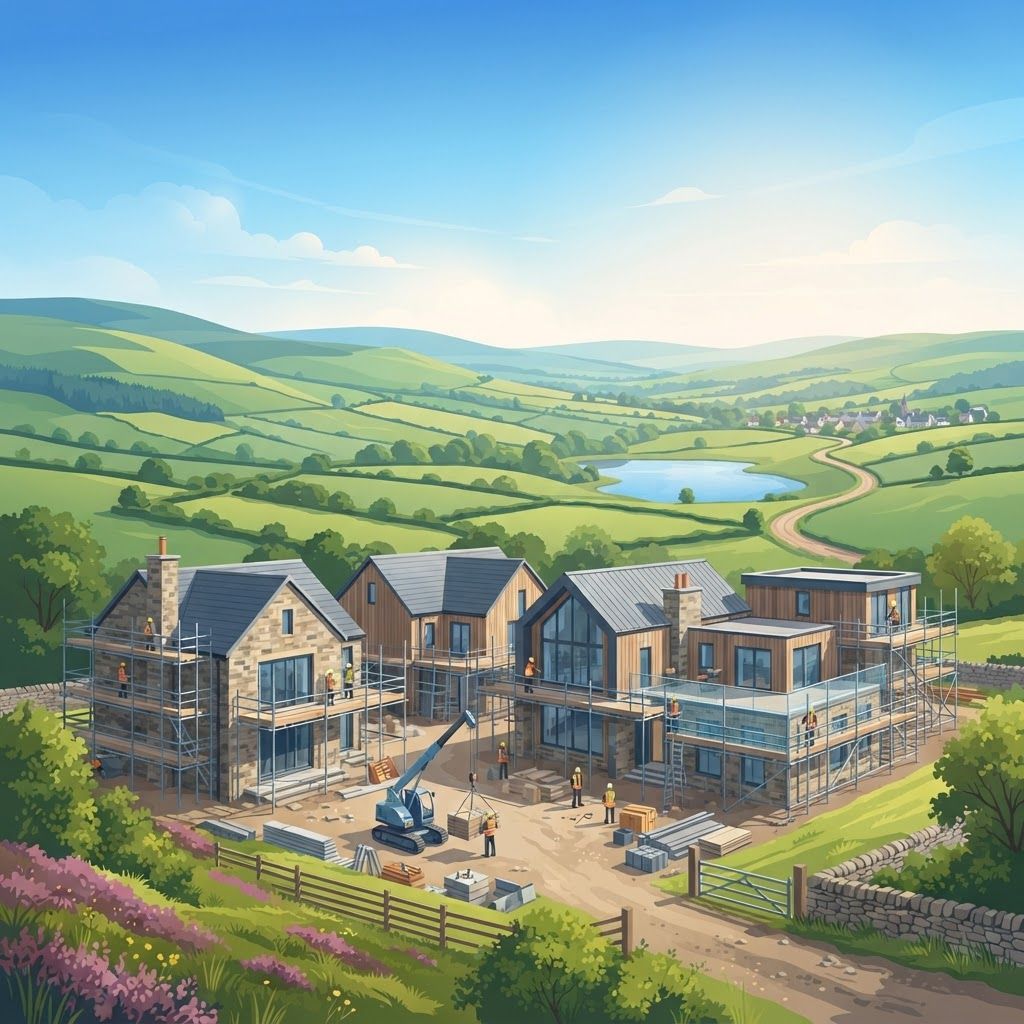
Housebuilding in the Scottish Borders
Residential construction in the Scottish Borders reflects a distinctive housing market. Demand comes from local families, people relocating from Edinburgh and further afield attracted by space and landscape, retirees, and a steady flow of self-builders drawn by relatively available rural plots. The result is a mix of volume estate development around the main towns, bespoke individual homes on rural sites, and a substantial market in conversions and extensions to existing stock.
Building here means working with stone, slate and render traditions that planning policy often requires new homes to respect, particularly in and near conservation areas. Rural sites frequently need private drainage, and connection to utilities can be a significant cost. Scottish building standards also impose demanding energy efficiency requirements, which shape construction methods from the outset.
Regional Housebuilders
Established Scottish housebuilders develop estates around Borders towns including Galashiels, Peebles, Kelso, Duns and Earlston. These developments deliver standardised house types built to consistent specification, with warranty cover and defined completion dates. For buyers, the advantages are predictability, new-build warranties and modern energy performance. The trade-off is limited design flexibility and layouts that follow national templates rather than local vernacular.
Local Bespoke Homebuilders
A tier of local building firms specialises in individual homes designed for specific clients and sites. These contractors work closely with architects to deliver one-off houses responding to orientation, views, exposure and ground conditions. For rural Borders plots, this tailored approach usually produces a better result than a standard house type, and local builders understand how to detail buildings for wind-driven rain and exposed elevations.
Timber Frame Specialists
Timber frame is widely used in Scottish residential construction, and specialist manufacturers and erectors serve the Borders. The system allows rapid weathertight enclosure, reducing exposure during construction, and achieves excellent thermal performance. Closed panel and structural insulated panel systems take this further, delivering high airtightness with factory-controlled quality. For self-builders, timber frame offers a predictable early programme.
Steading and Barn Conversion Specialists
The Borders has an extensive stock of redundant agricultural buildings, and converting steadings into homes is a well-established market. Specialists in this work understand the structural assessment of old masonry, the insulation challenges of solid walls, damp management in traditional construction and the planning considerations that govern conversion. Done well, these projects produce characterful homes; done badly, they suffer persistent damp and heating problems.
Extension and Alteration Contractors
Extending rather than moving is increasingly common, and a substantial part of the residential construction market is extensions, loft conversions, garage conversions and internal reconfiguration. Contractors in this sector must manage building work around occupied homes, which requires organisation and consideration as much as technical skill. Clear communication about dust, noise, services interruption and access is what distinguishes good firms.
Self-Build and Custom Build Contractors
Self-build has a strong following in rural Scotland, supported by plot availability that is scarce in cities. Contractors experienced in self-build work flexibly with clients who may undertake some work themselves, and can provide a weathertight shell for the client to fit out. This requires clear demarcation of responsibilities and careful sequencing, and contractors who do it well are valued highly.
Eco and Passive House Builders
A growing group of builders specialises in very low energy homes, including buildings approaching or meeting passive house standards. Techniques include high insulation levels, rigorous airtightness, thermal bridge-free detailing and mechanical ventilation with heat recovery. In the Borders climate, where heating demand is significant, these homes deliver dramatically lower running costs. The higher capital cost is offset over time and increasingly reflected in property value.
Groundworks and Foundation Specialists
Every house begins below ground. Groundworks contractors handle site strip, foundations, drainage, service ducts and external works. On rural sites this often extends to septic tanks or package treatment plants, soakaway systems and long access driveways. Ground conditions in the Borders vary from rock to soft alluvial deposits near rivers, and early site investigation prevents expensive foundation redesign.
Roofing and External Envelope Contractors
Roofing, rendering, external wall insulation and cladding contractors determine how a house performs against weather. Natural slate remains common and requires skilled fixing. Render systems must be specified for exposure. External wall insulation is increasingly used in retrofit projects to bring older homes up to acceptable thermal standards.
Mechanical, Electrical and Renewables Installers
Modern homes require heating, ventilation, electrical and increasingly renewable systems. Air source heat pumps have become the default heating choice for new rural homes off the gas grid, replacing oil. Solar panels, battery storage and electric vehicle charging points are commonly installed at construction stage, which is far cheaper than retrofitting.
Understanding Costs
Residential construction costs vary widely by specification, site and access. The cost of the building itself is only part of the picture: site works, utility connections, drainage, professional fees, warrants and contingency all add significantly. Rural sites frequently carry higher costs for access, services and drainage than urban plots. Budget realistically and include contingency of at least ten per cent.
Beware of quotes that appear substantially lower than others. They typically exclude items that will appear later as variations. Compare quotes line by line and insist on clarity about what is excluded.
Choosing a Residential Builder
Look for experience with your specific project type. A builder excellent at estate housing may not be the right choice for a listed steading conversion. Ask to visit completed projects and speak to previous clients about communication, programme adherence and how problems were handled.
Verify insurance and, for new builds, confirm what structural warranty will be provided. Check that the builder is comfortable working with your designer and understands the building warrant process. Agree a written contract with a payment schedule tied to milestones.
Planning and Regulation
New homes require planning permission and a building warrant. Rural sites face additional scrutiny regarding siting, design, access and drainage. Conservation areas impose design constraints on materials and detailing. Scottish building standards set demanding requirements for energy efficiency, accessibility and safety. Allow realistic time for these approvals, as they frequently take longer than clients anticipate.
Trends in Residential Construction
Energy efficiency is the dominant driver, with heat pumps and high-performance envelopes becoming standard. Home working has increased demand for dedicated office space and reliable connectivity. Retrofit of existing housing is a growing market as owners upgrade older properties rather than move. Offsite manufacture continues to expand, improving quality control and reducing site time.
Final Thoughts
Residential construction in the Scottish Borders rewards careful builder selection and thorough preparation. Match the contractor to the project type, verify credentials and references, budget realistically for rural site costs, and invest in energy performance. The result is a home suited to the landscape and affordable to run.
Want your brand featured in front of decision-makers? Publish a guest post or get a link insertion in our guides through AAMAX's guest post and link insertion service.
Helpful Links
 SponsoredAAMAX — Full-Service Digital Agency
Write for Us
Share your expertise with our readers. We welcome guest contributions from industry specialists.
Pitch your idea