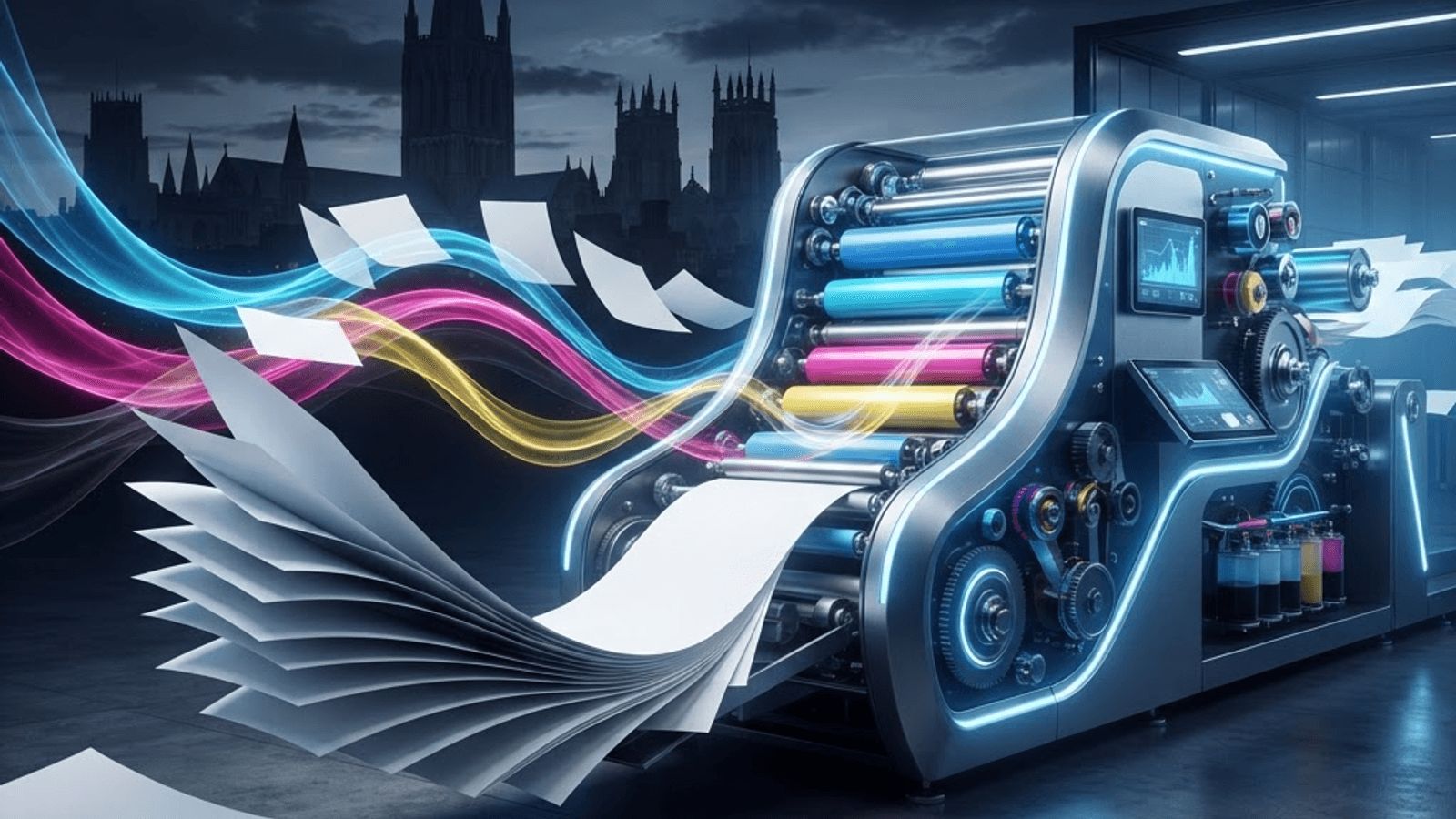
Norwich and Its Printing Heritage
Printing has deep roots in Norwich. The city was historically a centre for publishing, newspapers, bookbinding and commercial printing, and that heritage survives in a print sector that remains unusually capable for a city of its size. Today's Norwich print industry spans traditional lithographic presses producing long runs at low unit cost, digital presses handling short runs and personalisation, wide-format machines producing signage and exhibition graphics, garment decoration for teamwear and workwear, and specialist finishing including foiling, embossing and die cutting. For local businesses, that means most requirements can be met without going outside the county.
Choosing Between Printing Methods
Understanding the basic technologies makes purchasing decisions much easier. Lithographic printing has a higher setup cost but very low cost per unit at volume, making it right for thousands of brochures, catalogues or packaging items and offering the best colour fidelity for specific brand colours. Digital printing has no plate setup, making short runs economical, allowing variable data such as personalised names or unique codes, and enabling quick turnaround. Wide format covers anything oversized, from posters to vehicle graphics. Screen printing suits garments and rigid substrates at volume, while direct-to-garment and vinyl transfer handle small quantities. A good printer will recommend the method that suits your quantity rather than the one they happen to own.
1. Commercial Litho and Digital Print Houses
Established commercial printers form the core of the local market, running both litho and digital equipment alongside in-house finishing. They handle brochures, catalogues, magazines, annual reports, stationery, folders and direct mail, and typically offer design support, artwork preflighting, colour proofing and mailing services. For businesses producing regular marketing collateral, a single relationship with a full-service house simplifies procurement considerably.
2. Digital Print and Copy Shops
Quick-turnaround copy shops serve a different need: small quantities, fast. Typical work includes business cards, flyers, presentation documents, spiral and wire binding, laminating, plan copying, poster printing and last-minute reprints. Their city-centre convenience and same-day capability make them essential for professional services firms, students and event organisers working to short deadlines.
3. Large Format and Signage Printers
Wide-format specialists produce exhibition stands and pull-up banners, shop and office signage, window graphics and frosted vinyl, pavement and menu boards, wall murals and hoarding graphics. Beyond printing, the important capability is fabrication and installation, including substrate selection, weather durability and appropriate fixing. Retail, hospitality, construction and event businesses across Norwich rely on this sector heavily.
4. Vehicle Wrapping and Fleet Graphics Specialists
Vehicle graphics are among the most cost-effective advertising available to local trades and service businesses. Specialists in Norwich provide design that works at speed and distance, partial and full wraps, colour change wraps, fleet consistency across multiple vehicles and paint protection films. Quality here depends almost entirely on installation skill and material grade, since poorly applied vinyl fails visibly within a season.
5. Garment, Workwear and Teamwear Printers
Garment decoration serves clubs, schools, events, hospitality venues and trades. Services include screen printing for volume, embroidery for polo shirts and jackets, direct-to-film and direct-to-garment for small runs and complex artwork, and heat-applied numbering and lettering for sports kit. Reliable suppliers hold stock in consistent colours across seasons so that reorders and mid-season additions match existing garments.
6. Packaging and Label Printers
Norfolk's substantial food, drink and agricultural production base creates strong demand for packaging and labelling. Providers supply printed labels on rolls or sheets, food-safe packaging, cartons and sleeves, shrink sleeves, tamper-evident seals and variable data coding for batch and date information. Compliance is a critical dimension here, since labelling must meet legal requirements for ingredients, allergens, weights and origin claims.
7. Promotional Products and Branded Merchandise Suppliers
Merchandise suppliers source and decorate promotional items including pens, drinkware, bags, notebooks, lanyards, technology accessories and corporate gifts. The most useful suppliers advise on which items actually get used rather than discarded, and there is a clear shift towards durable, recyclable and reusable products as organisations become more conscious of waste and brand perception.
8. Book Printing, Publishing and Bookbinding Services
Given Norwich's literary status and university presence, book printing and binding remain genuine local specialisms. Services include short-run and print-on-demand paperbacks, hardback casebound production, thesis and dissertation binding, journals and academic publications, and archival and restoration binding. Independent authors and small publishers value suppliers who can advise on paper stock, spine calculation and cover finish.
9. Design, Artwork and Prepress Studios
Print quality depends substantially on file preparation. Design and prepress studios handle layout and typesetting, colour management and profiling, bleed and imposition setup, proofing and preflight checks, and conversion of files supplied in unsuitable formats. Many Norwich printers include prepress within their service, and this is frequently where the difference between an acceptable and an excellent printed result is determined.
10. Sustainable and Specialist Eco Printers
Environmental credentials have become a purchasing factor rather than a preference. Sustainable printers offer certified recycled and responsibly sourced papers, vegetable and low-migration inks, waterless printing processes, carbon-balanced production and plastic-free packaging and finishing. Public sector, charity and consumer-facing clients in particular now specify these standards in tender documents and supplier requirements.
Trends in the Printing Industry
Print has stabilised into a considered, higher-quality medium rather than a mass-volume one. Run lengths are shorter and more frequent, favouring digital production. Personalisation and variable data have made direct mail measurably more effective. Sustainability certification is now expected in commercial tenders. Print is increasingly integrated with digital campaigns through QR codes and personalised landing pages. Tactile finishing such as soft-touch lamination, spot varnish and foiling is being used deliberately to make printed items feel worth keeping. And lead times have tightened as customers expect online ordering with rapid dispatch.
How to Choose a Printing Supplier in Norwich
Match the technology to your quantity and turnaround rather than choosing on headline price alone. Ask for physical samples and, for critical colour work, a hard-copy proof rather than a screen approval. Provide artwork in the format requested with correct bleed and colour space, or pay for prepress rather than risking disappointment. Confirm what is included in a quotation, since finishing, delivery and proofing are often priced separately. Check environmental certifications if these matter to your customers or funders. Finally, value suppliers who ask what the printed item needs to achieve, because a printer who understands the purpose will often suggest a better and cheaper specification than the one you requested.
Want your brand featured in front of decision-makers? Publish a guest post or get a link insertion in our guides through AAMAX's guest post and link insertion service.
Helpful Links
 SponsoredAAMAX — Full-Service Digital Agency
Write for Us
Share your expertise with our readers. We welcome guest contributions from industry specialists.
Pitch your idea