

Carmarthenshire's Place in the Welsh Polymer Sector
Plastics processing rarely makes headlines, yet it underpins an enormous share of everyday manufacturing. In Carmarthenshire, polymer businesses have grown up around three natural demand streams: agriculture, food and drink production, and construction. Livestock troughs, silage sheeting, dairy fittings, food-grade trays, drainage components and window profiles all originate from processors operating within the county or its immediate surroundings.
The area's industrial estates around Llanelli, Cross Hands, Ammanford and Carmarthen provide the right kind of space for this work: high-bay units with three-phase power, good yard access for bulk resin deliveries and proximity to the M4 for onward distribution. Meanwhile the legacy of heavy industry in the Llanelli area left behind a workforce comfortable with shift-based production, tooling and machine maintenance.
Understanding the Main Processes
Choosing a manufacturer is far easier once you understand which process suits your part, because each carries very different tooling costs and volume economics.
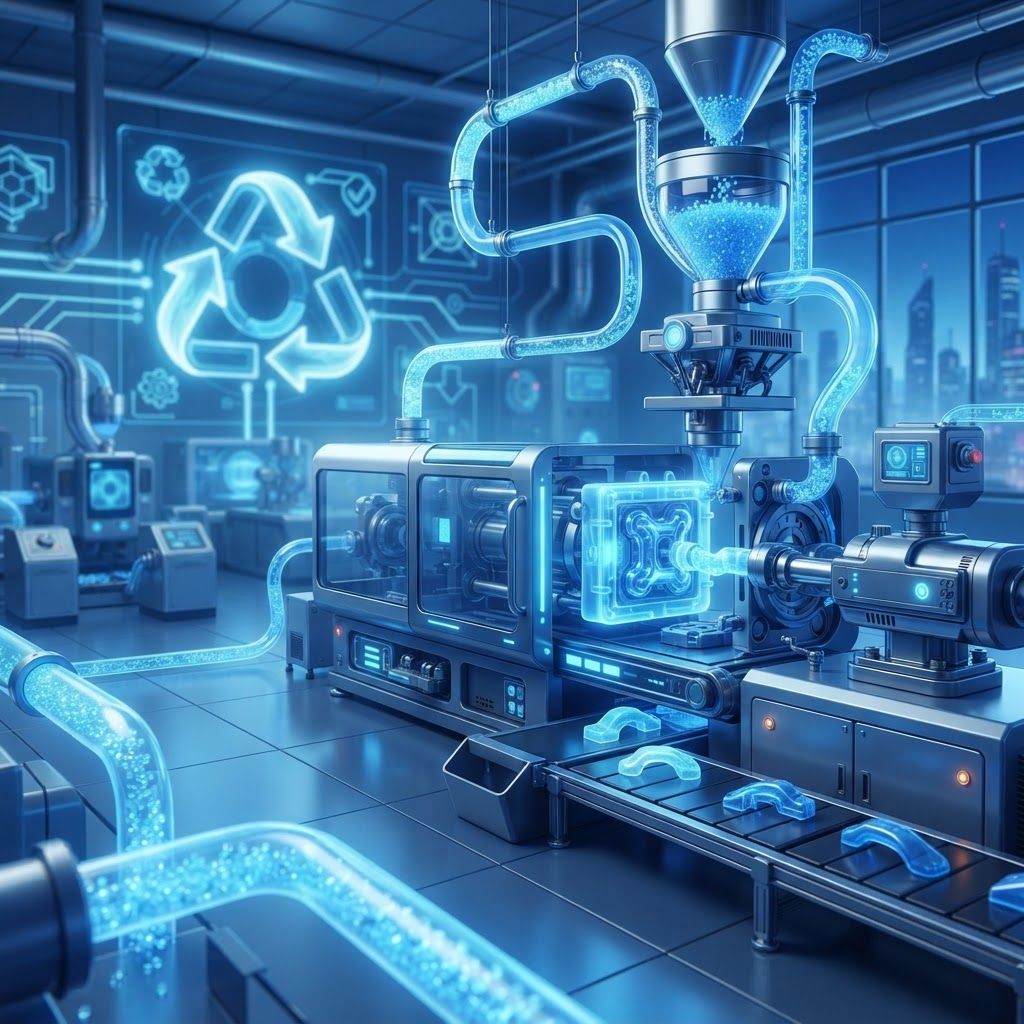
Injection moulding forces molten polymer into a hardened steel tool at high pressure. Tooling is expensive but part cost falls sharply at volume, making it ideal for runs in the thousands or millions. Cycle times are measured in seconds, and dimensional accuracy is excellent.
Extrusion pushes polymer continuously through a die to produce pipe, profile, sheet or film. It suits long, uniform sections and is the backbone of drainage, cable management and window systems.
Blow moulding inflates a heated parison inside a mould to create hollow items such as tanks, drums and containers.
Rotational moulding slowly tumbles powdered polymer inside a heated mould, producing large, seamless, stress-free hollow parts like water tanks and agricultural feeders. Tooling is comparatively cheap, so it suits low and medium volumes of big items.
Vacuum forming and thermoforming heat a sheet and draw it over a pattern. Tooling is inexpensive and lead times short, which makes it the go-to for machine guards, trays, packaging and point-of-sale items.
Fabrication and CNC machining cut, bend, bond and weld sheet material such as acrylic, polycarbonate, polypropylene and HDPE into tanks, enclosures, signage and bespoke assemblies. No tooling is required at all, so one-offs are viable.
Ten Notable Plastic Manufacturers in Carmarthenshire
1. Llanelli Polymer Engineering — A technical injection moulder running multi-cavity tooling for automotive, electrical and industrial customers. Strengths include in-house tool maintenance, scientific moulding process validation and full material traceability on every batch.
2. Cross Hands Plastics — A general-purpose moulder and assembler serving construction and consumer products. The business handles insert moulding, ultrasonic welding and light sub-assembly, making it useful for customers who want a finished component rather than a bare moulding.
3. Tywi Rotational Mouldings — Specialists in large hollow products: water and chemical storage tanks, livestock feeders, drinking troughs and roadside furniture. Rotomoulding's low tooling cost makes this a practical partner for agricultural equipment designers needing modest quantities.
4. Carmarthen Vacuum Forming — Fast-turnaround thermoforming for machine guarding, medical trolley trays, retail displays and prototype housings. The workshop produces its own timber and resin patterns, which keeps development costs low.
5. Ammanford Extrusions — Continuous profile and pipe extrusion in PVC, polypropylene and polyethylene, supplying drainage, ducting and building components. In-house die design allows bespoke profiles for glazing and cladding systems.
6. Gwendraeth Plastic Fabrications — Sheet fabrication using CNC routing, line bending and plastic welding to produce tanks, fume enclosures, bunds and clear guards. Popular with laboratories, water treatment operators and food processors needing chemically resistant bespoke items.
7. Burry Port Packaging Products — Food-grade thermoformed and moulded packaging for the region's meat, dairy and bakery producers. Operates to recognised food safety management standards and maintains documentation for food contact compliance.
8. Dinefwr Precision Mouldings — A smaller, precision-focused moulder handling technical engineering polymers such as nylon, acetal and glass-filled compounds. Suited to gears, bushes, housings and parts with tight tolerance requirements.
9. Cothi Recycled Polymers — A reprocessor and compounder converting post-industrial and post-consumer waste into regrind and pellet feedstock, and manufacturing recycled-content products such as boards, planks and site protection sheets.
10. Teifi Composite and Plastics — Combines GRP composite laminating with plastic fabrication for enclosures, covers, ducting and bespoke tanks. A practical choice where corrosion resistance and large panel sizes matter more than high volume.
Compliance, Standards and Documentation
Plastics processing is more heavily regulated than many buyers expect, and the paperwork matters. Food contact applications must comply with framework regulations and the specific plastics regulation, supported by a declaration of compliance and migration testing evidence. Potable water components require appropriate approval for contact with drinking water. Construction products often need declarations of performance and CE or UKCA marking.
Quality management certification to ISO 9001 is common among established processors, with ISO 14001 environmental certification increasingly expected on larger tenders. Automotive customers may require IATF 16949, and medical work demands ISO 13485. Ask directly which certificates are current rather than assuming, and request the actual certificate rather than a logo on a website.
Material traceability deserves particular attention. A good moulder can tell you the resin grade, supplier, batch number and any regrind percentage used in your parts. If a component fails in service, that trail is the difference between a contained investigation and a wholesale recall.
Sustainability and the Shift to Circular Materials
The Plastic Packaging Tax has sharpened commercial focus on recycled content, with a threshold that rewards packaging containing at least thirty per cent recycled material. That has driven genuine investment in reprocessing capability and in reformulating products to accept recyclate without losing performance.
Carmarthenshire processors are responding in several ways. Some have introduced closed-loop schemes that collect customers' production scrap for regrinding. Others have redesigned parts for mono-material construction, removing mixed-polymer assemblies that are difficult to recycle. Lightweighting continues to reduce resin consumption per part, while switching to mould-in colour rather than painted finishes eliminates a contamination source.
Energy is the other lever. Modern all-electric injection moulding machines consume substantially less power than older hydraulic equipment, and variable speed drives on ancillaries such as chillers and granulators cut baseline consumption. Processors who have invested here tend to hold price better when energy markets move.
How to Brief a Plastics Manufacturer Well
Provide function before form. Explain what the part must do, what loads and temperatures it sees, whether it faces ultraviolet exposure, chemicals or food contact, and what the expected service life is. A competent processor will then advise on polymer selection, wall thickness, draft angles, rib design and gate positions — advice that routinely saves significant tooling cost.
Be realistic about volumes. Injection moulding rarely makes sense below a few thousand parts unless tolerance demands it; vacuum forming, rotomoulding or fabrication will usually be cheaper for lower quantities. Discuss tooling ownership explicitly, including who holds the tool, who maintains it, and what happens if you move supplier.
Finally, plan for validation. Ask for first article inspection reports, dimensional checks against drawing, and sample approval before full production. It is far cheaper to correct a tool after twenty parts than after twenty thousand.
Final Thoughts
Carmarthenshire's plastics sector is more diverse than its size suggests, covering precision moulding, large rotational parts, extruded profiles, food-grade packaging, chemical-resistant fabrication and recycled compounding. For buyers, the key is matching process to volume and specification, then verifying compliance documentation properly. Do that, and the county offers genuinely capable, responsive polymer partners with the advantage of short supply lines and direct access to the people running the machines.
Want your brand featured in front of decision-makers? Publish a guest post or get a link insertion in our guides through AAMAX's guest post and link insertion service.
Helpful Links
 SponsoredAAMAX — Full-Service Digital Agency
Write for Us
Share your expertise with our readers. We welcome guest contributions from industry specialists.
Pitch your idea

