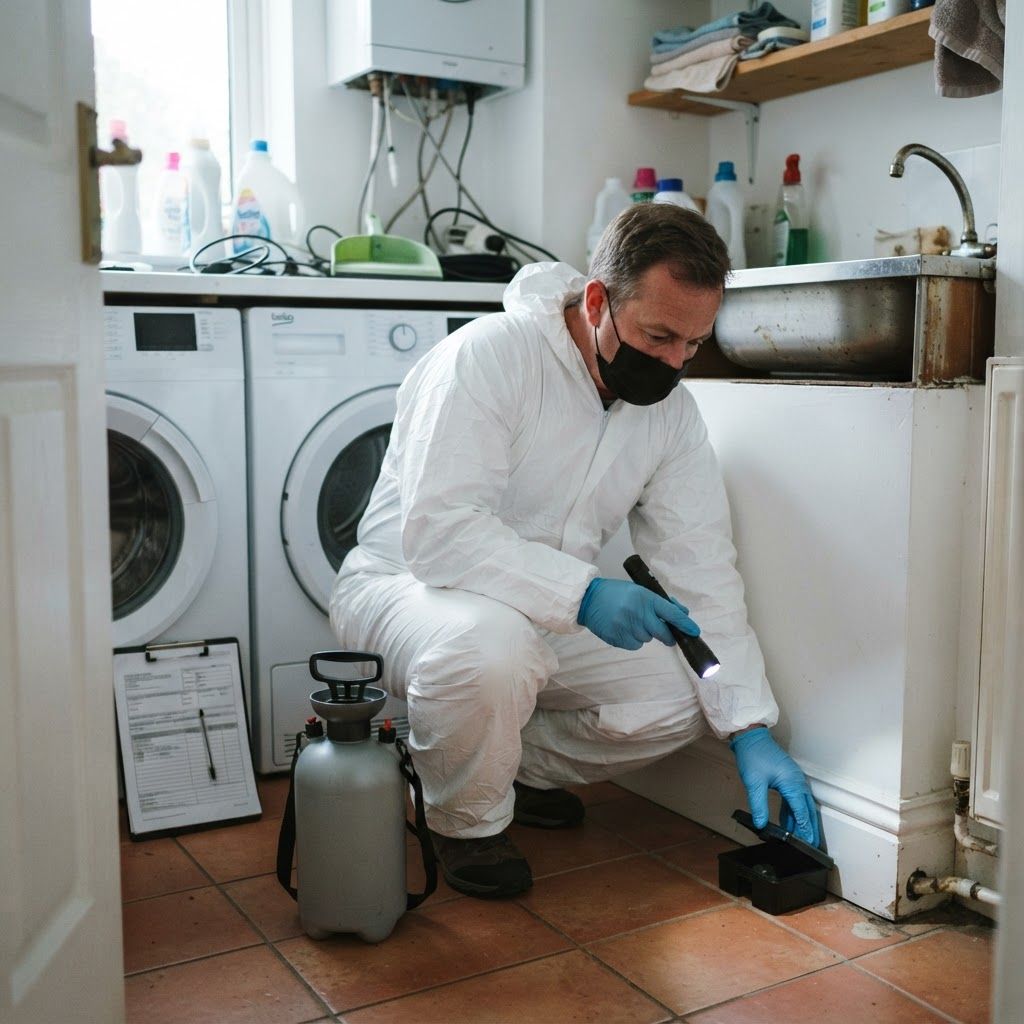
Understanding Pest Pressure in Barnsley
Barnsley's geography creates a particular pest profile. The borough sits at the meeting point of urban terraces, former industrial land, canal and river corridors along the Dearne, and genuinely rural farmland to the west. Each environment supports different species, and properties near green corridors or watercourses tend to experience higher rodent pressure than those in dense town-centre streets.
Seasonality is pronounced. Wasp activity peaks in late summer as colonies reach maximum size and workers become more aggressive around food sources. Rodent complaints climb sharply from October as harvest cover disappears and temperatures fall, driving mice and rats towards the warmth of cavity walls and loft spaces. Bed bugs and carpet moths, by contrast, are largely aseasonal and driven by movement of goods and people rather than weather.
The Case for Professional Treatment
Retail products have their place for very minor issues, but they fail for predictable reasons. Consumer rodenticides are formulated at low concentrations, over-the-counter insecticides frequently lack residual action, and neither addresses the entry points and harbourage that allow reinfestation. Professional pest control follows an integrated approach: identify the species accurately, survey to find the source and access routes, apply proportionate treatment, then proof the building so the problem does not simply recur.
Legal considerations matter too. Certain professional-use products are restricted to trained operatives, and rodenticide use is governed by stewardship rules designed to protect wildlife and non-target species. A qualified technician will use bait stations correctly, record placements, and recover unused bait rather than leaving it in situ indefinitely.
Ten Pest Control Providers Covering Barnsley
Barnsley Pest Control Solutions is one of the borough's most established providers, working across domestic, commercial and food-industry premises. It offers both one-off treatments and annual contracts, and its documentation standards make it a common choice for businesses needing audit-ready records.
Oakwell Rodent Management specialises specifically in rats and mice. Its approach leans heavily on proofing: after treatment, technicians survey and seal entry points around air bricks, service penetrations, roof junctions and drainage, which is what actually prevents recurrence in older terraced housing.
Dearne Valley Wasp & Bee Removal handles stinging insects with a strong emphasis on responsible practice. Wasp and hornet nests are treated, but honey bee colonies are wherever possible relocated in cooperation with local beekeepers rather than destroyed, an approach that has earned the firm considerable goodwill.
Penistone Rural Pest Services covers the agricultural west of the borough. Farm and stable environments bring different requirements, including rodent management around feed stores, mole control on grazing land, and bird proofing on barns and outbuildings.
Silkstone Bed Bug Specialists concentrates on one of the most difficult pests to eradicate. It combines detailed inspection with heat treatment and targeted residual application, and provides preparation guidance to customers because bed bug success depends heavily on how well a property is readied before the technician arrives.
Worsbrough Insect Control deals with the broad category of crawling and flying insects: ants, cockroaches, silverfish, fleas, carpet beetles and clothes moths. Textile pest work in particular has grown as natural-fibre carpets and wool furnishings have returned to fashion.
Cudworth Bird Proofing Experts focuses on pigeon and gull management for commercial and residential buildings. Netting, spike systems, wire deployment and post-clearance decontamination of guano-affected areas form the core of its service, with all work carried out within wildlife protection legislation.
Royston Mole & Garden Pest Control serves gardeners and grounds managers, tackling moles, rabbits and squirrels alongside advice on non-chemical deterrence. It is frequently engaged by sports clubs and larger private gardens across the borough.
Stairfoot Commercial Pest Contracts works almost exclusively with businesses: food premises, hospitality, warehousing and healthcare. Scheduled monitoring visits, electronic reporting and trend analysis help clients demonstrate due diligence during inspections.
Barugh Green Wildlife Management completes the list, handling the sensitive end of the sector. Squirrel exclusion from loft spaces, deterrence of nuisance foxes and advice on protected species such as bats are all managed with an emphasis on humane, legally compliant outcomes.
Prevention: The Most Cost-Effective Strategy
Most infestations exploit small, fixable weaknesses. Rodents need only a gap of a few millimetres to enter, so sealing around pipework, repairing damaged air bricks and fitting bristle strips to ill-fitting doors removes the majority of access routes. Bin discipline matters enormously: wheelie bins with cracked lids, food waste left in bags and bird feeding on the ground all sustain populations that would otherwise move on.
Indoors, storing dry goods in rigid containers, dealing with condensation and leaks promptly, and vacuuming beneath heavy furniture disrupts the conditions insects rely on. In lofts, keeping insulation clear of eaves ventilation and inspecting annually catches problems early, when treatment is simplest and cheapest.
Trends Reshaping the Industry
Regulatory tightening around rodenticides has pushed the sector towards non-toxic and monitoring-led methods. Digital rodent traps with remote alert capability are becoming common in commercial settings, allowing technicians to respond to actual activity rather than working to a fixed visit schedule. This reduces bait use and improves outcomes simultaneously.
Heat treatment has similarly transformed bed bug control, offering a chemical-free route that penetrates furniture and voids more reliably than sprays alone. There is also greater emphasis on proofing as a billable deliverable in its own right, reflecting an industry-wide recognition that treatment without exclusion is a temporary fix. Finally, customer expectations around wildlife ethics have risen, and the providers thriving in Barnsley are those offering humane, proportionate solutions.
Choosing a Pest Control Provider
Look for membership of a recognised trade association, which requires technicians to hold formal pest management qualifications and carry appropriate insurance. Ask what the treatment plan involves, how many visits are included, and whether follow-up is chargeable. A single spray with no return visit is rarely adequate for established infestations.
Insist on a written report identifying the species, the extent of activity, the products used and the proofing recommendations. If pets, children or vulnerable occupants are present, discuss this openly so treatment can be adapted. Above all, be wary of any provider promising instant eradication without inspecting the property. Effective pest control is methodical, and the firms that explain the process honestly are almost always the ones that resolve the problem.
Want your brand featured in front of decision-makers? Publish a guest post or get a link insertion in our guides through AAMAX's guest post and link insertion service.
Helpful Links
 SponsoredAAMAX — Full-Service Digital Agency
Write for Us
Share your expertise with our readers. We welcome guest contributions from industry specialists.
Pitch your idea