Farming on Oldham's Pennine Edge
It surprises many people to learn how much active agriculture sits within Oldham's boundaries. While the western side of the borough is densely urban, the land rising eastward toward Saddleworth and the Pennine moors is genuinely rural, characterised by dry stone walls, in-bye pasture, hay meadows and extensive moorland grazing. This is classic upland farming country, and it has been worked continuously for centuries.
The conditions define what is possible. Higher rainfall, thinner acidic soils, shorter growing seasons and exposed terrain make arable cropping largely impractical. Instead, the dominant enterprises are sheep and beef cattle, supported by grass and forage production. Farms tend to be family businesses spanning generations, operating across a mix of owned and rented land, often including common grazing rights on the moor.
What has changed dramatically is the economic model. Where upland farms once relied heavily on area-based subsidy, they now operate in a policy environment focused on environmental outcomes, and many have diversified into direct sales, tourism, contracting and land management services to build resilient income.
1. Saddleworth Moor Hill Farming
Saddleworth Moor Hill Farming represents the classic upland enterprise, running hardy hill sheep across in-bye land and extensive moorland grazing. The flock is built around breeds selected for hardiness, mothering ability and the capacity to thrive on rough grazing with minimal supplementary feed.
The business has become notable for combining traditional shepherding with participation in environmental land management, including moorland restoration, blanket bog rewetting and wader habitat improvement. That dual role, producing food while delivering public environmental benefit, increasingly defines the future of upland farming and this enterprise demonstrates it convincingly.
2. Pennine Valley Beef Company
Pennine Valley Beef Company finishes native breed cattle on grass and forage across the valley farmland east of Oldham. The emphasis is on slower-grown, forage-fed beef with strong eating quality, marketed through a combination of wholesale and direct-to-consumer channels.
Its differentiator is genuine traceability. Customers can trace meat back to specific farms and animals, which supports premium positioning against commodity beef. The company has also invested in rotational grazing management, improving both grass utilisation and soil carbon, which strengthens its environmental credentials alongside its commercial performance.
3. Oldham Dairy Enterprises
Dairy farming in the borough operates at modest scale compared with lowland Cheshire, but Oldham Dairy Enterprises has built a sustainable business around a moderately sized herd, grass-based production and local processing relationships. Milk goes into both liquid and artisan cheese supply chains.
Technology adoption stands out here. Herd health monitoring, automated feeding and detailed grassland measurement help the business extract strong performance from challenging land. Doorstep and local retail supply of bottled milk also provides margin insulation from volatile wholesale pricing.
4. Delph Sheep and Lamb Producers
Delph Sheep and Lamb Producers operates a stratified sheep system, breeding hardy hill ewes on higher ground and crossing on more sheltered land to produce prime lambs for market. This traditional structure remains one of the most efficient ways to convert upland grass into food.
The business has developed a strong reputation for breeding stock as well as prime lamb, selling rams and replacement ewes to other farms across the north. Careful genetic selection and rigorous flock health planning underpin that reputation, and buyers value the consistency it delivers.
5. Greenfield Market Gardens
Greenfield Market Gardens demonstrates that horticulture is viable in the borough with the right approach. Operating on sheltered, well-drained ground with polytunnel protection, the business produces salad crops, brassicas, soft fruit, herbs and seasonal vegetables for local outlets.
Its model centres on freshness and low food miles, supplying farm shops, independent greengrocers, restaurants and a vegetable box scheme. Extended season growing under cover and successional planting allow supply across a longer period than open field production would permit, which is critical for retaining wholesale customers.
6. Uppermill Mixed Farming Partnership
Uppermill Mixed Farming Partnership combines livestock with forage production and agricultural contracting, spreading risk across several income streams. The contracting arm provides silage making, hedge cutting, muck spreading and fencing services to neighbouring farms.
This diversified structure is increasingly common and highly practical. Machinery investment is justified across both the home farm and contracting work, improving utilisation and returns. The partnership also offers land management services to estates and public bodies, applying farming expertise to conservation objectives.
7. Lydgate Regenerative Agriculture
Lydgate Regenerative Agriculture has built its identity around soil-first farming, applying mob grazing, diverse pasture mixes, minimal soil disturbance and reduced chemical inputs. The aim is to improve soil structure, water infiltration and biodiversity while maintaining livestock output.
Results reported by regenerative operations of this type typically include reduced bought-in feed and fertiliser costs, better drought resilience and improved animal health. The business also hosts farm walks and knowledge sharing events, contributing to wider adoption of these practices across the Pennine farming community.
8. Denshaw Livestock and Land Management
Denshaw Livestock and Land Management operates across a substantial area of upland, combining sheep and cattle grazing with formal environmental land management agreements. Conservation grazing is used deliberately as a tool to maintain species-rich grassland and moorland habitat.
The business exemplifies how environmental payments and food production can be integrated rather than treated as competing objectives. It also undertakes grazing management contracts for landowners and conservation organisations who need livestock to maintain habitats but do not wish to farm themselves.
9. Oldham Community Farming Initiative
Oldham Community Farming Initiative operates a community-supported agriculture model, where local members subscribe in advance and receive a share of the harvest. Production focuses on vegetables, eggs and small-scale livestock, with members contributing labour alongside professional growers.
The social value is considerable. The initiative provides food growing education, volunteering opportunities, therapeutic horticulture sessions and a tangible connection between urban Oldham residents and local food production. Guaranteed subscription income also gives the growing operation unusual financial stability.
10. Diggle Equine and Grassland Farming
Diggle Equine and Grassland Farming combines hay and haylage production with equine livery and grazing services. Demand for quality forage and grazing from the substantial horse-owning population around Oldham makes this a genuinely commercial farming enterprise.
Forage quality management is the technical strength, with careful attention to cutting timing, conservation method and dust-free storage to meet the exacting standards of horse owners. Livery income complements forage sales, and both derive from the same core competence in grassland management.
Policy, Payments and the Changing Economics
Agricultural support in England has shifted decisively from area-based payments toward schemes rewarding environmental delivery. For Oldham's upland farms, this transition is consequential. Actions such as improving moorland condition, restoring peat, managing species-rich grassland, planting hedgerows and improving water quality can now generate meaningful income, but they require planning, record keeping and often capital investment.
The farms adapting most successfully treat environmental delivery as a genuine enterprise rather than a bolt-on. They map their land carefully, identify which parcels suit production and which suit environmental outcomes, and build a business plan around both. Those still hoping for a return to simple area payments face a considerably harder future.
Technology on Upland Farms
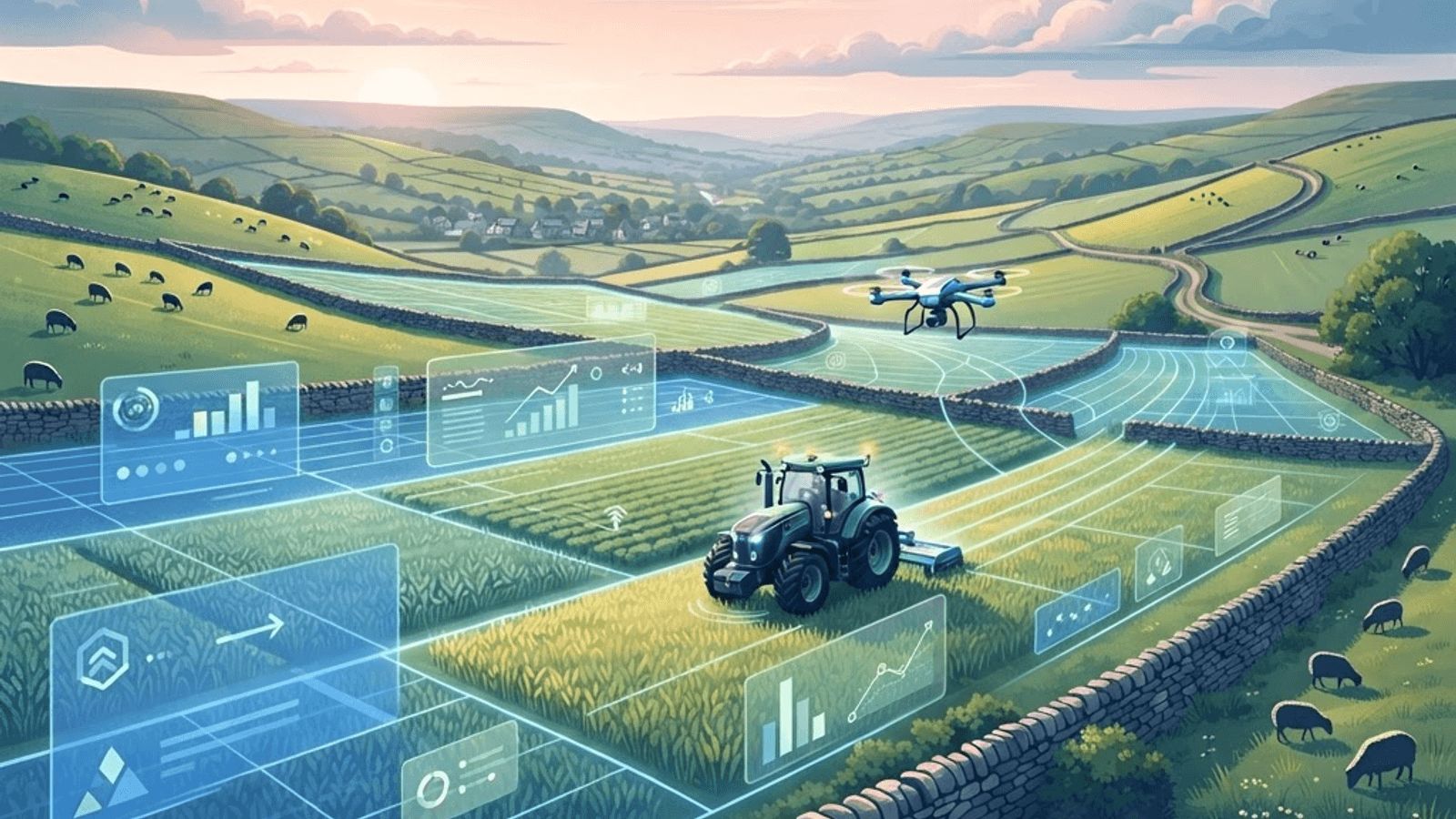
Precision agriculture has reached the Pennines, though in adapted form. Electronic identification of livestock enables detailed performance recording, allowing farmers to identify and cull underperforming animals with far more confidence than visual assessment permits. Grassland measurement, whether by plate meter or satellite imagery, supports rotational grazing decisions that meaningfully increase grass utilisation.
Drones assist with stock checking across difficult terrain, and remote water monitoring reduces daily travel to distant troughs. Farm management software has replaced paper records, which matters enormously given the documentation demands of modern assurance and environmental schemes.
Buying Local Farm Produce in Oldham
Residents wanting to support local agriculture have more options than ever. Farm shops, vegetable box schemes, community-supported agriculture memberships, farmers markets and direct meat box sales all shorten the chain between field and kitchen. Buying seasonally, choosing forage-fed meat and asking about provenance all help sustain the farms maintaining the borough's landscape.
That landscape connection is worth emphasising. The stone walls, hay meadows and grazed moorland that make Saddleworth and the Pennine fringe so valued for recreation exist because farming maintains them. Supporting these businesses is, in a very direct sense, investing in the countryside that residents enjoy.
Want your brand featured in front of decision-makers? Publish a guest post or get a link insertion in our guides through AAMAX's guest post and link insertion service.
Helpful Links
 SponsoredAAMAX — Full-Service Digital Agency
Write for Us
Share your expertise with our readers. We welcome guest contributions from industry specialists.
Pitch your idea