

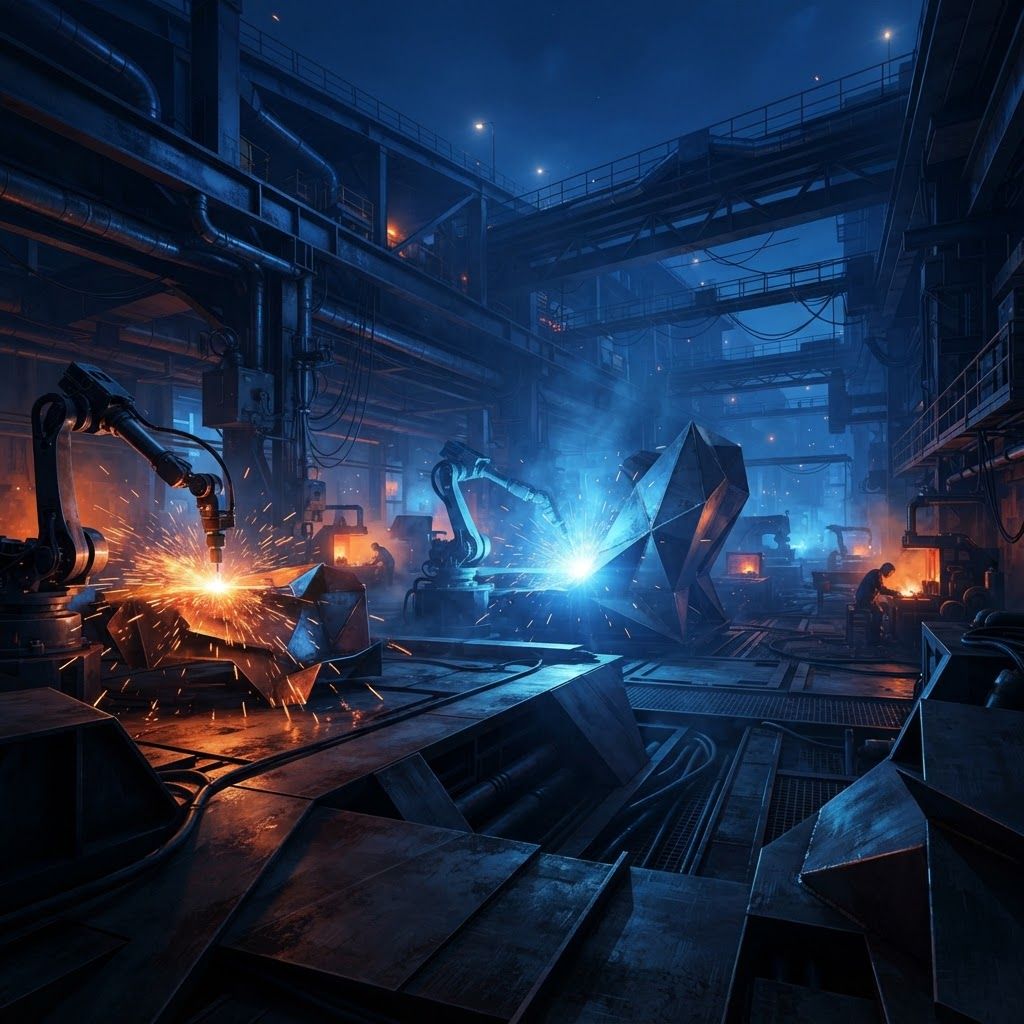
A Deep Engineering Heritage
Metalworking is woven into the industrial fabric of the West Midlands, and Wychavon shares fully in that inheritance. The district's engineering firms occupy units across Droitwich Spa, Evesham, Pershore and Honeybourne, supplying components and fabricated products into automotive, aerospace, food processing, agriculture, construction and general industry.
What characterises the local sector is technical capability at modest scale. These are rarely large plants; more often they are businesses of ten to a hundred people with serious equipment, long-standing customer relationships and skilled people who have spent careers in the trade.
The Range of Metalworking Capability
Precision machining covers CNC turning and milling, producing components to tight tolerance in steel, aluminium, stainless steel and specialist alloys. Multi-axis machining centres allow complex parts to be completed in single setups, improving accuracy and reducing cost.
Sheet metal fabrication involves laser or plasma cutting, CNC punching, press braking and welding to produce enclosures, panels, brackets and assemblies. Fibre laser cutting has transformed this segment, delivering speed and edge quality that older technologies could not approach.
Heavy fabrication and structural steelwork serves construction and industrial plant, requiring welding qualification, material certification and often CE or UKCA marking to execution class standards.
Architectural and decorative metalwork forms a distinct specialism, producing gates, railings, staircases, balustrades and bespoke features. The district's affluent property market and Cotswold-edge location support genuine demand for craft ironwork.
Supporting services include powder coating, galvanising, anodising, heat treatment and inspection, frequently provided by specialist businesses within reach.
Notable Metalworks Companies Serving the District
Precision machining companies across the Wychavon industrial estates supply turned and milled components to automotive, aerospace and hydraulic customers, many operating lights-out CNC production.
Sheet metal fabricators based around Droitwich and Evesham produce enclosures, guards, panels and assemblies with in-house laser cutting, forming and welding.
Stainless steel fabrication specialists serving the food industry manufacture hygienic tables, hoppers, conveyor frames and washdown equipment for the Vale's packhouses and processing plants.
Structural steelwork contractors operating in Worcestershire design, fabricate and erect frames for agricultural, industrial and commercial buildings across the district.
Agricultural engineering and fabrication workshops in the Vale of Evesham build and repair trailers, handling equipment and bespoke implements for growers and farmers.
Architectural metalwork and blacksmithing businesses in south Worcestershire produce bespoke gates, railings and interior features, combining traditional forging with modern fabrication.
Welding and on-site repair specialists across the district provide mobile services keeping production equipment and plant operational with minimal downtime.
Powder coating and surface finishing companies in the region apply durable protective and decorative finishes to fabricated products, often as part of a subcontract chain.
Toolmakers and press tool manufacturers in Worcestershire produce tooling, jigs and fixtures supporting volume manufacturing across the Midlands.
Metal stockholders with regional distribution supply bar, sheet, tube and section with cutting services, enabling fabricators to work without holding extensive inventory.
Technology Investment
Capital equipment defines what a metalworking business can do, and the pace of investment in the sector has been notable. Fibre laser cutting machines have replaced CO2 systems, offering higher speed on thin material and far lower running costs. Automated tower storage feeds sheet to the machine without operator intervention, enabling unmanned running.
Machining has seen similar advances, with multi-pallet systems, robotic part loading and in-process probing allowing extended unmanned operation. For UK manufacturers competing against lower-cost economies, automation is the principal route to viability.
Software integration has become equally important. CAD to CAM workflows, nesting optimisation that minimises material waste, and shop floor data capture that tracks job progress and machine utilisation all contribute to competitiveness.
Additive manufacturing in metal remains niche locally but is used by some for prototyping and complex low-volume parts.
Quality, Certification and Traceability
Customer expectations vary sharply by sector. General industrial work may require little beyond a dimensional check. Aerospace and defence demand AS9100 certification, full material traceability and detailed first article inspection reports. Food equipment fabrication requires appropriate stainless grades, hygienic weld finishing and documentation.
Structural steelwork carries specific obligations under the relevant execution class, including welder qualification, welding procedure specifications and factory production control certification. Buyers should verify these credentials rather than assume them.
Investment in coordinate measuring machines and inspection equipment distinguishes serious suppliers, providing objective verification rather than reliance on operator measurement.
Skills and the Workforce
The persistent challenge across the sector is skilled labour. Welders, machinists, setter-operators and fabricators are in short supply, and the demographic profile of the existing workforce means retirements will accelerate. Wychavon employers have responded by expanding apprenticeship programmes, partnering with colleges in Worcestershire and investing in training existing staff to operate new equipment.
The most successful businesses have built genuine progression routes, which retains people far more effectively than reactive pay increases.
Working With a Metalworks Supplier
Supply complete technical information including drawings with tolerances, material specification, finish requirements and any applicable standards. Ambiguity produces either questions that delay the job or assumptions that produce the wrong part.
Involve the fabricator early on design. Small changes to bend radii, hole positions or material choice can substantially reduce cost without affecting function, and experienced engineers will suggest these if given the opportunity.
Discuss volumes and repeat requirements honestly, as a supplier will approach a one-off prototype very differently from an ongoing annual schedule.
Outlook
Metalworking in Wychavon faces cost pressure and skills constraints, but demand across construction, food equipment, agriculture and industrial machinery remains solid. Businesses investing in automation, certification and training are demonstrating that UK metalworking can compete on capability, speed and reliability rather than price alone.
Want your brand featured in front of decision-makers? Publish a guest post or get a link insertion in our guides through AAMAX's guest post and link insertion service.
Helpful Links
 SponsoredAAMAX — Full-Service Digital Agency
Write for Us
Share your expertise with our readers. We welcome guest contributions from industry specialists.
Pitch your idea

