

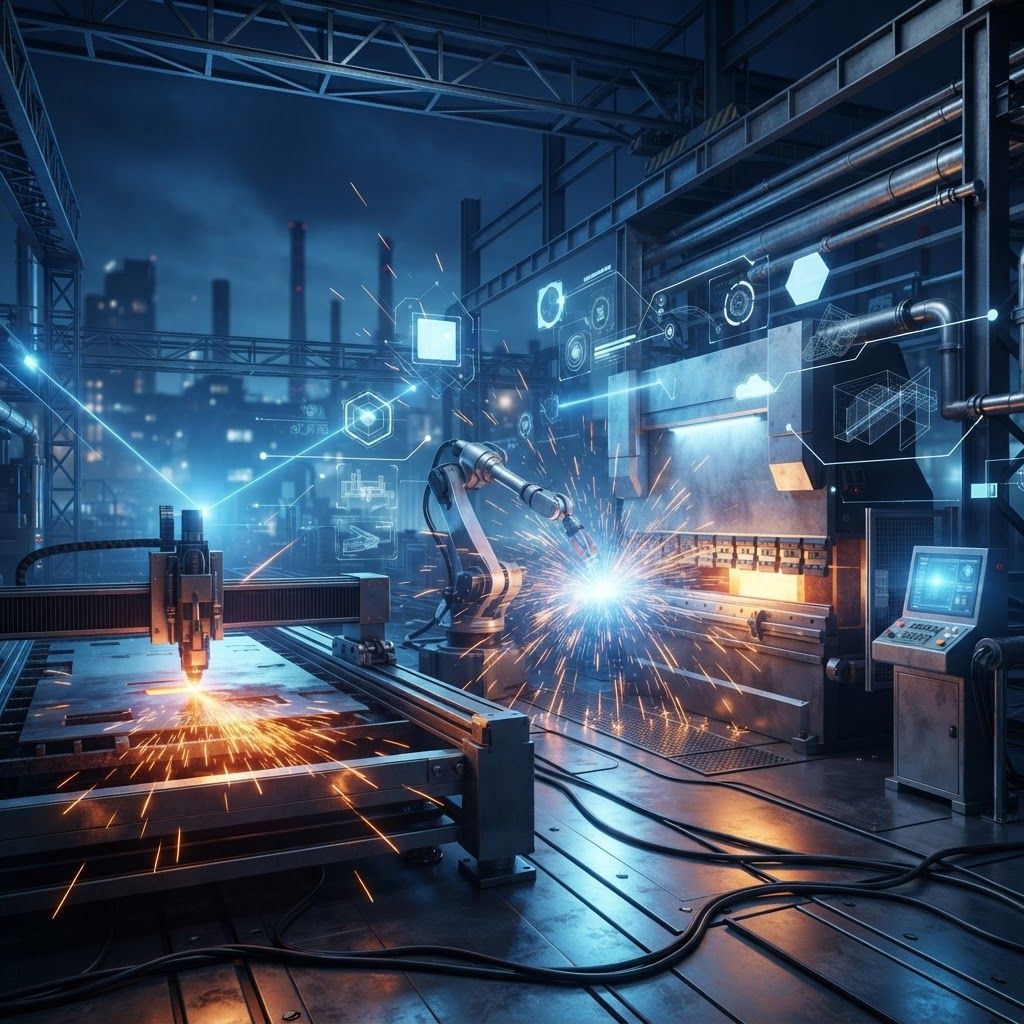
Metalworking in Dartford's Industrial Landscape
Metalworking is one of the oldest and most enduring trades in Dartford's industrial history, and it remains among the most vital. Every building, machine, vehicle and product depends at some point on metal cut, formed, joined or finished by skilled hands and capable equipment. The town's fabricators, machinists and metal finishers serve construction, manufacturing, transport, energy and infrastructure customers throughout the South East.
What distinguishes the modern metalworking sector from its predecessors is the integration of digital technology with traditional craft. Laser cutters driven by CAD files, press brakes with automatic tool changing, robotic welding cells and coordinate measuring machines sit alongside skilled welders, fitters and finishers whose judgement no software replaces.
Ten Metalworks Companies Leading the Trade
1. Darent Steel Fabrication produces structural steelwork for commercial, industrial and residential construction. Working from engineers' drawings, the company fabricates beams, columns, staircases and platforms with certified welding procedures and delivers to site ready for erection, supported by full traceability documentation.
2. Crayford Sheet Metal Works specialises in precision sheet metal fabrication, producing enclosures, panels, brackets and chassis. Laser cutting, CNC punching and press brake forming are supported by in-house powder coating, allowing complete finished assemblies to leave under one roof.
3. Thameside Architectural Metalwork creates balustrades, staircases, gates, canopies and decorative features. Architectural work demands aesthetic precision as well as structural integrity, with visible welds dressed to invisibility and finishes matched exactly across elements installed months apart.
4. Bluewater Precision Machining operates CNC turning and milling centres producing components to tight tolerances. Its inspection capability, including coordinate measurement with documented reports, serves customers in aerospace-adjacent, medical and instrumentation markets where dimensional evidence is mandatory.
5. Stone House Welding Services provides certified welding across mild steel, stainless steel and aluminium, including site welding and repair work. Holding qualified procedures and coded welders allows it to undertake work in regulated environments where uncertified welding is unacceptable.
6. Joyce Green Metal Finishing offers powder coating, wet spraying, galvanising coordination and passivation. Finishing determines corrosion resistance and appearance, and the company's pre-treatment discipline, often invisible in the finished product, is what makes coatings last in exposed conditions.
7. Temple Hill Stainless Fabrication focuses on stainless steel for food, pharmaceutical and laboratory environments. Hygienic fabrication requires continuous welds, radiused corners, avoidance of crevices and appropriate surface finishes, and the firm builds to those standards as routine.
8. Princes Road Heavy Engineering handles large fabrications, pressure vessels and heavy plate work. Capacity for large components, including craneage and appropriate rolling and bending equipment, distinguishes this end of the market from general fabrication.
9. Acacia Aluminium Systems works in aluminium extrusion and fabrication for glazing systems, framework and lightweight structures. Aluminium requires different welding techniques and handling from steel, and the company's specialisation avoids the quality problems that arise when generalists attempt it occasionally.
10. Hesketh Metal Spinning and Forming completes the list with metal spinning, rolling and specialist forming. These processes produce seamless conical and cylindrical shapes that would be costly to fabricate from flat plate, serving lighting, industrial and heritage restoration customers.
Technology Transforming Metalworking
Fibre laser cutting has been the most significant capability shift of the past decade, offering faster cutting, lower running costs and excellent edge quality on thin and medium gauge material. It has made complex profiles economically viable at low volumes, encouraging designers to consolidate multi-part assemblies into single cut-and-folded components.
Automation continues to expand. Robotic welding cells deliver consistency on repetitive assemblies, while automated bending systems reduce setup times. Rather than displacing skilled workers, these tools have generally redirected them toward setup, programming, quality control and the complex one-off work that automation cannot economically address.
Digital workflow matters increasingly. Customers supplying three-dimensional models rather than paper drawings enable direct programming, nesting optimisation and accurate quotation. Fabricators with strong digital capability quote faster and make fewer interpretation errors.
Understanding Quality in Metalwork
Quality in fabrication reveals itself in details. Weld appearance indicates control of heat input and technique, though appearance alone is insufficient for structural work, where procedure qualification and, where appropriate, non-destructive testing provide real assurance. Dimensional accuracy should be verified against drawings, particularly on assemblies that must interface with other trades.
Pre-treatment before coating is the most commonly neglected quality factor. Coatings applied over mill scale, grease or inadequately prepared surfaces fail prematurely regardless of the coating's own quality. Reputable finishers document their preparation process.
Material certification should accompany structural and regulated work, confirming grade and mechanical properties. Any fabricator hesitant to supply certification for such work should prompt caution.
Choosing a Metalworks Partner
Match the fabricator to the work. Precision sheet metal and heavy structural fabrication require quite different equipment, skills and mentalities, and few businesses excel at both. Review relevant certification for your application, particularly execution class requirements for structural steelwork.
Consider whether finishing is available in-house, since transferring work between fabricator and finisher adds time, cost and handling damage risk. Assess design support, as an experienced fabricator will suggest changes that reduce cutting time, eliminate secondary operations or improve assembly, often saving more than any price negotiation.
The Future of Dartford Metalworking
Skills succession remains the sector's greatest challenge, with experienced welders and fitters approaching retirement and apprentice recruitment competitive. The businesses investing seriously in training are securing their futures. Set against that, demand looks healthy: construction activity, infrastructure renewal, reshoring of manufacturing and the energy transition all generate metalwork. Dartford's fabricators, blending digital capability with genuine craft, are well placed to meet it.
Want your brand featured in front of decision-makers? Publish a guest post or get a link insertion in our guides through AAMAX's guest post and link insertion service.
Helpful Links
 SponsoredAAMAX — Full-Service Digital Agency
Write for Us
Share your expertise with our readers. We welcome guest contributions from industry specialists.
Pitch your idea

