

Metalworking and the Making of Industrial Basildon
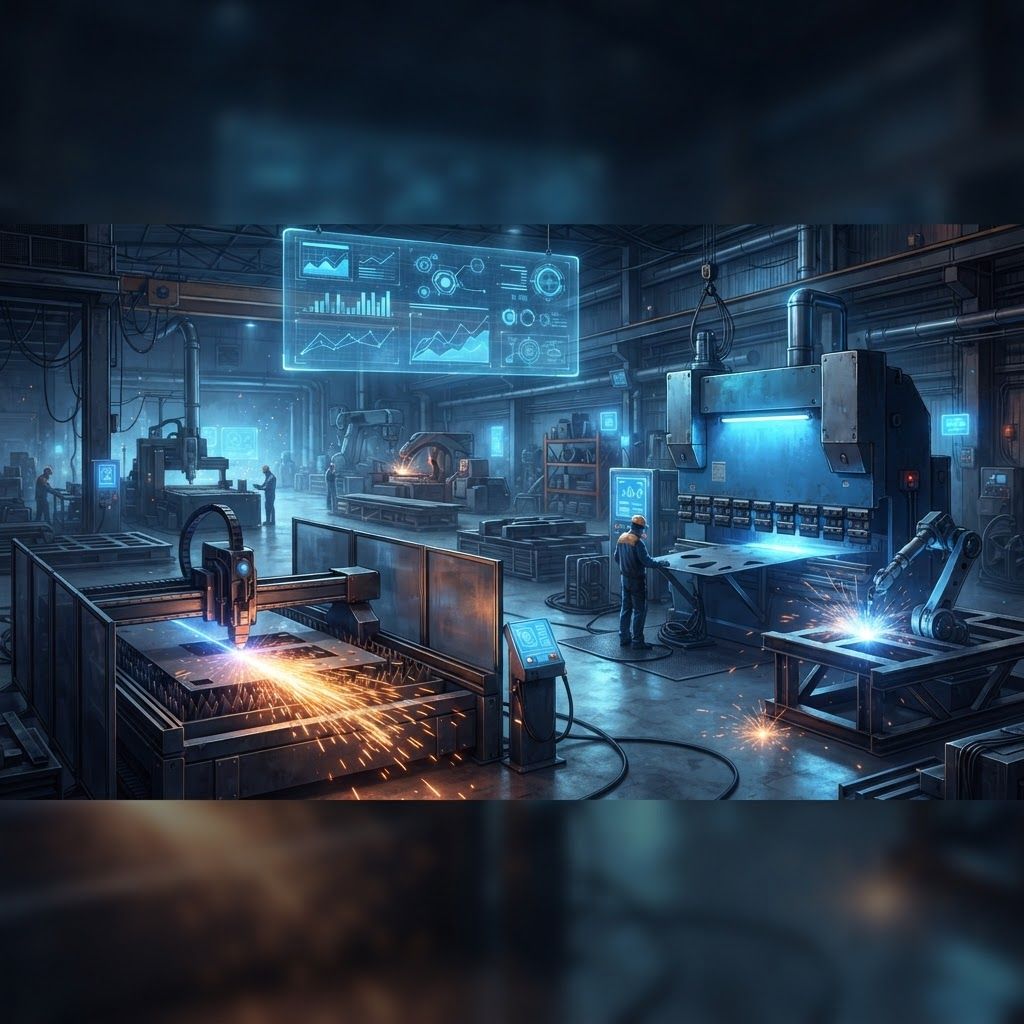
If any single industry defines Basildon's industrial character, it is metalworking. The town's growth was built on engineering, and metal fabrication, machining and welding remain among its most widely practised trades. Walk through the industrial estates at Burnt Mills, Christopher Martin Road or Cranes Farm and you will find everything from single-bay welding shops to substantial fabrication facilities equipped with laser cutters, press brakes and coordinate measuring machines.
This concentration creates real advantages for buyers. Competition keeps pricing keen, the density of specialists means unusual requirements can usually be met somewhere locally, and the informal networks between firms mean that a company lacking a particular capability will often know exactly who has it.
The Disciplines Within Metalworking
Structural fabrication produces beams, columns, staircases, balustrades and frameworks, typically in mild steel and to construction standards. Sheet metal work involves cutting, punching, folding and welding thinner gauge material into enclosures, panels, ductwork and brackets. Precision machining removes material to achieve tight tolerances on components. Welding and pipework fabrication covers pressure systems, process pipework and vessel work. Surface finishing includes galvanising, powder coating, anodising, plating and painting. Toolmaking and jig fabrication supports other manufacturing operations.
These are genuinely distinct skill sets, and a company excellent at heavy structural steel is not necessarily well suited to delicate stainless steel sheet work.
The Top 10 Metalworks Companies Serving Basildon
1. Estuary Steel Fabrication produces structural steelwork for construction and industrial projects, holding the execution class certification that specifiers require and offering site erection alongside workshop fabrication.
2. Basildon Sheet Metal Works operates laser cutting, CNC punching and press braking to produce enclosures, panels, chassis and brackets, with a reputation for accurate flat pattern development and clean welded finishes.
3. Thameside Precision Machining undertakes CNC turning and milling to tight tolerances in a wide range of metals, supported by a temperature-controlled inspection area and full dimensional reporting.
4. Nevendon Stainless Fabrication specialises in food-grade and hygienic stainless steel fabrication, producing tanks, hoppers, tables and pipework with the polished finishes and crevice-free welds those applications demand.
5. Pitsea Welding Services provides coded welding across a range of processes and materials, undertaking on-site structural repair, plant maintenance and pressure pipework with appropriate procedure qualification.
6. Laindon Architectural Metalwork manufactures balustrades, gates, canopies, railings and decorative metalwork, combining fabrication skill with the finish quality that visible architectural work requires.
7. Fryerns Powder Coating and Finishing offers shot blasting, powder coating and wet spray finishing, plus galvanising coordination, providing the protective and decorative finishing that fabricators depend upon.
8. Crouch Valley Tube Manipulation specialises in tube and pipe bending, end forming and fabricated tubular assemblies for handrails, roll structures, exhausts and machine frames.
9. Vange Heavy Engineering handles large fabrications, machine bases, hoppers and structural assemblies requiring substantial lifting capacity and heavy plate working capability.
10. Billericay Laser and Waterjet Cutting completes the list as a profiling specialist, cutting sheet and plate in metals and other materials for fabricators and manufacturers who need parts rather than complete assemblies.
Trends Reshaping the Metalworking Sector
Automation of cutting and forming has raised the baseline of achievable accuracy. Fibre laser cutting has largely displaced older technologies for thinner materials, offering faster cutting and better edge quality, while offline programming of press brakes reduces setup time dramatically and makes small batches economic.
Digital workflow integration is the second trend. Fabricators increasingly accept three-dimensional models directly, generating flat patterns, nesting programmes and bending sequences automatically. This reduces errors and shortens lead times, but it does require customers to supply clean, well-constructed models.
Skills succession is the sector's most serious long-term challenge. Experienced fabricators and machinists are retiring, and firms that have invested seriously in apprenticeships are the ones best placed for the next decade. It is a reasonable question to ask any prospective supplier.
How to Specify Fabrication Work Successfully
Provide proper drawings. A dimensioned drawing with tolerances, material specification, weld symbols, finish requirements and any critical features clearly identified will produce a better result and a more accurate price than a sketch or a verbal description. Where possible supply a three-dimensional model alongside the drawing.
Specify tolerances honestly. Demanding tight tolerances on every dimension increases cost substantially, so identify which features genuinely matter and allow reasonable general tolerances elsewhere. Good fabricators appreciate this and will price accordingly.
Address finishing at the outset. Galvanising affects dimensions and can distort thin sections, powder coating requires masking of threads and mating faces, and paint systems need appropriate surface preparation. Deciding on finish after fabrication has begun often means rework.
Discuss inspection and documentation. For structural or safety-critical work, weld procedure qualification, welder certification, material certificates and inspection records may be required, and these need to be agreed before production rather than requested afterwards.
Final Thoughts
Basildon's metalworks companies represent a remarkably deep pool of practical engineering capability. From a single bracket to a complete structural steel frame, from hygienic stainless vessels to architectural balustrades, the town's fabricators and machinists can deliver work to a high standard with the responsiveness that comes from being genuinely local. For anyone with a metal fabrication requirement in Essex or East London, the options here are hard to beat.
Want your brand featured in front of decision-makers? Publish a guest post or get a link insertion in our guides through AAMAX's guest post and link insertion service.
Helpful Links
 SponsoredAAMAX — Full-Service Digital Agency
Write for Us
Share your expertise with our readers. We welcome guest contributions from industry specialists.
Pitch your idea

