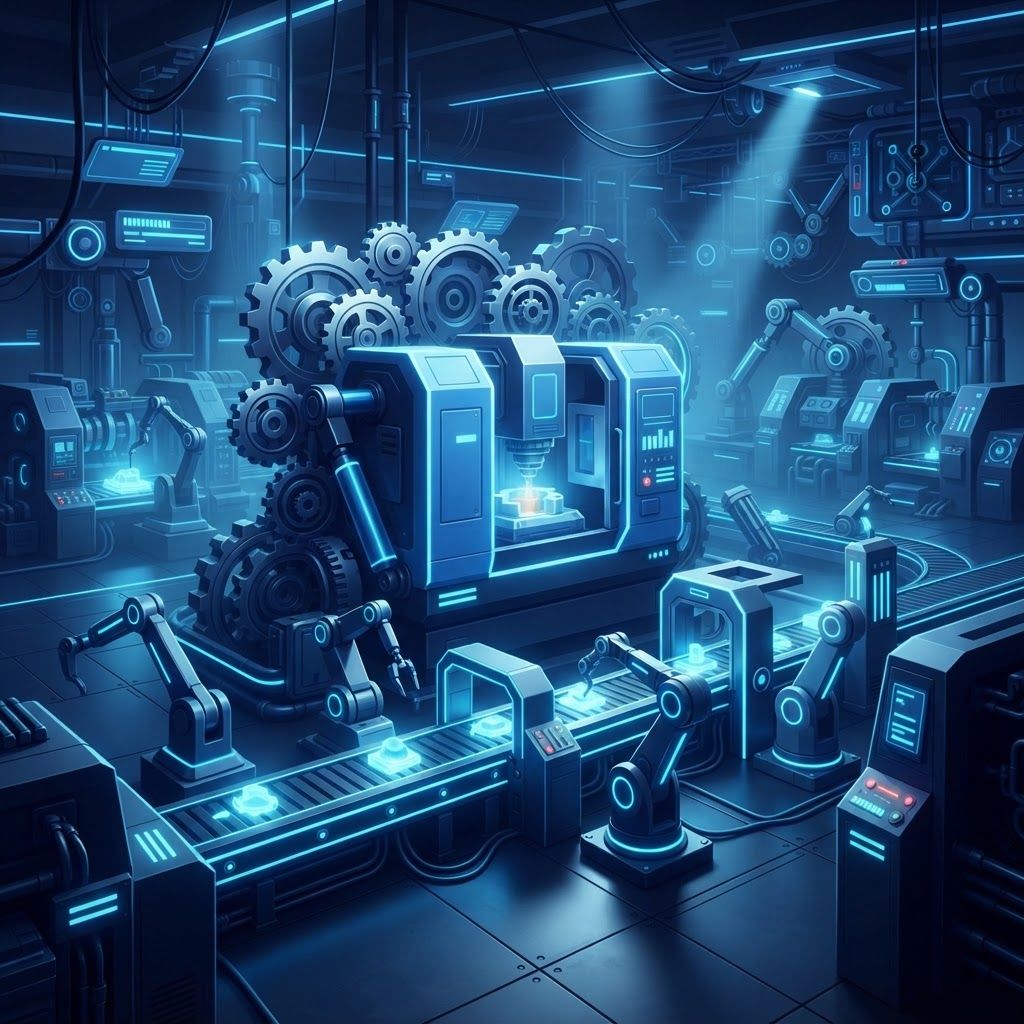
An Engineering Tradition
Machinery manufacture in the Stroud district began with the textile industry. The mills needed fulling stocks, carding engines, spinning frames and looms, and local foundries and machine shops grew up to supply them. When the woollen trade declined, that engineering capability found new markets in agricultural machinery, internal combustion engines, pumps, compressors and industrial equipment.
The result is a district with a disproportionate depth of mechanical engineering skill for its size. Machine shops, fabricators, designers and controls engineers operate from industrial estates at Stonehouse, Dudbridge, Brimscombe and Quedgeley, and from converted mill buildings throughout the valleys. Many are small and specialised, serving customers nationally and internationally from unassuming premises.
Notable Names in the District
The towering historical presence is R A Lister and Company of Dursley, whose stationary engines, generating sets and agricultural machinery were exported worldwide and made the name Lister synonymous with rugged reliability. Its successor Lister Petter continued diesel engine and generating set manufacture, and the engineering diaspora from these operations seeded numerous local businesses.
Renishaw, based at Wotton-under-Edge with Gloucestershire facilities, manufactures metrology systems, machine tool probes, encoders and additive manufacturing machines. It is among the most technically advanced machinery manufacturers in Britain, and its equipment is used in factories across the world.
Spirax Sarco, headquartered in nearby Cheltenham, is a global leader in steam system equipment, valves, traps and thermal energy management, with a substantial Gloucestershire engineering and manufacturing footprint.
Within Stroud itself and the surrounding valleys, a cluster of smaller specialists produces bespoke machinery: process equipment for food and beverage producers, conveying and handling systems, packaging machinery, test rigs, and automation cells. Firms offering CNC machining, sheet metal fabrication, welding and assembly work as both subcontractors and original equipment manufacturers. Names associated with the area include Delta Motion style motion control integrators, Cotswold Machinery Services and various independent engineering works with decades of continuous trading.
Agricultural machinery dealers and manufacturers serve the Severn Vale farming community, supporting brands such as John Deere, New Holland, Massey Ferguson and Kuhn, with local firms undertaking modification, refurbishment and bespoke implement fabrication.
What Local Machinery Builders Do
Bespoke special purpose machinery is the core competence. A food producer needing a machine to handle an unusual product, a laboratory requiring a custom test rig, or a manufacturer automating a manual process will typically commission a one-off design. This work demands close collaboration, mechanical design, electrical and control engineering, software, build and commissioning.
Subcontract machining and fabrication supports both these projects and external customers. Capabilities across the district include multi-axis CNC milling and turning, precision grinding, laser and waterjet cutting, press braking, TIG and MIG welding to coded standards, and assembly of complex mechanisms.
Service, refurbishment and spares form a substantial and often overlooked revenue stream. Many industrial machines run for thirty years or more, and keeping them operational requires reverse engineering obsolete parts, upgrading controls and retrofitting safety systems to current standards.
Industry Trends
Automation demand is strong and rising. Labour availability challenges have pushed manufacturers of all sizes to automate tasks previously done manually. Collaborative robots have lowered the entry barrier, allowing small firms to automate individual operations without redesigning entire production lines. Machinery builders in the district increasingly integrate robotics, vision systems and flexible feeding.
Industrial connectivity is transforming after-sales. Machines fitted with sensors and remote access allow builders to monitor performance, diagnose faults and often resolve issues without a site visit. Predictive maintenance, using vibration and thermal data to anticipate failure, is moving from aspiration to practice.
Energy efficiency has become a purchasing criterion. Rising industrial energy costs mean customers scrutinise consumption, and machinery designed with efficient drives, heat recovery and intelligent standby modes has a clear commercial advantage. Given Gloucestershire's expertise in steam and thermal systems, this is a natural regional strength.
Compliance requirements continue to develop, with machinery safety standards, functional safety assessment and CE or UKCA marking all requiring documented engineering effort. Competent builders treat this as integral to design rather than paperwork added at the end.
Selecting a Machinery Manufacturer
Define the requirement thoroughly before approaching suppliers. A clear user requirement specification covering throughput, product variants, footprint, utilities, operator interaction, cleaning regime and expected life will produce far better proposals than a vague brief. Good builders will help refine it.
Examine relevant experience. Ask to see machines they have built for similar applications and, where possible, to speak with those customers about reliability and support. A supplier who has solved a comparable problem before will deliver faster and with fewer surprises.
Clarify the commercial structure. Bespoke machinery projects commonly use staged payments against design approval, build milestones, factory acceptance testing and site acceptance. Understand what is included, particularly installation, operator training, documentation, spares packages and warranty terms.
Assess support capability honestly. A machine that is critical to production needs responsive service. Ask about engineer availability, typical response times, remote diagnostic capability and spares holding. Proximity matters, and a builder within an hour of your site has a practical advantage.
The Outlook
Machinery manufacture in the Stroud district is a quiet success story. It rarely makes headlines, but the combination of inherited mechanical skill, modern automation capability and world-class local exemplars in metrology and thermal engineering makes the area genuinely strong. For manufacturers anywhere in the South West needing custom equipment, automation or engineering support, the depth of talent available within the Five Valleys is worth exploring before looking further afield.
Want your brand featured in front of decision-makers? Publish a guest post or get a link insertion in our guides through AAMAX's guest post and link insertion service.
Helpful Links
 SponsoredAAMAX — Full-Service Digital Agency
Write for Us
Share your expertise with our readers. We welcome guest contributions from industry specialists.
Pitch your idea