Jewellery, Design and Dundee's Creative Identity
Dundee occupies an interesting position in Scottish jewellery. The city's UNESCO City of Design status and the presence of Duncan of Jordanstone College of Art and Design have sustained a genuine jewellery and silversmithing community, producing makers who work in the city rather than leaving for larger markets. V&A Dundee has strengthened this further, giving contemporary craft a prominent platform and drawing visitors interested in design-led objects.
The result is a jewellery market with an unusual balance. Alongside national retail chains and established family jewellers sit independent studios and designer-makers producing distinctive contemporary work, often drawing on Scottish material and motif traditions without slipping into tourist pastiche. For buyers, this means genuine choice between recognisable brands and pieces that are effectively unique.
Scottish Jewellery Traditions
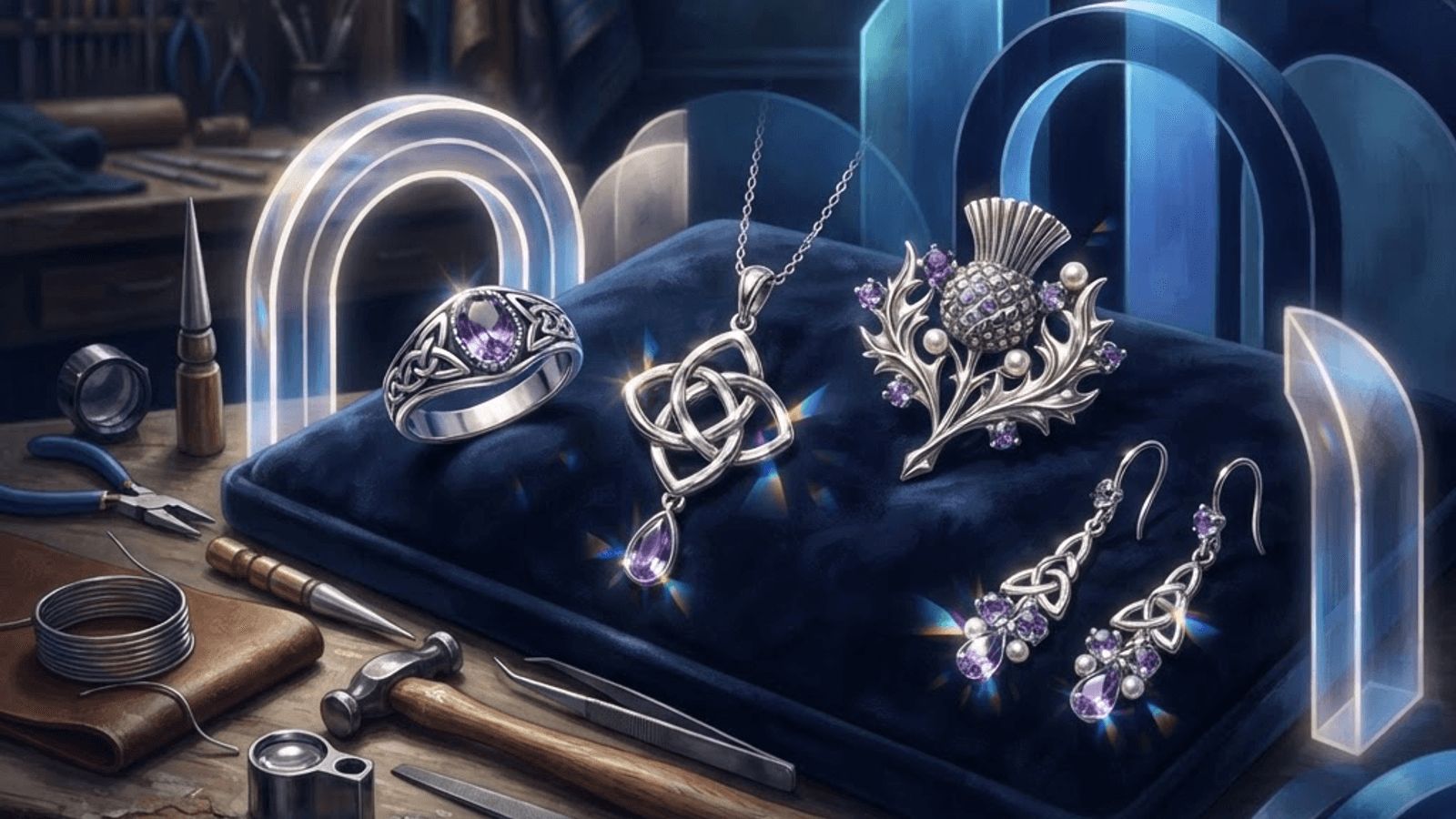
Scottish jewellery carries several distinct traditions worth understanding. Celtic knotwork designs, drawn from early medieval metalwork and manuscript illumination, remain enduringly popular and carry symbolic associations with continuity and connection. Thistle motifs reference national identity directly. Luckenbooth brooches, heart-shaped designs historically given as tokens of affection, have a specifically Scottish history.
Material traditions matter equally. Scottish agate and river pearls featured in Victorian Scottish jewellery. Silver has been worked in Scotland for centuries, with Edinburgh and Glasgow historically holding assay offices. Contemporary Scottish makers frequently reinterpret these traditions in modern forms, producing work that reads as current design rather than historical reproduction.
Leading Jewellery Brands Serving Dundee
Ortak is among the most recognised Scottish jewellery brands, producing silver and gold pieces drawing on Celtic, Norse and Scottish natural motifs. Its work is widely stocked across Scotland and offers accessible entry to Scottish design tradition with reliable manufacturing quality.
Sheila Fleet produces enamelled silver and gold jewellery inspired by Orkney landscape and light, and the distinctive colour work has built a strong following throughout Scotland. Pieces of this kind appeal to buyers wanting Scottish provenance combined with genuinely individual visual character.
Hamilton and Inches represents the premium end of Scottish jewellery retail, with a long-established reputation for fine jewellery, watches and silverware. For significant purchases including engagement rings and heirloom pieces, established jewellers of this calibre provide the expertise and after-sales service that major purchases warrant.
Beaverbrooks serves the mainstream fine jewellery market with diamond jewellery, bridal ranges and branded watches. Its strength lies in staff training, clear certification practice and structured guarantee arrangements, which matter considerably for customers making an unfamiliar high-value purchase.
Pandora maintains strong presence in the Overgate and elsewhere, and its charm bracelet model has genuine appeal as a gifting mechanism that builds over years. The commercial insight is that customers return repeatedly to add pieces, creating an unusually durable customer relationship.
Thomas Sabo occupies similar territory with a design language distinct from Pandora, appealing to buyers wanting collectible contemporary jewellery at accessible price points with reliable quality standards.
Kiltane and Scottish heritage retailers in the city stock jewellery alongside knitwear and tartan, serving both local buyers and visitors seeking Scottish pieces with clear provenance. Quality varies considerably in this segment, making retailer reputation important.
Independent Dundee jewellery studios and designer-makers represent the most distinctive part of the local scene. Working in silver, gold and mixed materials, these makers produce limited runs and commissioned pieces, offering direct consultation with the person who will actually make the jewellery. For engagement rings and commemorative pieces, this route often produces better results than retail selection.
Established family jewellers in Dundee city centre provide the services that transactional retail does not, including repairs, resizing, restringing, valuation and remodelling of inherited pieces. This expertise is genuinely scarce and worth supporting, since a competent bench jeweller can transform unworn inherited jewellery into something worn daily.
Vintage and antique jewellery dealers across the city and wider Tayside offer pieces with genuine history, frequently at better value than equivalent new items and with the environmental advantage of requiring no new mining. Victorian and Art Deco pieces in particular offer craftsmanship difficult to obtain at comparable prices today.
Hallmarks and What They Tell You
British hallmarking provides genuinely useful consumer protection, and understanding it prevents costly mistakes. Precious metal articles above prescribed weights must carry a hallmark applied by an assay office, indicating the metal's fineness, the sponsor who submitted it and the office that tested it. A date letter is often included.
Practically, this means a buyer can verify metal content independently rather than relying on a seller's claim. Items described as silver or gold without appropriate hallmarking should prompt questions. Retailers are required to display a dealer's notice explaining hallmarks, and any jeweller unable or unwilling to explain the marks on a piece is not one to buy from.
Diamonds, Gemstones and Certification
Diamond buying benefits enormously from understanding the four characteristics that determine value, namely carat weight, colour, clarity and cut. Of these, cut quality has the greatest effect on how a stone actually looks, since a well-cut stone returns light brilliantly while a poorly cut stone appears dull regardless of its other qualities.
Independent certification from a recognised laboratory provides objective assessment, and any significant diamond purchase should include it. Laboratory-grown diamonds have become a substantial part of the market, chemically identical to mined stones but considerably less expensive, allowing larger stones within a given budget. They must be disclosed clearly, and reputable jewellers do so without hesitation. Coloured gemstone buyers should ask specifically about treatments, since heating, oiling and dyeing are common and materially affect value.
Ethical Sourcing and Sustainability
Provenance questions have become routine in jewellery buying, particularly among younger customers. Recycled gold and silver now feature prominently, offering identical material quality without new mining impact. Fairmined and Fairtrade gold certification addresses labour conditions in artisanal mining. The Kimberley Process governs rough diamond trade, though buyers seeking stronger assurance often prefer laboratory-grown stones or certified recycled material.
Independent makers frequently lead here, since small-scale production allows genuine supply chain knowledge that larger operations struggle to achieve. Many Dundee designer-makers work primarily in recycled precious metal and can state exactly where their materials came from.
Buying Well: Practical Guidance
Set a budget before shopping and treat it firmly, since jewellery selling is skilled at incremental escalation. Prioritise cut quality over carat weight in diamonds. Check hallmarks and ask for certification on significant stones. Consider commissioning from a local maker for meaningful pieces, since the cost is often comparable to retail while the result is individual.
Ask about after-sales service including resizing, rhodium replating for white gold, stone tightening and cleaning, since these determine how a piece ages. Insure valuable jewellery and obtain a proper valuation. Finally, consider vintage and antique options, which frequently offer superior craftsmanship at better prices.
Final Thoughts
Dundee's jewellery market benefits genuinely from the city's design culture, combining recognised Scottish brands, established fine jewellery retail, mainstream collectible ranges and an unusually strong independent maker community. Buyers who understand hallmarking, insist on certification for significant stones and consider commissioning local makers get both better value and more meaningful pieces. In a city that has built its modern identity around design, choosing jewellery made locally has a particular appropriateness.
Want your brand featured in front of decision-makers? Publish a guest post or get a link insertion in our guides through AAMAX's guest post and link insertion service.
Helpful Links
 SponsoredAAMAX — Full-Service Digital Agency
Write for Us
Share your expertise with our readers. We welcome guest contributions from industry specialists.
Pitch your idea