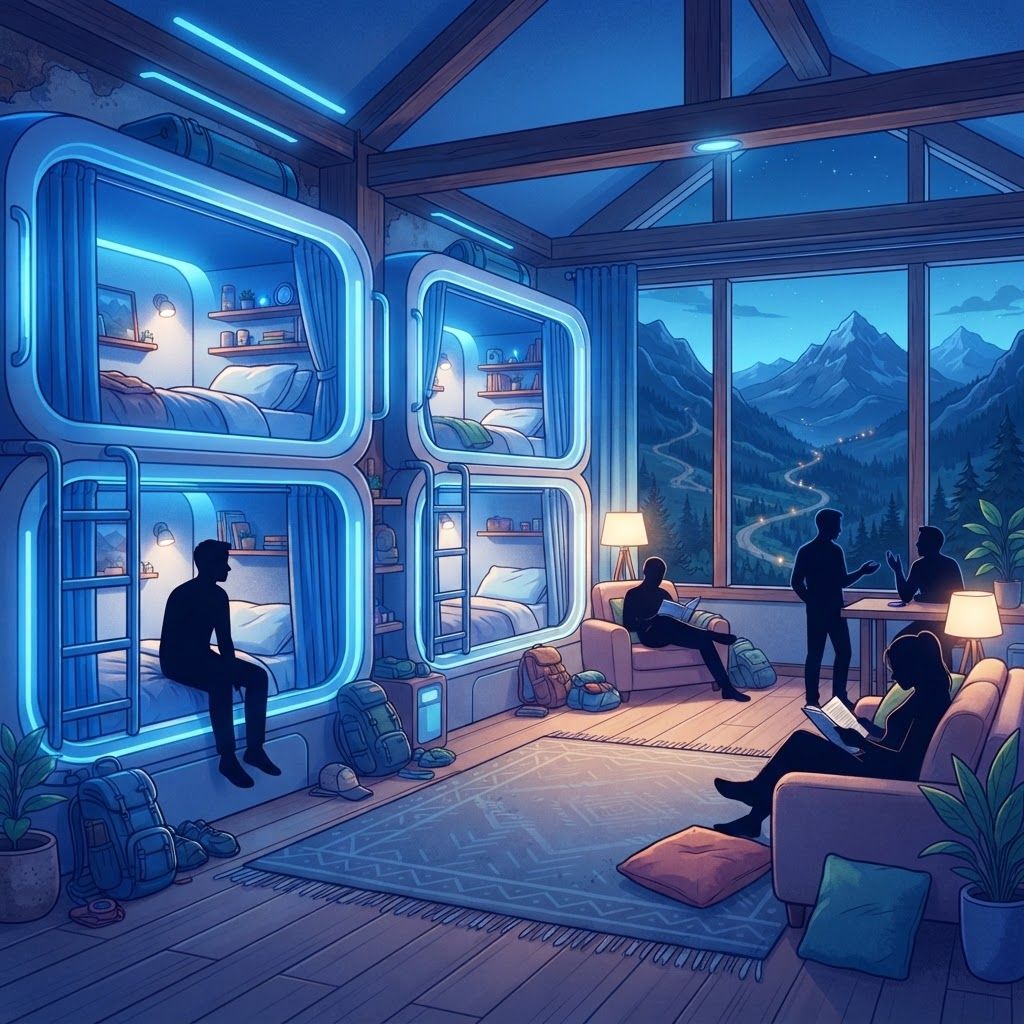
Why Powys Is Hostel Country
Hostels exist where people walk, climb, cycle and travel on a budget, and Powys has all of those in abundance. The county sits astride some of Britain's most significant long-distance routes, including Offa's Dyke Path along its eastern border, the Wye Valley Walk, Glyndwr's Way through its heart, the Beacons Way across the south and the Trans Cambrian Way for mountain bikers. Each of these generates steady demand for inexpensive, sociable, no-frills accommodation.
Add to that the Bannau Brycheiniog national park, an outdoor education sector that brings thousands of school and youth groups to the region each year, Duke of Edinburgh's Award expeditions using the Beacons as training ground, and a strong club culture among cavers, climbers and paddlers, and the result is a dense and varied network of hostels, bunkhouses, camping barns and group centres.
Understanding the Different Types
Before choosing, it helps to understand the distinctions, because the terms are used loosely.
Youth hostels in the traditional sense offer dormitories and private rooms, self-catering kitchens, communal lounges, staffed reception and often meals. They accept individuals, families and groups and are generally the most comfortable option.
Independent hostels operate similarly but without national network membership, and they range from highly polished boutique properties to genuinely basic accommodation.
Bunkhouses are usually simpler: bunk-bedded rooms, a kitchen, drying room and shower block, often converted from farm buildings and frequently available for sole use by a group.
Camping barns are the most basic tier, offering shelter, a sleeping platform and minimal facilities, aimed at walkers carrying their own sleeping bags and stoves.
Group activity centres combine accommodation with instruction, catering and equipment, serving schools, youth organisations and corporate teams.
Ten Hostel Options Worth Knowing
1. Youth hostels in the central Brecon Beacons. The area around Libanus, Brecon and the Storey Arms corridor contains the county's flagship budget accommodation, positioned for the ascent of Pen y Fan and Corn Du. These properties fill quickly in summer and at weekends year-round.
2. Llwyn-y-Celyn and the A470 corridor hostels. Set within the national park on the main north-south route, these provide the easiest access in the county for travellers without a car, since bus services follow the same corridor.
3. Llangorse Lake area bunkhouses. Serving watersports, climbing and riding, accommodation here is geared to activity groups and frequently attached to instruction providers with their own equipment and qualified staff.
4. Farm bunkhouses in the Black Mountains. Converted stone barns on working hill farms around Talgarth, Llanigon and the eastern escarpment. Simple, warm, exceptionally well placed for Offa's Dyke Path, and often run by families who have farmed the land for generations.
5. Hay-on-Wye budget accommodation. The book town supports hostel-style and shared accommodation that becomes intensely busy during the festival and remains a reliable stopover for long-distance walkers the rest of the year.
6. Elan Valley and Rhayader bunkhouses. Serving mountain bikers on the Trans Cambrian Way, walkers, and increasingly astronomy visitors drawn by the International Dark Sky Park. Facilities emphasise secure bike storage, drying space and early breakfasts.
7. Cambrian Mountains hostels around Llanidloes and Llangurig. Positioned on Glyndwr's Way and the Severn Way, these offer genuine remoteness at very low cost, and are among the quietest places to stay anywhere in Wales.
8. Lake Vyrnwy and Berwyn range bunkhouses. Northern Powys accommodation serving forest trails, the Pistyll Rhaeadr waterfall and the wild Berwyn moorland, popular with cycling clubs and walking groups.
9. Caving club huts and bunkhouses in the upper Swansea Valley. A specialist but important category, providing accommodation close to the major cave systems. Some are club-owned and available to visiting groups by arrangement, and facilities are designed around getting very muddy people clean.
10. Outdoor education and activity centres countywide. Residential centres offering full-board accommodation with instructed activity programmes, used heavily by schools, scouting and guiding groups, and adult clubs booking sole use.
What to Look For
Drying facilities are the single most important feature in Welsh upland hostels. A proper heated drying room transforms a wet week of walking. Kitchen quality is next: enough hobs, pans and fridge space for the number of beds matters enormously when a full hostel cooks at the same time.
Check whether the property is staffed or self-access with a key code, and whether it operates sole-use bookings that could mean your dates are unavailable to individuals. Confirm whether bedding is provided or whether you need a sleeping bag, since practice varies widely between youth hostels and camping barns.
For groups, ask about safeguarding policies, fire risk assessments, first aid provision and whether the operator holds relevant activity licensing if instruction is included.
Costs and Value
Hostel accommodation in Powys remains among the best value in Britain. A dormitory bed costs a small fraction of a hotel room, private rooms in hostels undercut budget hotels comfortably, and camping barns are cheaper still. Sole-use bookings of a bunkhouse for a group of twelve to twenty often work out remarkably economical per person, which is why club and family reunion bookings are so common.
Getting There Without a Car
This is where Powys hostels distinguish themselves. Several are deliberately located near bus routes along the A470 and A483, near stations on the Heart of Wales and Cambrian lines, or directly on long-distance paths. Walkers arriving on foot are the original hostel clientele and remain well served, though it is always worth confirming the last realistic arrival time and whether an evening meal or shop is accessible.
Seasonality and Etiquette
Summer weekends, school holidays, the Duke of Edinburgh's Award expedition season in spring and early summer, and festival periods are the busiest times. Winter is quiet, with some smaller properties closing or operating group-only bookings.
Hostel etiquette still matters: respect quiet hours, clean up in shared kitchens, use the drying room rather than the dormitory radiator, and pack considerately if leaving before dawn for a summit sunrise.
The Value of the Network
Powys hostels are not simply cheap beds. They are the infrastructure that makes the county's landscape accessible to people of every income, and the social character of a shared kitchen after a hard day on the hills is a genuine part of the experience. For walkers, cyclists, cavers, families and groups, they remain the smartest way to spend time in mid Wales.
Want your brand featured in front of decision-makers? Publish a guest post or get a link insertion in our guides through AAMAX's guest post and link insertion service.
Helpful Links
 SponsoredAAMAX — Full-Service Digital Agency
Write for Us
Share your expertise with our readers. We welcome guest contributions from industry specialists.
Pitch your idea