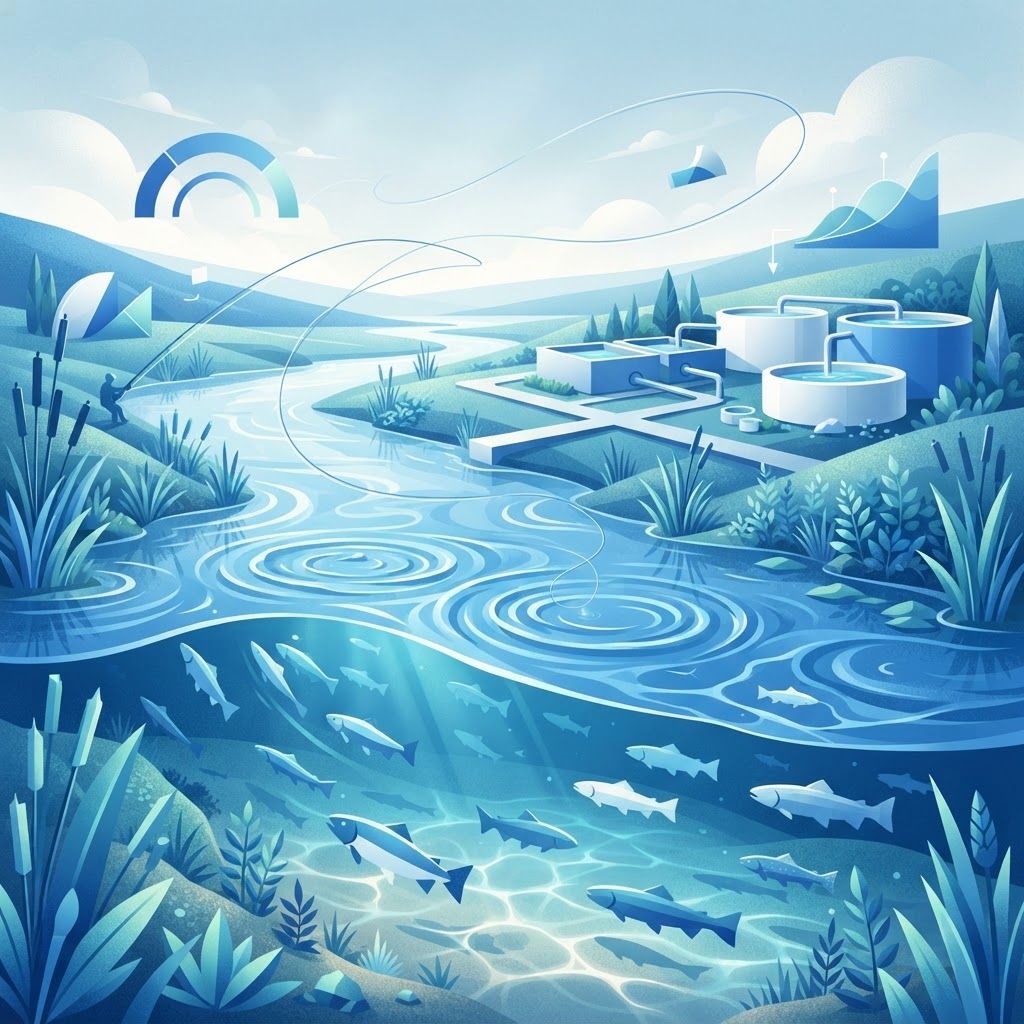
The River Test: A Fishery Landscape Like No Other
Few rivers carry the reputation of the Test. Fed by the Hampshire chalk aquifer, it runs clear, cool and remarkably stable in temperature and flow, producing the invertebrate life that supports exceptional wild brown trout and, in its lower reaches, migratory salmon and sea trout. Dry fly fishing as a discipline was substantially developed on this water, and anglers travel internationally to fish beats that have been managed continuously for well over a century.
That reputation supports a genuine local economy. Fishery businesses in Test Valley span syndicate and day-ticket angling, river keepering and habitat management, trout farming and aquaculture, smokehouses and processing, tackle and guiding, and increasingly ecological consultancy. Many combine several of these activities, because a chalk stream fishery is as much a land and water management operation as a sporting one.
The Issues Defining the Sector
Water quality and abstraction dominate every conversation. Chalk streams depend on groundwater, and the aquifer is also a public water supply. Reduced flows during dry periods concentrate nutrients and raise temperatures, which stresses fish and invertebrates. Nutrient enrichment from agriculture and wastewater, along with fine sediment smothering gravel spawning beds, are the principal ecological pressures. Fishery businesses now spend substantial time and money on catchment-scale mitigation rather than simply managing their own banks.
Habitat restoration has become a core discipline. Narrowing over-wide channels to increase flow velocity, introducing large woody debris, gravel cleaning and reintroduction, bank re-profiling and controlling invasive species all improve spawning success and invertebrate abundance. Much of this work is funded through partnerships between fisheries, rivers trusts, water companies and environmental schemes.
Wild fish management has shifted markedly. Many beats have reduced or ended stocking in favour of managing for self-sustaining wild populations, with catch-and-release, barbless hooks and careful handling as standard. It is a slower route to good fishing but a more durable one.
On the aquaculture side, the borough's spring-fed trout farms benefit from exceptionally clean, constant-temperature water, producing fish of a quality that supports premium smoked and fresh markets.
Ten Fishery Companies in Test Valley
1. Test Valley Fisheries. Manages multiple beats offering syndicate memberships and day tickets for wild brown trout. Employs full-time river keepers and runs an active habitat programme including gravel restoration and woody debris introduction.
2. Chalkstream Trout Farm. Spring-fed aquaculture producing rainbow and brown trout for the table and for stocking still waters. Low stocking densities and constant clean water produce firm, clean-flavoured fish sold fresh and smoked.
3. Stockbridge Angling Estates. Historic beats with long-established keepering traditions, offering rods on a seasonal basis alongside accommodation and guiding. Strong emphasis on traditional dry fly etiquette and careful fish handling.
4. Anton River Management. A river keepering and habitat consultancy working for private owners, syndicates and conservation bodies. Weed management, bank restoration, invasive species control and ecological survey work.
5. Romsey Smokehouse & Fish Processing. Cold and hot smoking of locally farmed trout and other species, supplying delicatessens, farm shops and restaurants. Traditional smoking methods with full traceability back to the producing farm.
6. Wherwell Fly Fishing School. Casting instruction, entomology and river craft tuition for beginners and improvers, plus guided days on the Test. Qualified instructors and an emphasis on conservation-minded angling from the outset.
7. Longstock Water Gardens Fishery. Combines managed still water and river fishing with habitat-rich planted margins. Popular with anglers wanting varied water and with visitors interested in the wider aquatic ecology.
8. Nursling Sea Trout Beats. Lower river beats fishing for migratory sea trout and salmon, with an active interest in fish passage improvement and monitoring of migratory runs.
9. Broughton Aquaculture Supplies. Supplies hatchery equipment, aeration, feed, netting and water quality monitoring to fish farms and fisheries. A support business without which much of the sector would struggle.
10. Mottisfont Riverine Conservation. A conservation-focused organisation undertaking restoration projects, invertebrate and fish population monitoring, and education work with schools and community groups along the catchment.
Advice for Anglers and Fishery Owners
Book early and match the beat to your ability. Test beats are limited in number and the best rods are taken well in advance. Some water demands accurate presentation to visible fish in gin-clear conditions, which is humbling for a newcomer. A guided day first is money well spent and will make subsequent visits far more productive.
Respect the local conventions. Upstream dry fly rules apply on much of the river, barbless hooks are widely required, and wading is often restricted or prohibited to protect gravel beds. These rules exist for ecological reasons, not merely tradition.
Handle fish properly. Keep them in the water, use wet hands or a knotless net, minimise air exposure and allow full recovery before release. In warm, low-flow conditions, consider whether fishing at all is appropriate, as stressed fish recover poorly from capture at high water temperatures.
For fishery owners, invest in habitat before stock. A river with clean gravel, good flow diversity, marginal cover and abundant invertebrates will produce better fishing at lower ongoing cost than repeated stocking into degraded habitat. Work with the catchment partnerships, because water quality problems originating upstream cannot be solved within your own boundaries.
The Outlook for the Test
Chalk streams are globally rare, with the majority found in southern England, which places a particular responsibility on those managing them. The pressures are real, but so is the response: restoration funding has increased, catchment partnerships are more effective, and public awareness of chalk stream ecology is far higher than a decade ago. For Test Valley, fisheries are not just sporting businesses but custodians of an internationally significant habitat, and the companies leading on habitat restoration and wild fish management are shaping the river's next century.
Want your brand featured in front of decision-makers? Publish a guest post or get a link insertion in our guides through AAMAX's guest post and link insertion service.
Helpful Links
 SponsoredAAMAX — Full-Service Digital Agency
Write for Us
Share your expertise with our readers. We welcome guest contributions from industry specialists.
Pitch your idea