

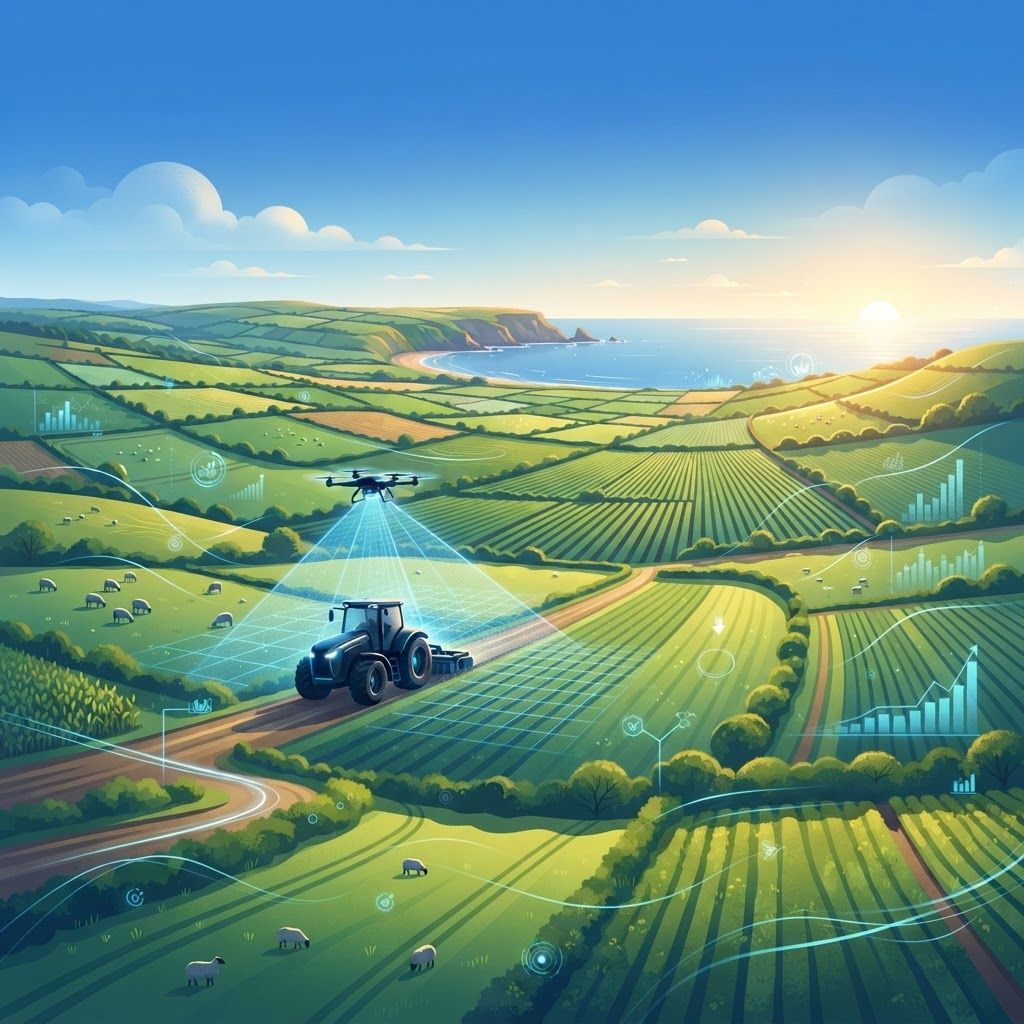
The Agricultural Heart of South Wales
The Vale of Glamorgan is often described as the garden of Wales, and the description is well earned. Unlike much of the country, where thin upland soils and high rainfall restrict farming to livestock grazing, the Vale enjoys relatively gentle topography, fertile loams over limestone and a comparatively mild, dry climate moderated by the Bristol Channel. The result is one of the few parts of Wales capable of sustained arable production alongside productive dairy and livestock enterprises.
This agricultural character defines the landscape between Cardiff and Bridgend. Fields of wheat, barley and oilseed sit alongside grazing pasture, orchards and increasingly horticultural production. Farms range from substantial commercial arable operations to family livestock holdings, diversified estates and small-scale growers supplying local markets. Together they form a rural economy that supports processing, machinery, veterinary, feed and haulage businesses throughout the county.
The Main Farming Enterprises in the Vale
Arable farming is more prominent here than anywhere else in Wales. Winter wheat, barley, oats and oilseed rape are the principal crops, with some maize grown for forage. Yields compare favourably with English arable regions, and proximity to Welsh feed mills and processors provides a local market.
Dairy farming remains a cornerstone. The Vale's grass growing conditions support both grazing-based and higher-input systems, and Welsh milk feeds a substantial processing sector producing cheese, butter and liquid milk. Herd sizes have grown over time as margins have tightened, with significant investment in parlour technology and grassland management.
Beef and sheep production occupies the less intensively cropped land, particularly towards the coast and on heavier soils. Welsh lamb and beef enjoy protected designation status, which supports premium positioning in domestic and export markets.
Horticulture has expanded considerably, driven by consumer interest in local food. Vegetable growing, soft fruit, salad crops and increasingly protected cropping under polytunnels supply farm shops, box schemes and independent retailers. Finally, diversification enterprises including farm shops, holiday accommodation, events venues, equestrian facilities and renewable energy now contribute substantially to farm incomes.
Ten Farming Companies Across the Vale
Glamorgan Arable Farms operates substantial cereal and oilseed cropping, applying precision agronomy and variable rate application across its acreage.
Vale Dairy Enterprises runs a grass-based dairy system with rotational grazing and investment in herd genetics and milk quality.
Coastal Livestock Company produces beef and lamb on coastal grassland, with an emphasis on native breeds suited to the conditions.
Cowbridge Mixed Farming combines arable rotation with livestock, using integrated systems that improve soil health and spread market risk.
Llantwit Horticultural Growers supplies vegetables and salad crops to farm shops, box schemes and local restaurants throughout the growing season.
Barry Vale Poultry produces free range eggs and poultry for regional retailers and wholesalers.
Severn Soft Fruit Farms grows strawberries, raspberries and other soft fruit under protection, extending the Welsh season considerably.
Rhoose Organic Farming Company operates certified organic production across arable and livestock, supplying the organic supply chain.
Penarth Estate Farming manages diversified land including cropping, grazing, woodland and renewable energy generation.
Dinas Powys Regenerative Agriculture completes the list, applying cover cropping, reduced tillage and rotational grazing to rebuild soil carbon and biodiversity.
Policy Change and Farm Support
Welsh agriculture is undergoing the most significant policy transition in decades. The shift away from area-based direct payments towards support linked to environmental outcomes and sustainable land management represents a fundamental change in farm economics. Payments increasingly reward habitat creation, tree planting, soil management, water quality protection and carbon storage rather than simply land occupation.
For Vale farmers this creates both challenge and opportunity. Productive arable and dairy businesses that received substantial area payments face income restructuring, while farms with scope to deliver environmental outcomes alongside production may find new revenue streams. Woodland creation targets, habitat connectivity and water catchment management all feature prominently.
Practical adaptation is already visible. Many farms have undertaken carbon audits, established field margins and buffer strips, planted hedgerows and trees, and reviewed nutrient management planning. Regulations on nutrient application, particularly in relation to water quality, have required investment in slurry storage and spreading equipment across the dairy sector.
Technology and Modern Farming Practice
Precision agriculture has moved from novelty to standard practice on larger holdings. Satellite guidance reduces overlap on field operations, saving fuel and inputs. Variable rate application adjusts fertiliser and seed according to soil mapping and crop sensing, improving efficiency and reducing runoff. Yield mapping provides field-level data that informs future decisions.
Livestock technology has advanced similarly. Electronic identification, automated weighing, health monitoring collars and robotic milking systems improve both animal welfare and labour efficiency. For dairy farms facing persistent labour shortages, automation has become a practical necessity rather than a luxury.
Soil health has emerged as a central theme. Reduced tillage, cover cropping, diverse rotations and organic matter building improve water infiltration, reduce erosion and cut fuel use. Given the Vale's exposure to both drought and heavy rainfall events, resilient soils have real commercial value.
Renewable energy and on-farm diversification continue expanding, with solar arrays, anaerobic digestion and biomass contributing income and reducing energy costs.
Markets, Provenance and Direct Selling
Welsh food provenance has genuine market value. Protected designations for Welsh lamb and beef, along with strong national branding, support premium positioning. Locally, farm shops, farmers markets, box schemes and direct online sales have grown substantially, allowing producers to capture more of the retail value.
Proximity to Cardiff is a major advantage for direct selling. A farm near Cowbridge or Llantwit Major can reach a large urban population within half an hour, making farm shops, pick-your-own operations and delivery schemes commercially viable in a way they would not be in more remote parts of Wales.
Final Thoughts
Farming in the Vale of Glamorgan combines favourable natural conditions, productive enterprises and increasing sophistication in both technology and environmental management. The sector faces real pressures from policy transition, input costs and climate variability, but it also benefits from strong provenance branding, proximity to urban markets and fertile land that few other Welsh regions can match. The farms adapting most successfully are those integrating environmental outcomes with commercial production rather than treating them as competing objectives.
Want your brand featured in front of decision-makers? Publish a guest post or get a link insertion in our guides through AAMAX's guest post and link insertion service.
Helpful Links
 SponsoredAAMAX — Full-Service Digital Agency
Write for Us
Share your expertise with our readers. We welcome guest contributions from industry specialists.
Pitch your idea

