

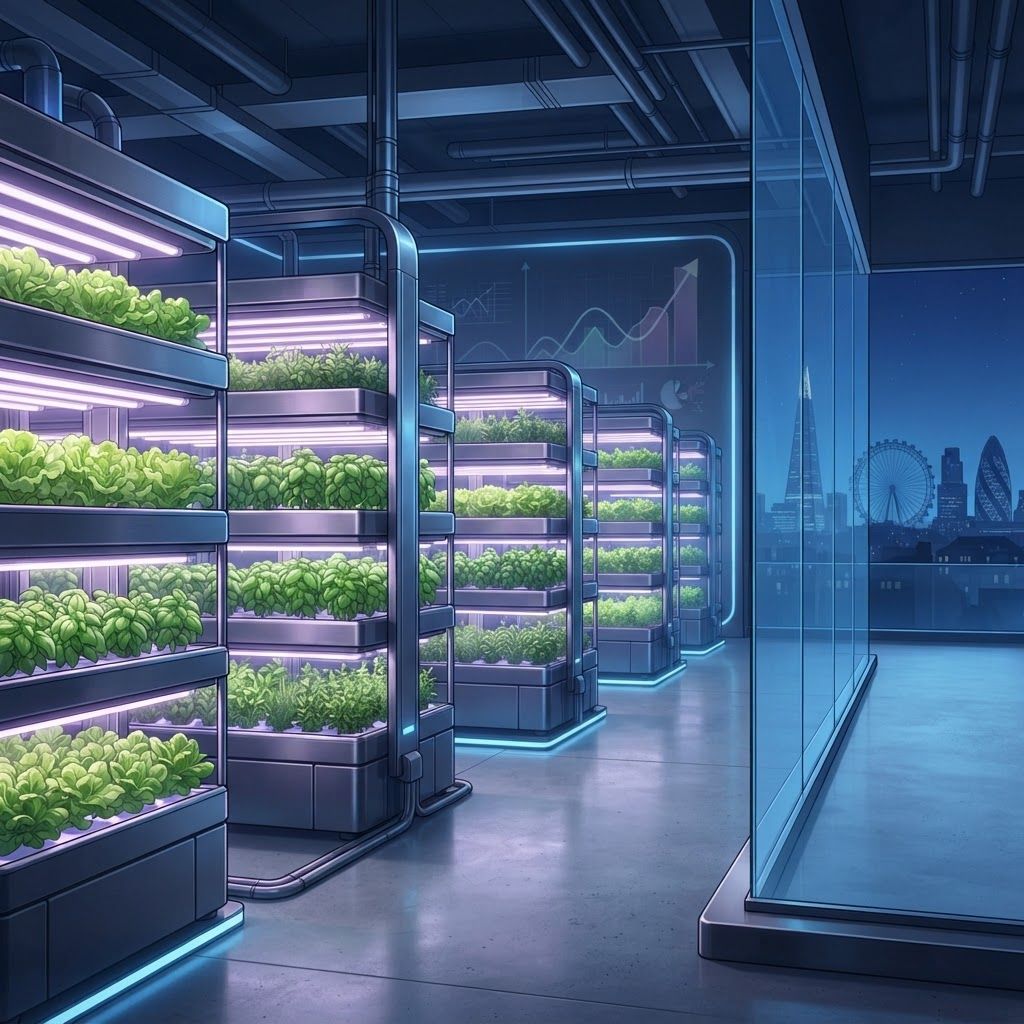
Rethinking What Farming Means in Inner London
Hammersmith and Fulham has no arable acreage in any conventional sense. What it does have is rooftops, disused industrial units, railway margins, estate land, school grounds and a population increasingly interested in where food comes from. Over the past decade that combination has produced a distinctive urban farming sector, built on controlled environment agriculture, community horticulture and short supply chains into local restaurants and retailers.
The economics of urban farming differ fundamentally from rural production. Land is expensive, so yield per square metre matters far more than total area. Labour is costly, so automation and volunteer models both play significant roles. Transport distances are negligible, so freshness and shelf life become competitive advantages rather than logistical problems. Businesses that understand these inversions tend to build viable operations; those that simply shrink a rural model rarely do.
1. Growing Underground
Growing Underground pioneered subterranean hydroponic farming in London, producing microgreens and salad leaves in controlled conditions using LED lighting and nutrient film techniques. The model demonstrates what urban agriculture can achieve when it stops competing with field production on commodity crops and focuses instead on high-value, short-shelf-life produce where proximity to the customer is decisive. Its influence across the London urban farming sector has been considerable.
2. Cultivate London
Cultivate London works across West London converting underused sites into productive growing spaces while training young people in horticulture. Its dual purpose matters: the organisation produces plants and food while delivering employability outcomes. For a borough with both regeneration land and youth employment priorities, that combination has proved durable and well supported by local partners.
3. Bushel and a Peck Urban Growers
Operating at a neighbourhood scale, Bushel and a Peck focuses on intensive small-plot vegetable production and supply to local independent food businesses. The commercial logic is simple and effective: grow varieties that travel badly, harvest to order, and deliver the same day. Restaurants gain flavour and freshness that national distribution cannot match, and the grower captures margin that would otherwise disappear into logistics.
4. Fulham Palace Meadows Allotments
The Fulham Palace Meadows allotment site is one of the borough's most significant growing spaces, supporting hundreds of plot holders. While not a commercial farming company, its role in local food production, biodiversity, soil health and horticultural skills transfer is substantial. Allotment networks also function as informal training grounds, and many small commercial growers begin here before scaling into managed sites.
5. Square Mile Farms
Square Mile Farms brings vertical farming into offices and residential developments, installing growing systems that produce leafy greens and herbs on site. Its relevance to Hammersmith and Fulham lies in the borough's large commercial office stock. Workplace farming delivers fresh produce alongside employee engagement and wellbeing outcomes, which is why corporate occupiers have proved a receptive market.
6. Hammersmith Community Gardens Association
This long-established organisation manages several growing sites across the borough, combining food production with environmental education and community engagement. Its work with schools and residents builds practical horticultural knowledge at a scale no single commercial farm could achieve, and its sites contribute meaningfully to local biodiversity and green infrastructure.
7. LettUs Grow Partner Farms
LettUs Grow develops aeroponic growing technology used by indoor farming operators, including those serving the London market. Aeroponics suspends roots in a nutrient mist, improving growth rates and reducing water consumption compared with conventional methods. Technology providers like this are a genuine part of the urban farming ecosystem, since most inner-London production depends on engineered systems rather than soil.
8. Vertical Future
Vertical Future designs and operates controlled environment farms with a strong emphasis on automation, data and crop science. Its model addresses urban farming's hardest problem, which is labour cost per unit of output. By instrumenting the growing environment and automating handling, it targets the productivity levels that make indoor production commercially competitive rather than merely demonstrative.
9. Sky Garden Rooftop Growers
Rooftop growing operations across West London use flat commercial roofs for raised bed and container production of vegetables, herbs and edible flowers. The approach makes use of space that carries no alternative commercial value, and produce supplied directly into nearby kitchens commands premium pricing. Structural loading assessment and irrigation design are the practical constraints that determine feasibility.
10. Edible Estates
Edible Estates transforms neglected land on housing estates into productive growing spaces managed with residents. The social returns are significant, but so are the horticultural ones: these sites collectively represent a meaningful area of cultivated land within the borough, producing genuine quantities of fruit and vegetables while improving the immediate environment.
Trends Driving Urban Agriculture
Controlled environment agriculture continues to advance as LED efficiency improves and energy management becomes more sophisticated. Because lighting and climate control dominate operating costs, incremental efficiency gains translate directly into commercial viability. Second, the shift toward high-value crops is now well established, with microgreens, herbs, edible flowers and specialist salads dominating because they justify indoor production economics.
Third, integration into the built environment is accelerating. Developers increasingly incorporate growing infrastructure into new schemes, partly for sustainability credentials and partly because residents and office tenants value it. Fourth, circularity is becoming central, with waste heat, rainwater capture and organic waste composting all reducing input costs while improving environmental performance.
Challenges That Remain
Energy pricing is the sector's principal vulnerability, since indoor farming substitutes electricity for sunlight. Access to affordable space is the second constraint, as urban land values almost always favour other uses. Skills are a third issue; controlled environment agriculture requires a blend of horticulture, engineering and data capability that the labour market supplies unevenly. Organisations that combine training with production, as several in the borough do, address that problem directly.
Getting Involved Locally
Residents interested in participating have several practical routes. Allotment waiting lists are long but worth joining early. Community garden volunteering offers immediate hands-on experience and structured learning. Schools and estate-based projects frequently need practical help and horticultural knowledge. For businesses, workplace growing installations and local sourcing partnerships are the most direct ways to support the sector while gaining tangible benefits.
Final Thoughts
Farming in Hammersmith and Fulham will never supply the borough's food needs, and framing it that way misses the point. What urban agriculture delivers is fresher produce for local food businesses, genuine environmental improvement, skills development and a visible connection between residents and food production. The organisations above show how varied that work can be, spanning advanced indoor technology, community horticulture and commercial rooftop growing. Together they make a compelling case that agriculture belongs in cities as well as countryside.
Want your brand featured in front of decision-makers? Publish a guest post or get a link insertion in our guides through AAMAX's guest post and link insertion service.
Helpful Links
 SponsoredAAMAX — Full-Service Digital Agency
Write for Us
Share your expertise with our readers. We welcome guest contributions from industry specialists.
Pitch your idea

