

Farming at the Heart of Huntingdonshire
Agriculture is not a peripheral industry in Huntingdonshire. It shapes the landscape, the economy and much of the district's identity. The land itself divides broadly into the rich black peat and silt soils of the northern fens around Ramsey and Warboys, and the heavier clays and loams to the south and west toward Kimbolton and the Ouse valley. That variation supports a genuinely diverse cropping pattern, from combinable arable to high-value vegetables and salad crops.
The district's farms range from family businesses of a few hundred acres to substantial estates and corporate farming operations managing many thousands. What they share is a high level of technical sophistication. English arable farming operates on fine margins, and the businesses that endure are those managing soil, water, inputs and machinery with genuine precision.
What Local Farms Produce
Wheat and barley dominate the combinable acreage, supplying milling, malting and feed markets. Oilseed rape remains present though reduced by pest pressure. Sugar beet is significant, particularly on the better soils within reach of processing. Field beans and peas play an important role in rotations, adding nitrogen and breaking disease cycles.
The fen soils support intensive vegetable production including potatoes, onions, carrots, celery, lettuce and brassicas. These crops demand irrigation, cold storage, precise harvest timing and substantial seasonal labour, and they connect Huntingdonshire directly to national supermarket supply chains.
Ten Notable Farming Businesses and Estates
1. G's Fresh is among the most significant agricultural businesses in the wider fenland region, with deep roots in the area. Its integrated model spans growing, packing and distribution of salads, vegetables and prepared produce, and its scale allows investment in irrigation infrastructure, plant breeding partnerships and mechanisation that smaller growers cannot match individually.
2. Produce World and its successor operations have long been associated with fenland root vegetable production, particularly potatoes and onions. The business model combines farming with grading, storage and packing, which captures more value from each crop and gives retail customers year-round consistency.
3. Large family arable partnerships across the Ouse valley represent the backbone of local farming. Typically managing between five hundred and several thousand acres of combinable crops, these businesses have professionalised substantially, employing agronomic consultants, using variable-rate application and sharing machinery through contracting arrangements.
4. Ramsey and Warboys peat fen growers occupy some of England's most productive vegetable land. These operations specialise in high-value crops requiring intensive management, and they are at the forefront of debates about peat soil conservation, water table management and carbon emissions from cultivated peatland.
5. Traditional landed estates within the district combine farming with woodland, let property, renewable energy and environmental schemes. Their diversified income allows longer-term land management decisions, and many have become leaders in habitat creation and public access provision.
6. Agricultural contracting businesses deserve recognition as farming companies in their own right. Many smaller Huntingdonshire farms no longer own combines or sprayers, instead buying operations from contractors with modern, high-capacity machinery. This model spreads capital cost across many hectares and gives small farms access to current technology.
7. Livestock and mixed farms in the western parishes maintain beef, sheep and some dairy enterprises on land less suited to intensive arable. These businesses are important for grassland habitat management and increasingly supply local butchers and farm shops directly, capturing retail margin.
8. Organic and regenerative farming enterprises have grown steadily across the district. Practising reduced tillage, diverse rotations, cover cropping and integrated livestock, these businesses focus on soil biology and input reduction. Several have become informal demonstration sites, hosting farmer groups examining lower-input systems.
9. Horticultural and glasshouse growers produce plants, salad crops and ornamentals under protection. Modern glasshouse operations achieve remarkable yields per hectare and are progressively decoupling from fossil energy through heat recovery, combined heat and power and improved insulation.
10. Farm diversification enterprises illustrate where the sector is heading. Farm shops, camping and glamping, equestrian facilities, wedding venues in converted barns, solar arrays and anaerobic digestion have all become significant income sources, reducing dependence on volatile commodity markets.
Technology Transforming Local Agriculture
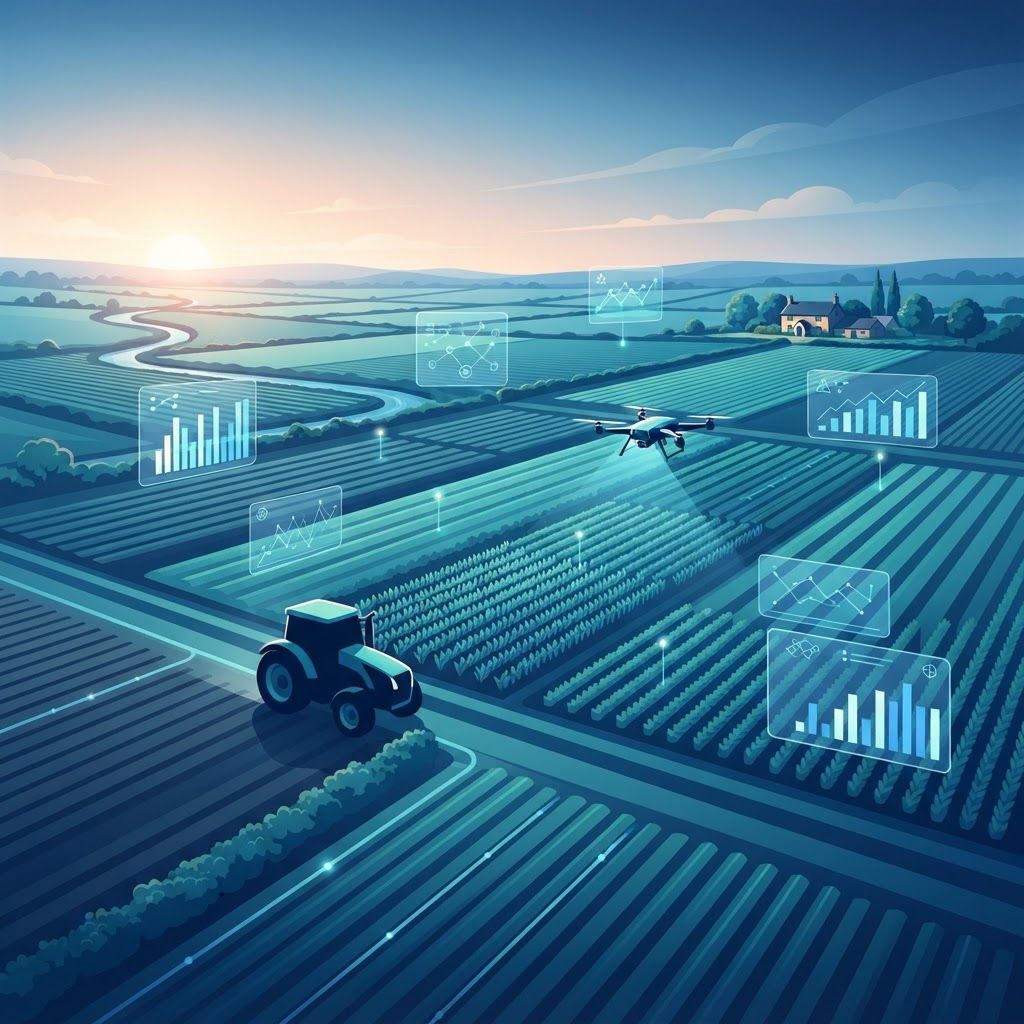
Precision agriculture is now standard on larger Huntingdonshire farms. Satellite guidance, controlled traffic farming, variable-rate fertiliser application based on soil and yield mapping, and section control on sprayers reduce both input cost and environmental impact. Some operations apply nitrogen at different rates within a single field based on live crop sensing.
Data management is increasingly central. Farm management software links field records, input applications, machinery telemetry and financial performance, allowing gross margin analysis at field level. This granularity supports decisions such as removing consistently unprofitable field corners from production and entering them into environmental schemes instead.
Autonomous and lightweight machinery is emerging, driven by both labour availability and soil compaction concerns. Smaller robotic platforms performing precision weeding and monitoring are being trialled locally, particularly in vegetable crops where hand labour has become scarce and expensive.
Environmental Change and Policy
The shift from area-based subsidy toward payment for environmental outcomes has fundamentally altered farm business planning. Huntingdonshire farms are entering schemes covering hedgerow management, buffer strips, wildflower margins, winter bird food, reduced tillage and water quality protection. For many, environmental income has become a deliberate enterprise rather than an afterthought.
Water management is a particular local priority. The fens depend on an engineered drainage system, and balancing agricultural water supply with flood risk, peat conservation and biodiversity requires cooperation between farmers, drainage boards and environmental bodies. Reservoir construction for irrigation storage has become common as summer abstraction becomes less reliable.
Conclusion
Huntingdonshire farming combines exceptional natural productivity with a high degree of technical and commercial sophistication. The businesses above stand out for scale, innovation, environmental leadership or the quiet consistency that has kept family farms viable across generations. As policy, climate and technology continue to shift, the district's agricultural sector looks well positioned to adapt.
Want your brand featured in front of decision-makers? Publish a guest post or get a link insertion in our guides through AAMAX's guest post and link insertion service.
Helpful Links
 SponsoredAAMAX — Full-Service Digital Agency
Write for Us
Share your expertise with our readers. We welcome guest contributions from industry specialists.
Pitch your idea

