

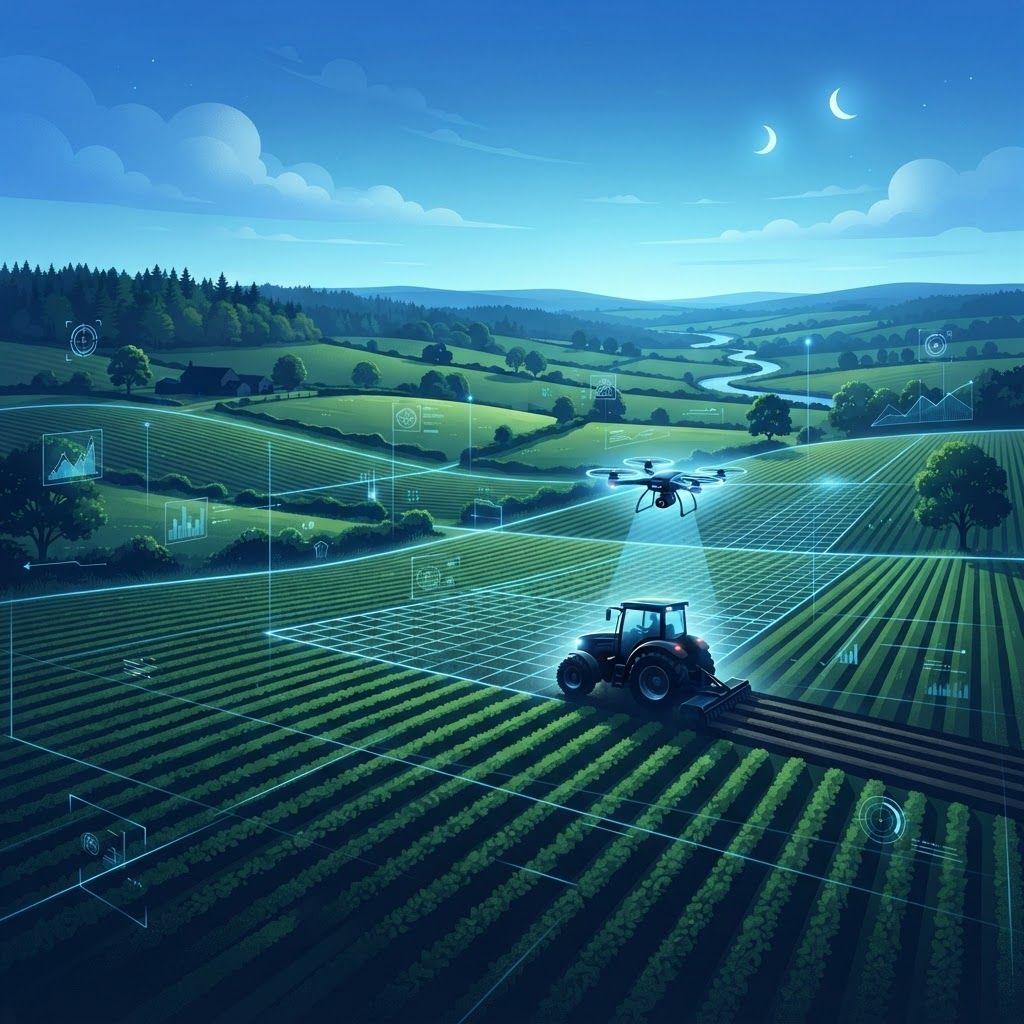
Farming in the Severn Vale
Gloucester sits in one of England's most agriculturally varied landscapes. To the west lie the Forest of Dean and the Wye Valley; to the east the Cotswold escarpment; and between them the Severn Vale, with deep alluvial soils that have supported mixed farming for centuries. The result is a county where dairy, beef, sheep, arable, horticulture, orcharding and cider production all coexist within a short radius of the city.
This diversity gives Gloucestershire agriculture genuine resilience. Where monoculture regions rise and fall with a single commodity price, the county's mixed profile spreads risk. It also creates a dense local supply chain, with processors, hauliers, agronomists, vets and machinery dealers all within easy reach.
Leading Farming Companies Around Gloucester
Severn Vale Dairy Farms operates large-scale milk production with investment in robotic milking and herd health monitoring, supplying regional processors.
Cotswold Arable Enterprises manages combinable crops across the escarpment, using precision drilling and variable rate application to optimise inputs.
Gloucester Livestock Company focuses on beef and sheep production, with grassland management systems designed around rotational grazing.
Vale Horticultural Growers produces field vegetables and salads for regional wholesalers and retailers, working to tight harvest and cold chain schedules.
Forest Edge Organic Farming operates certified organic mixed farming, combining livestock, cereals and vegetables in a closed-loop rotation.
Severnside Poultry Producers runs free range egg and table bird production with strong biosecurity and welfare accreditation.
Quedgeley Agricultural Contractors provides contract cultivation, harvesting, silage and spraying services to farms that prefer not to own full machinery fleets.
Cotswold Cider Orchards maintains traditional and bush orchards producing fruit for the county's well-established cider industry.
Barnwood Regenerative Farming practises minimum tillage, cover cropping and diverse rotations aimed at building soil organic matter and reducing input dependency.
Westgate Farm Enterprises combines food production with diversified income streams including farm retail, events and renewable energy.
The Policy Landscape
UK agriculture is navigating the most significant policy transition in decades. The shift away from area-based direct payments towards schemes rewarding environmental outcomes has changed farm business planning fundamentally. Payments now attach to actions such as soil health improvement, habitat creation, hedgerow management, water quality protection and species recovery.
For Gloucestershire farms this creates both opportunity and complexity. Land in the Severn floodplain has natural value for wetland habitat and flood mitigation. Cotswold grassland supports species-rich options. But accessing these schemes requires administrative capacity that smaller family farms often struggle to resource, and specialist advisory support has become a growth area in itself.
Technology on the Modern Farm
Precision agriculture has moved from novelty to normal. GPS-guided tractors reduce overlap and input waste. Variable rate fertiliser application matches nutrients to measured soil and crop need rather than field averages. Yield mapping from combines builds a multi-year picture of field performance that informs future decisions.
Livestock technology has advanced equally. Robotic milking has spread across Gloucestershire dairies, improving yields and giving farmers back time while generating detailed per-cow health data. Electronic identification, automated weighing and sensor-based heat detection improve both productivity and welfare outcomes.
Drones and satellite imagery now provide crop monitoring at a resolution and frequency that ground walking cannot match, identifying stress, disease and nutrient deficiency early enough to act. The barrier is increasingly data interpretation rather than data collection, which is why agronomy services have become more analytical.
Regenerative Practice and Soil Health
Soil has become the central topic in progressive farming discussion. Decades of intensive cultivation depleted organic matter across much of lowland England, reducing water-holding capacity, resilience to drought and natural fertility.
Regenerative approaches address this through reduced tillage, permanent soil cover, diverse rotations, integration of livestock and reduced synthetic inputs. Farms around Gloucester adopting these methods report improved infiltration during heavy rain, which matters considerably in a catchment prone to flooding, alongside reduced fuel and fertiliser costs.
The transition is not without challenge. Yields can dip during the adjustment period, and machinery investment differs. But the medium-term economics increasingly favour lower-input systems, particularly with volatile fertiliser pricing.
Diversification and Farm Business Resilience
Few Gloucestershire farms now rely solely on commodity production. Diversification takes many forms: farm shops and box schemes selling direct to Gloucester consumers, holiday accommodation and glamping exploiting Cotswold tourism, wedding and events venues in converted barns, solar arrays and anaerobic digestion, equestrian livery, and educational visits.
These enterprises smooth cash flow and reduce exposure to commodity cycles. They also reconnect farms with the local population, building the public understanding and support that agriculture increasingly needs.
Challenges Facing Local Farmers
Labour availability remains difficult, particularly for horticulture and livestock, where seasonal and skilled roles are hard to fill. Succession is another pressing concern, with an ageing farmer demographic and high land values making entry difficult for new entrants.
Climate volatility is now a planning assumption rather than a future risk. Wetter autumns complicate drilling, summer drought stresses grassland, and Severn flooding affects low-lying land. Resilience measures, from improved drainage and water storage to more robust crop varieties, are becoming standard investment.
Final Thoughts
Farming around Gloucester is diverse, technically sophisticated and adapting rapidly to new policy and environmental realities. The county's mixed agricultural base, combined with proximity to strong local markets, positions it well. The farms thriving are those combining production efficiency with environmental delivery and diversified income, an approach that looks increasingly like the template for British agriculture as a whole.
Want your brand featured in front of decision-makers? Publish a guest post or get a link insertion in our guides through AAMAX's guest post and link insertion service.
Helpful Links
 SponsoredAAMAX — Full-Service Digital Agency
Write for Us
Share your expertise with our readers. We welcome guest contributions from industry specialists.
Pitch your idea

