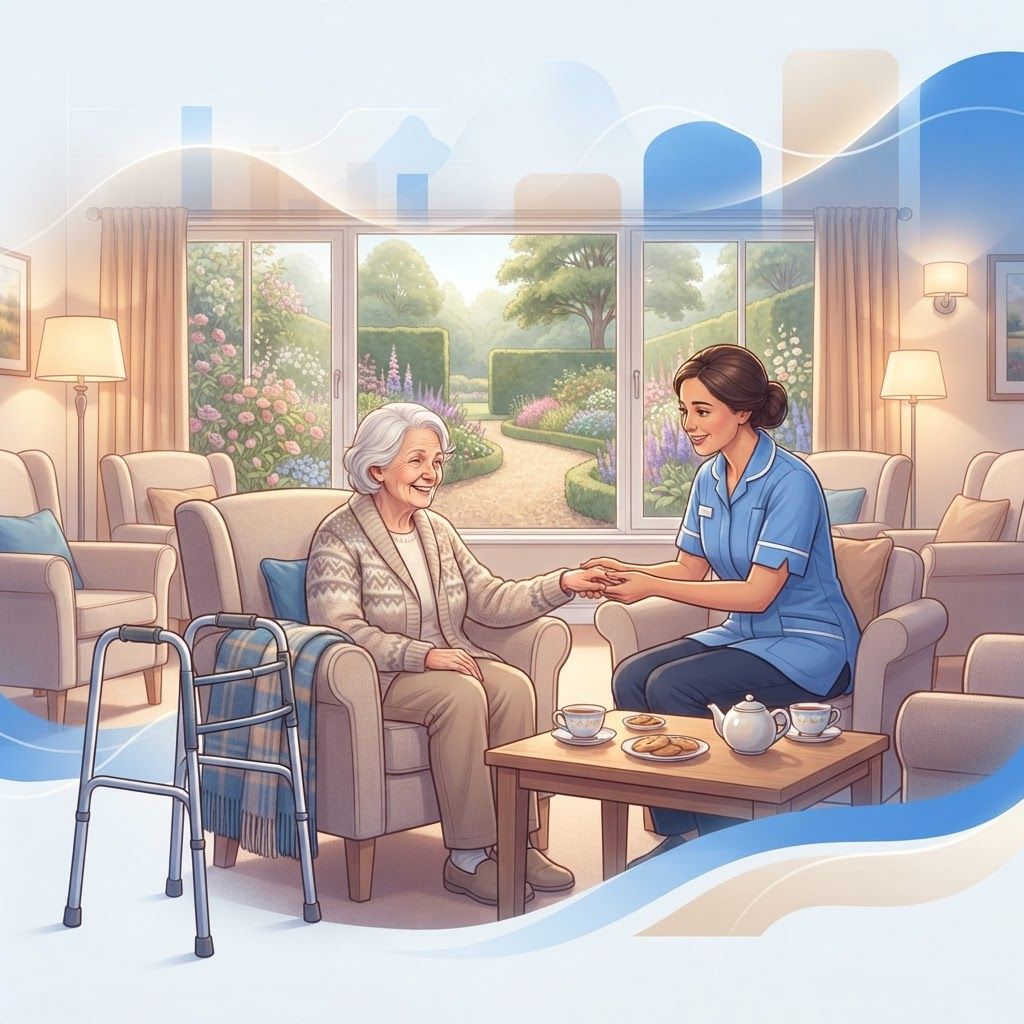
Understanding Elderly Care in Basingstoke and Deane
Basingstoke and Deane has an ageing population profile typical of prosperous southern England, and demand for high-quality later-life care has grown steadily across the borough. The result is a mixed market: purpose-built modern homes on the edge of Basingstoke, converted country houses in the villages around Overton, Kingsclere and Old Basing, and specialist dementia units attached to larger campuses. Provision spans residential care, nursing care, dementia care, respite stays and end-of-life support.
Families approaching this decision for the first time are often surprised by how much the categories matter. Residential care covers help with washing, dressing, medication prompts and meals. Nursing care adds registered nurses on duty around the clock, which is essential for complex conditions, PEG feeding, catheter management or advanced frailty. Dementia care requires specific environmental design and staff training, not simply a locked door. Matching the category to the need is the first and most important filter.
1. Bramley Court Care Home
A purpose-built home in the Bramley area, this provider is widely regarded for combining modern accommodation with a genuinely person-centred culture. En-suite rooms, landscaped gardens designed for safe independent walking, and a dedicated dementia community are its core strengths. Staff continuity is notably good, which matters enormously for residents with cognitive decline who rely on familiar faces to feel settled.
2. Beechwood Grove Nursing Home
Positioned for higher-dependency needs, Beechwood Grove offers registered nursing cover twenty-four hours a day alongside residential places. It is a frequent choice for families whose relative is discharged from hospital with ongoing clinical needs, and its links with community district nursing and palliative services in north Hampshire are well established. Rehabilitation-focused short stays are also offered.
3. Chineham Park Residential Home
Serving the Chineham and Sherborne St John catchment, this home has built a reputation on activity provision and family involvement. Structured daily programmes covering gentle exercise, music, gardening, baking and reminiscence work address the isolation that undermines wellbeing in later life more than any single clinical factor. Its open-visiting approach and regular relatives' meetings are appreciated by local families.
4. Overton Manor Care Home
Set in a period property with substantial grounds in the rural west of the borough, Overton Manor appeals to residents who have spent their lives in village Hampshire and would find a large urban facility disorientating. Smaller resident numbers allow a domestic, household-scale routine. Home-cooked food using local suppliers is a consistent point of praise, and the setting supports meaningful outdoor time in all seasons.
5. Oakridge House
A larger Basingstoke home offering both residential and dementia care, Oakridge House is valued for its specialist environmental design — clear sightlines, contrasting colour cues, memory boxes outside bedroom doors and enclosed circular walking routes. These are evidence-based interventions that reduce agitation and falls in dementia populations, and their consistent application here distinguishes the home from providers that treat dementia as an add-on service.
6. Kingsclere Lodge
Kingsclere Lodge focuses on residential and respite care with a strong community integration ethos. Residents maintain links with village churches, clubs and families, and the home actively facilitates outings rather than treating them as occasional events. Respite provision here is particularly useful for family carers in the north of the borough who need planned breaks to sustain caring at home for longer.
7. Sherfield Park Care Centre
A modern campus-style development offering a full continuum from independent-living support through to nursing care. Its principal advantage is that residents can transition between levels of support without moving to a new building and losing familiar staff and friendships — a significant protective factor for both couples with differing needs and residents facing progressive conditions.
8. St Michael's Hospice Related Care Partners
End-of-life care in the borough benefits from close working relationships between local care homes and hospice services in north Hampshire. Homes that hold recognised end-of-life care accreditation and maintain formal links with specialist palliative teams deliver measurably better symptom control and family support. Families should always ask directly which hospice or community palliative service a home partners with.
9. Old Basing Residential Home
A smaller independent home in one of the borough's most historic villages, this provider trades scale for intimacy. With fewer residents, care plans are noticeably more individual — meal preferences, waking times and daily routines are genuinely negotiated rather than standardised. Independent homes of this size often achieve the warmest atmospheres, though families should verify financial stability and staffing depth carefully.
10. Tadley and Baughurst Area Care Providers
The northern fringe of the borough is served by a cluster of well-regarded homes and domiciliary providers around Tadley and Baughurst. For families whose relative wishes to remain at home as long as possible, high-quality domiciliary and live-in care from these operators can defer or replace a residential move entirely, and should be assessed alongside care-home options rather than after them.
What Actually Signals Quality
Regulatory ratings from the Care Quality Commission are the essential starting point, but they are a snapshot. More telling indicators are available on an unannounced visit. Look at staff-to-resident interaction in communal areas during a quiet afternoon: are residents being spoken with, or simply supervised in front of a television? Check whether call bells are answered promptly. Ask for the staff turnover figure and the proportion of agency shifts — high agency use is the strongest predictor of inconsistent care. Read the activities timetable and then ask residents whether it happens.
Costs and Funding in Hampshire
Care home fees in the borough sit toward the higher end of the national range, reflecting local property and wage costs, with nursing care commanding a premium over residential. Families should request a full written fee breakdown covering what is included and what is charged separately — hairdressing, chiropody, escorted appointments and certain therapies are commonly extra. A local authority needs assessment and financial assessment should be requested early, as should an NHS Continuing Healthcare assessment where clinical needs are substantial. Funded Nursing Care contributions are available for residents in nursing homes who meet criteria, and attendance allowance eligibility is frequently overlooked.
Making the Decision
Visit at least three homes, ideally twice, with one visit unannounced and one at mealtime. Take the prospective resident wherever possible; their reaction to the atmosphere is more reliable than any brochure. Ask how the home handles deterioration, hospital admissions and end-of-life wishes, because those conversations are far harder to have later. Above all, prioritise the quality of relationships between staff and residents over the newness of the carpet. In Basingstoke and Deane there is real depth of good provision — the task is finding the home whose culture fits the person you love.
Want your brand featured in front of decision-makers? Publish a guest post or get a link insertion in our guides through AAMAX's guest post and link insertion service.
Helpful Links
 SponsoredAAMAX — Full-Service Digital Agency
Write for Us
Share your expertise with our readers. We welcome guest contributions from industry specialists.
Pitch your idea