

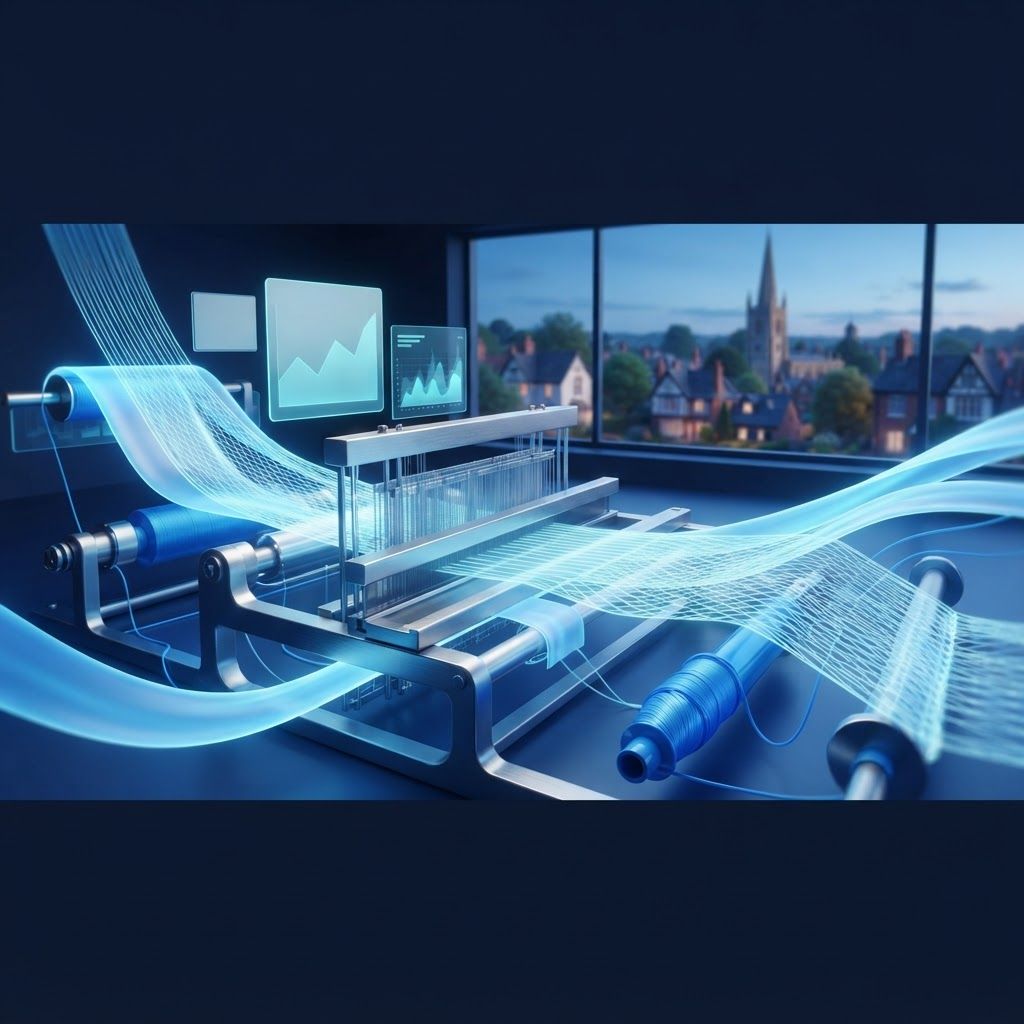
Textile Manufacturing in Modern Essex
The textile industry in Essex today bears little resemblance to the volume weaving and garment production that characterised British manufacturing a century ago. Mass apparel manufacturing largely migrated overseas decades ago, and what remains in and around Chelmsford has survived by moving decisively towards specialisation, technical performance and short-run responsiveness.
This restructuring has been more successful than the headline decline suggests. Contemporary Essex textile businesses supply technical fabrics for industrial applications, contract upholstery for commercial interiors, protective and corporate workwear, digitally printed soft furnishings, and bespoke production for interior designers and heritage projects. These are markets where proximity to the customer, design collaboration and rapid turnaround outweigh unit labour cost.
What Defines Quality in Textile Manufacturing
Fabric performance is measurable, and buyers who understand the metrics make far better decisions. Abrasion resistance, tested through standardised rub cycle methods, determines how upholstery will survive commercial use. Colour fastness to light and rubbing determines whether furnishings will fade or transfer dye. Tensile and tear strength matter for technical and industrial applications. Flame retardancy standards are legally mandatory for much contract furniture and public space textiles.
Certification and compliance form the second pillar. Contract upholstery must meet defined ignition source standards. Workwear intended as protective equipment requires certification against specific hazard standards. Textiles used in healthcare, transport and hospitality carry sector-specific requirements. A manufacturer that cannot produce current test certification for its output is not a viable supplier for regulated applications.
Sustainability credentials have shifted from marketing differentiator to procurement requirement, particularly for public sector and corporate contracts. Certified organic fibre content, recycled polyester derived from post-consumer waste, responsible chemical management certification and water reduction in dyeing and finishing all now feature in tender documentation.
Ten Notable Textile Manufacturers and Suppliers Serving Chelmsford
Camira Fabrics is among the most influential contract textile manufacturers supplying the Essex commercial interiors market. Its output focuses on upholstery and panel fabrics for office furniture, public transport and healthcare environments, with a strong emphasis on wool blends, recycled polyester constructions and rigorous performance testing. Its work on transport moquette and its use of recycled marine plastic in fabric production have set benchmarks the wider sector follows.
Panaz specialises in performance textiles for healthcare, hospitality and contract interiors, and supplies extensively into Essex hotels, care facilities and commercial premises. Its distinguishing capability is engineered functional finishing: antimicrobial treatments, waterproof barrier constructions and enhanced cleanability that allow fabrics to survive demanding environments while retaining a designed appearance rather than an institutional one.
Alpha Textiles produces upholstery fabric for furniture manufacturers and specifies extensively into the contract and residential markets served from Essex. Its strength lies in breadth of construction and colour range combined with reliable performance testing, making it a dependable specification source for furniture producers who need consistent supply across long production runs.
Herculite manufactures technical and industrial textiles including coated fabrics, barrier materials and specialist protective constructions used by Essex industrial and construction customers. This is a segment where textile engineering matters far more than aesthetics, and where material specification is driven by tensile performance, chemical resistance and environmental durability.
Alexandra Workwear supplies corporate and protective workwear across the Essex commercial and public sector market. Its capability covers garment design, fit range provision, protective certification, embroidery and printed branding, and managed replacement programmes for large workforces. Businesses in Chelmsford's logistics, manufacturing, healthcare and hospitality sectors form a natural customer base.
Portwest is a major supplier of protective clothing and technical workwear to Essex industrial and construction employers. Its range covers high visibility garments, flame resistant clothing, waterproof outerwear and cold storage protection, all supported by certification against the relevant protective equipment standards. Its scale allows the stock availability that industrial customers require.
Standfast and Barracks operates as a specialist textile printer supplying interior designers and furnishing brands, including projects across Essex. Its capability spans both traditional rotary printing and digital printing, which allows it to serve heritage reproduction work and short-run bespoke commissions with equal competence. This flexibility makes it valuable for restoration and high-specification residential projects.
Vanners produces woven silk textiles of exceptional quality from its East Anglian base, supplying luxury accessory and tailoring markets that extend into the Essex and London trade. Its jacquard weaving capability represents one of the last genuine concentrations of high-end silk manufacturing skill in the country, and its work is specified where material quality is the primary consideration.
Anglia Fabrics serves the regional trade as a fabric supplier and converter, providing cutting, finishing and distribution services to upholsterers, curtain makers and small furniture producers across Essex. Businesses of this type form essential infrastructure for the local craft and interiors trade, providing the material access and technical advice that smaller producers cannot source directly from mills.
Global Textiles Group operates as a sourcing and converting business supplying fabric to the East of England manufacturing and interiors trade. Its value proposition centres on managed sourcing, quality assurance on imported material, and holding stock locally so that Essex producers can operate without carrying substantial inventory risk themselves.
Technology and Digital Printing
Digital textile printing has transformed the economics of short-run production. Traditional rotary screen printing requires substantial setup investment that only amortises across long runs, which historically pushed bespoke and small-batch work out of reach. Digital printing eliminates most of that setup cost, allowing economically viable runs of a few metres and making genuine design customisation commercially practical.
For Essex interior designers, hospitality operators and heritage projects, this has been transformative. A designer can now commission a unique fabric for a single commercial interior at a cost that would have been impossible two decades ago. It has also shortened lead times dramatically, replacing months with weeks.
Sustainability and Circular Production
The textile industry's environmental impact is substantial, and the Essex sector has responded more seriously than many observers expect. Recycled polyester derived from post-consumer bottles now appears extensively in contract upholstery. Water and chemical reduction in dyeing and finishing has advanced considerably. Take-back and recycling programmes for end-of-life contract textiles are emerging, though genuine fibre-to-fibre recycling at scale remains a challenge.
Durability itself is the most underrated sustainability measure. A commercial fabric that survives fifteen years of heavy use has a far lower lifetime impact than one requiring replacement every four years, regardless of recycled content. The Essex manufacturers with the strongest environmental positions tend to be those whose products last longest.
Selecting a Textile Manufacturer
Buyers should begin with the performance specification rather than the appearance. Establish the abrasion requirement, the flame retardancy standard, the colour fastness expectation and any sector-specific compliance obligation. Request current test certification rather than accepting assurance. Confirm minimum order quantities and lead times against project timelines. Then evaluate design and colour options within the field of compliant candidates.
For Chelmsford businesses, the practical advantage of regional supply is collaborative: the ability to visit, to assess samples in person, to discuss modification with someone who understands the production constraints, and to resolve problems without navigating time zones and shipping schedules.
Want your brand featured in front of decision-makers? Publish a guest post or get a link insertion in our guides through AAMAX's guest post and link insertion service.
Helpful Links
 SponsoredAAMAX — Full-Service Digital Agency
Write for Us
Share your expertise with our readers. We welcome guest contributions from industry specialists.
Pitch your idea

