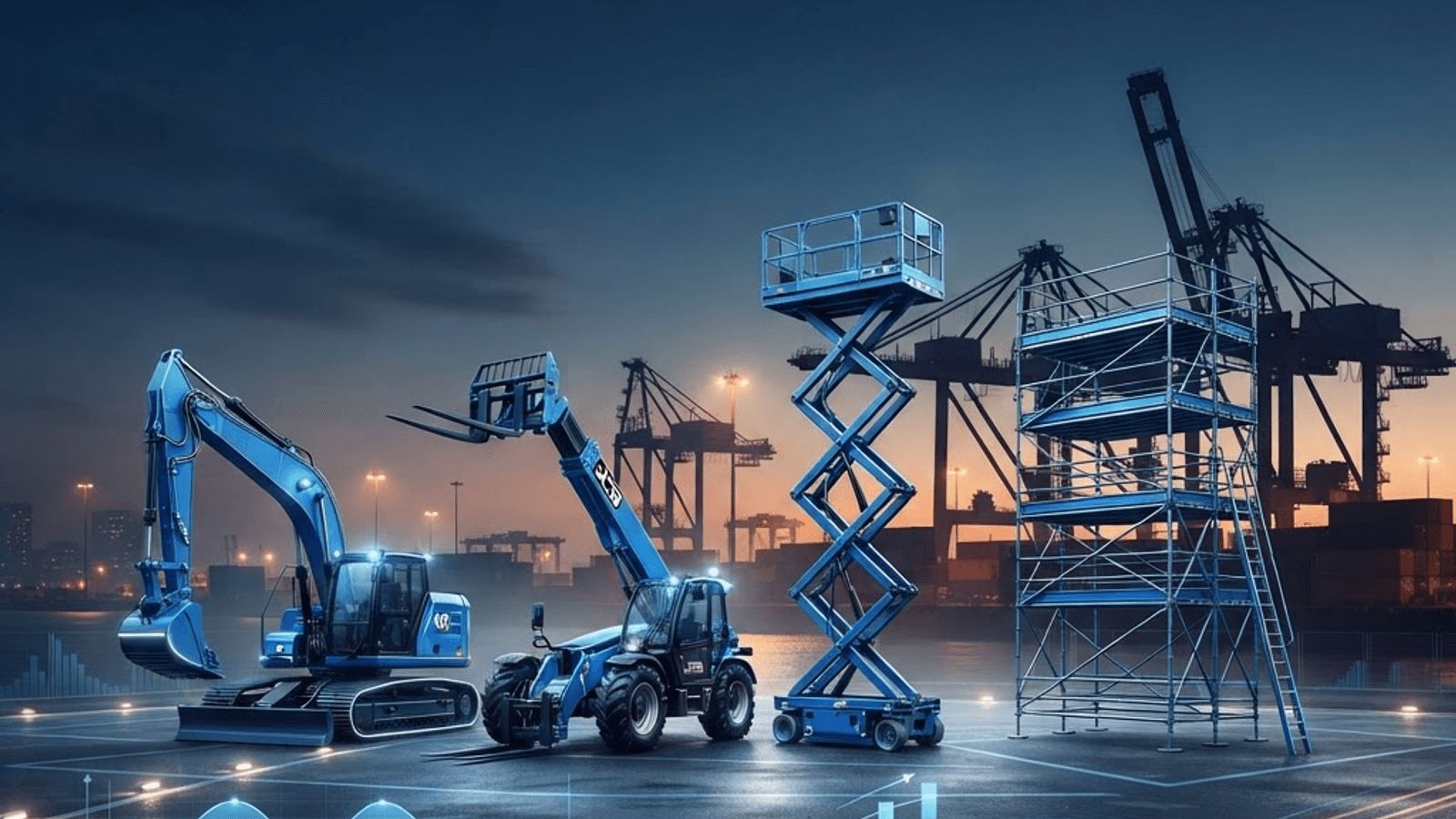
Why Equipment Hire Dominates the Local Construction Market
Plant and tool hire underpins construction across North East Lincolnshire in a way that is easy to overlook. The economics are straightforward: heavy equipment is expensive to buy, depreciates steadily, requires storage, insurance, maintenance and statutory inspection, and sits idle between projects. For most contractors, and almost all homeowners, hiring transfers those burdens to a specialist and converts capital expenditure into a predictable project cost.
The borough's demand profile is unusually varied. Port and logistics activity around Immingham and the Grimsby docks generates requirements for lifting equipment, access platforms and material handling. Industrial and processing facilities need shutdown and maintenance plant, often at short notice. The domestic market drives steady demand for mini excavators, dumpers, compaction plant, scaffold towers and power tools as homeowners undertake extensions, driveways and landscaping. Coastal and estuary environments add a further dimension, with flood defence, groundworks and marine-adjacent projects requiring specialist equipment.
Ten Equipment Hire Operations Worth Knowing
1. Humber Plant Hire offers a broad fleet spanning mini excavators through to larger tracked machines, dumpers, rollers and attachments. Operated hire is available alongside self-drive, which is valuable for customers without the relevant competence cards.
2. Grimsby Tool and Equipment Hire serves the trade and domestic market with hand tools, power tools, breakers, mixers, floor preparation equipment and access towers. Short-hire flexibility and weekend rates make it a practical choice for homeowners.
3. Immingham Access and Lifting specialises in powered access, including scissor lifts, boom lifts and telehandlers, plus lifting accessories with current inspection certification. Working at height in industrial settings is the core focus.
4. Estuary Groundworks Plant concentrates on excavation and earthmoving, supplying excavators, trenchers, compaction equipment and attachments such as breakers, augers and grading buckets, with delivery across the borough.
5. Cleethorpes Event and Site Services combines construction hire with event infrastructure, supplying temporary fencing, welfare units, generators, lighting towers and portable sanitation. Both construction sites and the resort's substantial events calendar draw on this equipment.
6. Freshney Scaffolding and Access Hire provides system scaffold, mobile towers, podium steps and edge protection, with erection services where a design and handover certificate is required.
7. Wolds Agricultural and Site Machinery serves the rural western borough with telehandlers, tractors with attachments, chippers and land drainage equipment, bridging agricultural and construction requirements.
8. Great Grimsby Concrete and Compaction supplies mixers, power floats, poker vibrators, laser screeds and compaction plant for concrete and hardstanding work, along with practical advice on curing and finishing.
9. Scartho Garden and Landscaping Hire focuses on the domestic outdoor market with turf cutters, rotavators, stump grinders, chippers, plate compactors and pressure washers, alongside straightforward guidance for first-time users.
10. Humberston Welfare and Site Setup handles the infrastructure that surrounds the actual building work, including cabins, toilets, drying rooms, storage containers and temporary power distribution, which becomes essential on longer projects.
Hiring Safely and Legally
Equipment hire carries genuine legal obligations, and understanding them protects both cost and safety. Under health and safety legislation, anyone using work equipment must be competent to do so, and equipment must be suitable for the task, maintained and inspected.
For powered access equipment, the recognised competence framework is IPAF certification, with categories covering different machine types. For plant such as excavators, dumpers and telehandlers, CPCS or NPORS cards demonstrate competence. Reputable hire companies will ask for evidence of competence before releasing certain machines, and a supplier that hands over a telehandler without any such check is not doing you a favour.
Lifting equipment and accessories are subject to statutory thorough examination at defined intervals, and current certification should accompany the equipment. Always check that documentation is present and in date on delivery, because responsibility for using uncertified lifting gear does not rest solely with the supplier.
Insurance is the other frequently overlooked element. Hired-in plant is normally the hirer's responsibility while in their possession, and standard household or business policies may not cover it. Hire companies typically offer damage cover as an option, and for expensive machines this is usually worth taking. Read the terms regarding excess, theft from site and operator error.
Getting the Specification Right
The most common and expensive hire mistake is choosing the wrong size machine. An excavator too large for the access route cannot reach the work. One too small extends hire duration and increases total cost. Practical considerations include gate and passage widths, ground bearing capacity, overhead obstructions such as cables and trees, and the presence of underground services.
Underground services deserve emphasis. Striking a gas main, water main, electricity cable or fibre route during excavation is dangerous and extremely costly. Service plans should be obtained, cable avoidance tools used, and trial holes dug by hand where services are suspected. Many hire companies supply cable avoidance tools, and hiring one alongside an excavator is among the cheapest risk reductions available.
Attachments frequently transform machine usefulness. A breaker converts an excavator into a demolition tool. An auger makes fence post installation quick. A grading bucket improves finish quality. Discussing the whole task rather than just the machine usually produces better recommendations from a knowledgeable hire desk.
Cost Structures and How to Control Them
Hire pricing typically uses daily, weekly and monthly rates, with weekly rates offering considerably better value than five separate days and monthly rates better still. Additional charges commonly include delivery and collection, fuel, damage cover, consumables such as breaker points and cutting discs, and cleaning if equipment is returned excessively dirty.
Two practices reliably reduce cost. First, plan sequencing so that machines are on site only when actively needed rather than for the whole project duration. Second, confirm exactly what is included at the point of order, particularly fuel policy and whether the quoted rate includes damage cover. Ambiguity here produces most hire invoice disputes.
For frequent hirers, account arrangements and negotiated rates make a material difference. For one-off domestic projects, comparing two or three suppliers and asking about weekend rates, which sometimes count as a single day, is worthwhile.
Technology and Sustainability in the Hire Sector
The hire industry is modernising quickly. Telematics now track machine location, hours and fault codes, improving maintenance and reducing theft. Online booking with real-time availability has become standard among larger operators.
Sustainability is driving the most visible change. Battery-electric mini excavators, dumpers and compaction plant are entering fleets, offering zero local emissions and dramatically lower noise, which makes them valuable for work in occupied buildings, near residential areas and in enclosed spaces. Hybrid and hydrogen-ready generators and battery-powered lighting towers are replacing older diesel units on many sites. For projects in sensitive locations across the borough, asking about low-emission options is increasingly likely to yield a genuine choice.
Practical Advice for Homeowners
Homeowners hiring plant for the first time should be candid about their experience. A reputable hire desk will steer an inexperienced user towards manageable equipment, offer a briefing, and suggest operated hire where the risk is real. Watching the handover demonstration properly, reading the operating instructions, wearing appropriate protective equipment and stopping when tired are simple measures that prevent most incidents.
It is also worth considering whether hiring is the right answer at all. For a single afternoon of light work, a hand tool may suffice. For substantial groundworks near services, engaging a contractor with their own plant and insurance may cost less than hiring, learning and correcting mistakes.
Final Thoughts
Equipment hire is a mature, well-served sector across North East Lincolnshire, spanning heavy plant for port and industrial work through to small tools for domestic gardens. The ten operations profiled here cover excavation, access, lifting, concrete work, landscaping and site welfare. Specifying the right size machine, verifying competence and certification requirements, understanding damage liability, and sequencing hire periods tightly will keep projects safe, compliant and on budget.
Want your brand featured in front of decision-makers? Publish a guest post or get a link insertion in our guides through AAMAX's guest post and link insertion service.
Helpful Links
 SponsoredAAMAX — Full-Service Digital Agency
Write for Us
Share your expertise with our readers. We welcome guest contributions from industry specialists.
Pitch your idea