

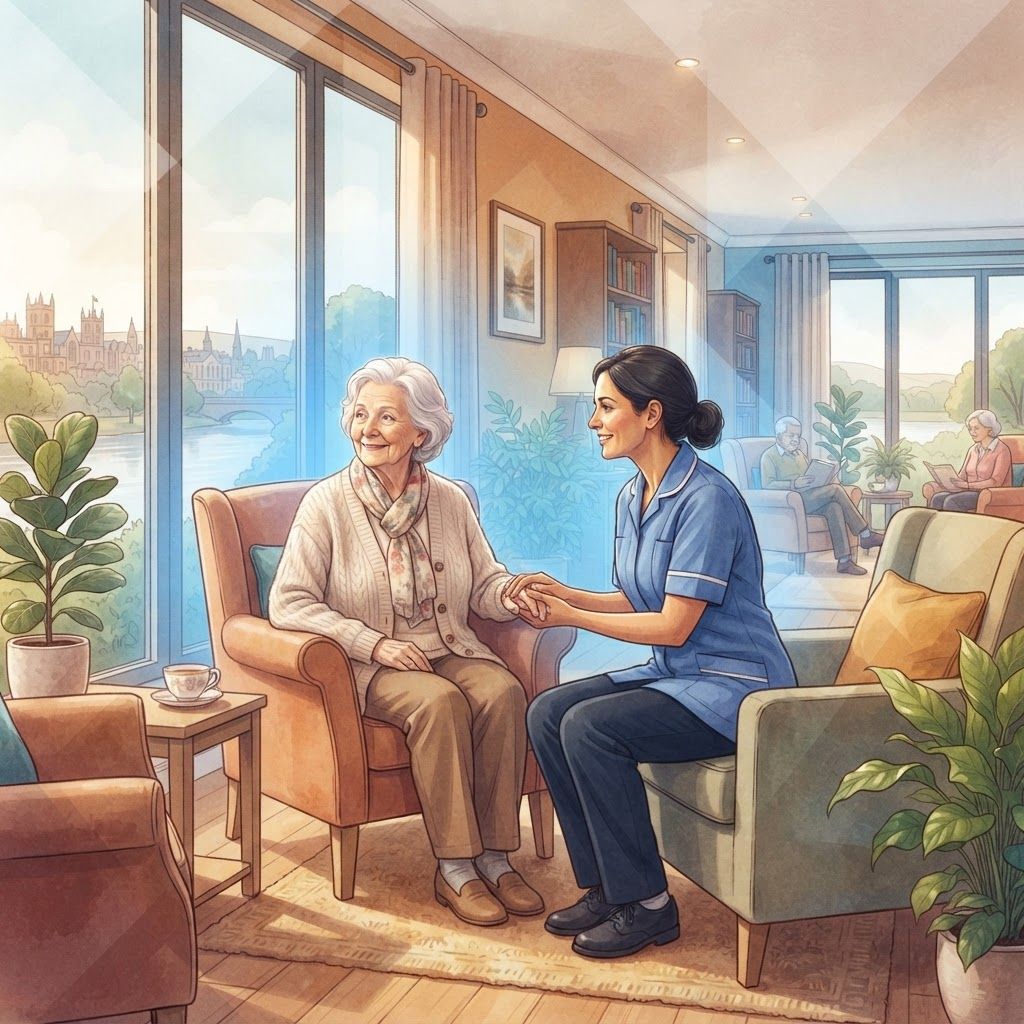
Understanding Elderly Care in the Borough
England's population is ageing steadily, and Stockton-on-Tees reflects this national pattern. Demand for residential and nursing care continues to grow, alongside dementia-specialist provision, respite services and care delivered in people's own homes. For families, navigating this landscape is often unfamiliar and emotionally difficult territory.
Care provision in the borough spans several distinct models. Residential care homes provide accommodation with personal care support. Nursing homes add qualified nursing staff for people with medical needs. Dementia-specialist units offer adapted environments and trained staff. Extra care housing allows independent living with support on site, and domiciliary care delivers assistance at home. Each suits different levels of need.
How to Assess Care Quality
Regulatory inspection is the essential starting point. All care homes in England are inspected by the healthcare regulator and rated across safety, effectiveness, care, responsiveness and leadership. Published reports contain detailed findings that go well beyond the headline rating and are worth reading in full.
Staffing is the single strongest determinant of care quality. High staff turnover, heavy reliance on agency workers and low staff-to-resident ratios consistently correlate with poorer outcomes. Ask directly about turnover rates, retention, training provision and how staffing levels change overnight.
Atmosphere tells you a great deal that documents cannot. Visit unannounced if permitted, at different times of day. Observe whether residents are engaged or left unattended, whether staff address people by name and with warmth, whether communal areas are actually used, and whether the home smells clean. Talk to residents and visiting families directly.
Ten Notable Elderly Care Providers Serving Stockton-on-Tees
1. Barchester Healthcare Homes
Barchester operates well-regarded homes in the region offering residential, nursing and dementia care. Its facilities typically feature purpose-built accommodation, en-suite rooms, landscaped gardens, on-site catering with fresh cooked meals and structured activity programmes. Investment in staff training and dementia-specific environmental design is a consistent characteristic.
2. HC-One Care Homes
HC-One is one of the larger providers nationally with homes serving the Teesside area. Provision covers residential, nursing and specialist dementia care, with an emphasis on person-centred care planning, life history work and family involvement in decision making.
3. Four Seasons Health Care Homes
Four Seasons homes in the region provide nursing and residential care with capability for more complex health needs, including palliative and end-of-life care delivered in partnership with community nursing and hospice teams. Continuity of care at the end of life is a particular strength of nursing-registered homes.
4. Independent Family-Run Care Homes in Stockton
The borough retains a number of smaller independent homes, often family-owned and long-established. Their advantages typically include lower resident numbers, more consistent staffing, a domestic rather than institutional atmosphere and strong local community links. For residents who find larger settings overwhelming, these can be an excellent fit.
5. Dementia-Specialist Residential Units
Dedicated dementia units employ specific environmental design principles including clear wayfinding, contrasting colours for orientation, memory boxes outside bedrooms, safe circular walking routes and secure garden access. Staff receive advanced training in communication and behavioural support, which materially reduces distress and the need for restrictive practice.
6. Nursing Homes with Complex Care Capability
Homes registered for nursing care support residents with conditions requiring qualified clinical oversight, including advanced Parkinson's disease, stroke rehabilitation, catheter and stoma care, wound management, diabetes requiring insulin, and percutaneous feeding. Registered nurses are present around the clock.
7. Extra Care Housing Schemes in the Borough
Extra care housing offers self-contained flats with a private front door alongside on-site care staff, communal facilities, restaurants and organised activities. It preserves independence and privacy while providing reassurance and flexible support that can increase as needs change, and often represents better value than residential care.
8. Respite and Short-Stay Care Services
Respite provision offers planned short stays, giving family carers a period of rest and allowing older people to experience a home before considering permanent admission. It also supports recovery following hospital discharge, reducing readmission risk. Many families find a respite stay the most informative way to assess a home.
9. Domiciliary Care Agencies in Stockton-on-Tees
Home care agencies deliver personal care, medication support, meal preparation, companionship and domestic assistance in the person's own home. Visits range from short daily calls to live-in arrangements. For many older people, this is the preferred option, and it is generally more cost-effective at lower levels of need.
10. Day Care and Community Support Services
Day services provide social interaction, structured activity, meals, personal care and therapeutic input during the day while the person continues living at home. They combat the isolation strongly associated with cognitive and physical decline and provide valuable regular respite for family carers.
Trends in Elderly Care
Person-centred and relationship-based care has replaced task-focused models as the recognised standard, prioritising individual preferences, life history and dignity. Technology is increasingly used to support safety, with fall detection, discreet monitoring and digital care records improving oversight without intruding on privacy.
Environmental design has advanced considerably, particularly in dementia care, where thoughtful layout, lighting and sensory considerations reduce agitation. Integration between care homes, general practice, community nursing and hospital teams is also improving, reducing avoidable admissions among frail residents.
Practical Guidance for Families
Begin with a care needs assessment from the local authority, which is free and available to anyone appearing to need care. This determines the level of support required and whether the person qualifies for funded care following a financial assessment. Carers are entitled to their own separate assessment.
Understand the funding position early. Care may be self-funded, partly or fully local authority funded depending on capital and income, or in some cases funded by the NHS where needs are primarily health-related. Seek independent financial advice before committing significant assets.
Visit at least three homes, at varied times, and involve the older person in the decision wherever they have capacity to participate. Read the full inspection report rather than the rating alone, and check the contract carefully for fee increase terms, notice periods and what is genuinely included.
Final Thoughts
Stockton-on-Tees offers a range of elderly care options spanning large regulated providers, independent family-run homes, specialist dementia units, extra care housing and home-based support. Taking time to assess staffing, atmosphere and inspection findings, and considering less restrictive alternatives before residential care, gives the best chance of a decision the whole family remains confident in.
Want your brand featured in front of decision-makers? Publish a guest post or get a link insertion in our guides through AAMAX's guest post and link insertion service.
Helpful Links
 SponsoredAAMAX — Full-Service Digital Agency
Write for Us
Share your expertise with our readers. We welcome guest contributions from industry specialists.
Pitch your idea

