

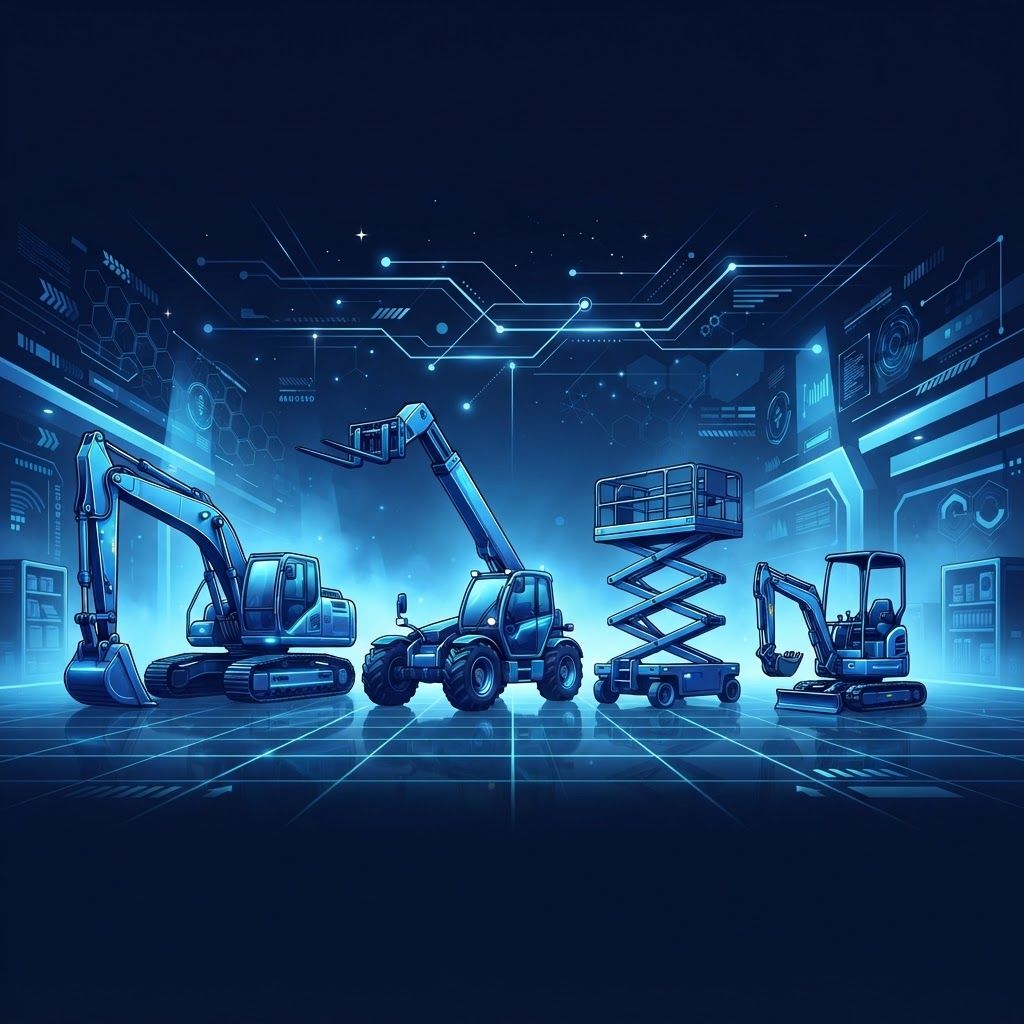
Why Plant Hire Dominates the Construction Supply Chain
Very few contractors own the full range of equipment their projects require. An excavator sitting idle between jobs represents capital tied up, depreciation accruing, insurance premiums running and maintenance obligations continuing. Hiring converts that fixed cost into a variable one that matches actual workload, which is why the plant hire sector has grown to underpin almost all construction activity.
Newark and Sherwood is well served because of its geography. The A1 and A46 corridors give hire depots easy reach across Nottinghamshire, Lincolnshire and beyond, and the district's mix of housebuilding, industrial development, agricultural activity and domestic improvement work sustains demand across every equipment category from mini diggers to tower cranes.
What Is Typically Available
Hire fleets in the district generally divide into categories. Earthmoving covers mini excavators from around one tonne up to larger tracked machines, dumpers, rollers and compaction plant. Access equipment includes scaffold towers, scissor lifts, boom lifts and podium steps. Powered tools cover breakers, disc cutters, floor saws, mixers and compactors. Site services include generators, lighting towers, welfare units, portable toilets, heaters and dehumidifiers. Specialist hire extends to telehandlers, concrete pumps, trenchers, stump grinders and surveying equipment.
Most depots also hire to the general public as well as to trade accounts, which makes serious equipment accessible to homeowners tackling driveways, landscaping or renovation projects.
Ten Equipment Hire Businesses Serving the District
Newark Plant Hire offers a broad local fleet covering excavators, dumpers, compaction equipment and small tools, with delivery across the district and flexible hire periods from a day upwards.
Sherwood Tool and Plant serves the forest villages and northern parishes with tool hire, mini plant and garden machinery, popular with both trades and domestic customers.
Trent Valley Equipment Hire focuses on earthmoving and groundworks plant, supplying excavators, dumpers and rollers to housebuilders and civil contractors working across the Trent corridor.
A1 Access Hire specialises in powered access including scissor lifts, cherry pickers and boom lifts, along with the familiarisation training operators need to use them safely.
Ollerton Plant Services provides plant hire with or without operators, which is valuable for clients who need machine work done but have no qualified operator available.
Lindum Group operates its own plant division supporting its construction contracts and hiring externally, benefiting from the maintenance standards a major contractor demands of its own fleet.
Forest Site Services concentrates on site setup equipment: welfare units, generators, lighting towers, fencing and temporary accommodation, covering everything needed to establish a compliant site.
Bilsthorpe Machinery Hire combines construction plant with agricultural machinery hire, reflecting the district's rural economy and serving farms as well as builders.
Newark Concrete and Pumping supplies concrete alongside pump hire, solving the practical problem of placing concrete on sites with restricted access, a common issue in the district's older village streets.
Midlands Crane and Lifting Services provides mobile cranes, telehandlers and lifting equipment with appointed persons and lift planning, which is a regulatory requirement for anything beyond the simplest lifting operation.
Understanding Hire Costs
Hire is normally priced by the day, week or month, with weekly rates offering considerably better value than daily hire once a job extends beyond two or three days. Monthly rates improve further. The headline rate is rarely the whole cost, though, and quotations should be examined for delivery and collection charges, fuel, damage waiver or insurance, attachments charged separately, and cleaning charges if equipment is returned dirty.
Damage waiver deserves particular attention. It typically reduces but does not eliminate liability, and it usually excludes certain categories of loss entirely, including theft where security was inadequate. Contractors with their own plant insurance may decline the waiver, but should confirm their policy actually covers hired-in equipment, because many do not without a specific extension.
Operator Competence and Legal Requirements
Hiring equipment does not transfer responsibility for safe use. Under health and safety legislation, whoever operates plant must be competent, and for most powered plant that means holding a recognised card such as CPCS or NPORS for the specific machine category. Powered access equipment requires IPAF training. Abrasive wheels, telehandlers and excavators used for lifting all carry additional requirements.
Lifting operations are particularly regulated. Anything involving a crane or an excavator used as a lifting appliance requires a lift plan prepared by a competent appointed person, along with current thorough examination certificates for the lifting equipment and accessories. Reputable hire companies will supply these certificates and will often decline to hire to customers who cannot demonstrate competence.
Practical Advice for Planning a Hire
Book in advance during busy periods. Spring and summer see peak demand for excavators, access equipment and landscaping plant, and popular machines can be unavailable at short notice. Confirm access dimensions before ordering: a machine that cannot get through a gateway or around a corner is an expensive mistake, and micro excavators exist precisely for restricted garden access.
Inspect equipment on delivery and record its condition, ideally with photographs. This protects against being charged for pre-existing damage. Check that operating manuals and any required certificates are supplied, that fuel type is confirmed, and that you understand the daily checks expected of the operator.
Finally, think about the whole task rather than the single machine. A groundworks job typically needs an excavator, a dumper, a compactor and possibly a trench support system. Hiring these together from one supplier usually costs less in delivery charges and simplifies coordination.
Sustainability and the Changing Fleet
Hire fleets across the region are gradually electrifying. Battery-powered mini excavators, electric dumpers, hybrid lighting towers and battery-hydrogen generator alternatives are appearing, driven by air quality requirements, noise restrictions on urban and residential sites, and clients' carbon reporting obligations. Electric plant is particularly useful for indoor work and for sites in noise-sensitive locations such as near schools or residential streets in Newark town centre.
Telematics has also become standard on larger equipment, tracking location, hours and fault codes. For hirers this means better-maintained machines; for contractors, it means accurate utilisation data that helps decide whether hiring or purchasing makes more sense for frequently used items.
Getting the Best From a Hire Relationship
Contractors who hire regularly benefit from opening trade accounts, which secure better rates, credit terms and priority availability. Building a relationship with one or two depots pays off when a machine breaks down mid-job and a replacement is needed quickly, because suppliers prioritise their established customers. For occasional or domestic hirers, comparing two or three local depots on total cost rather than headline rate usually reveals a clear winner.
Want your brand featured in front of decision-makers? Publish a guest post or get a link insertion in our guides through AAMAX's guest post and link insertion service.
Helpful Links
 SponsoredAAMAX — Full-Service Digital Agency
Write for Us
Share your expertise with our readers. We welcome guest contributions from industry specialists.
Pitch your idea

