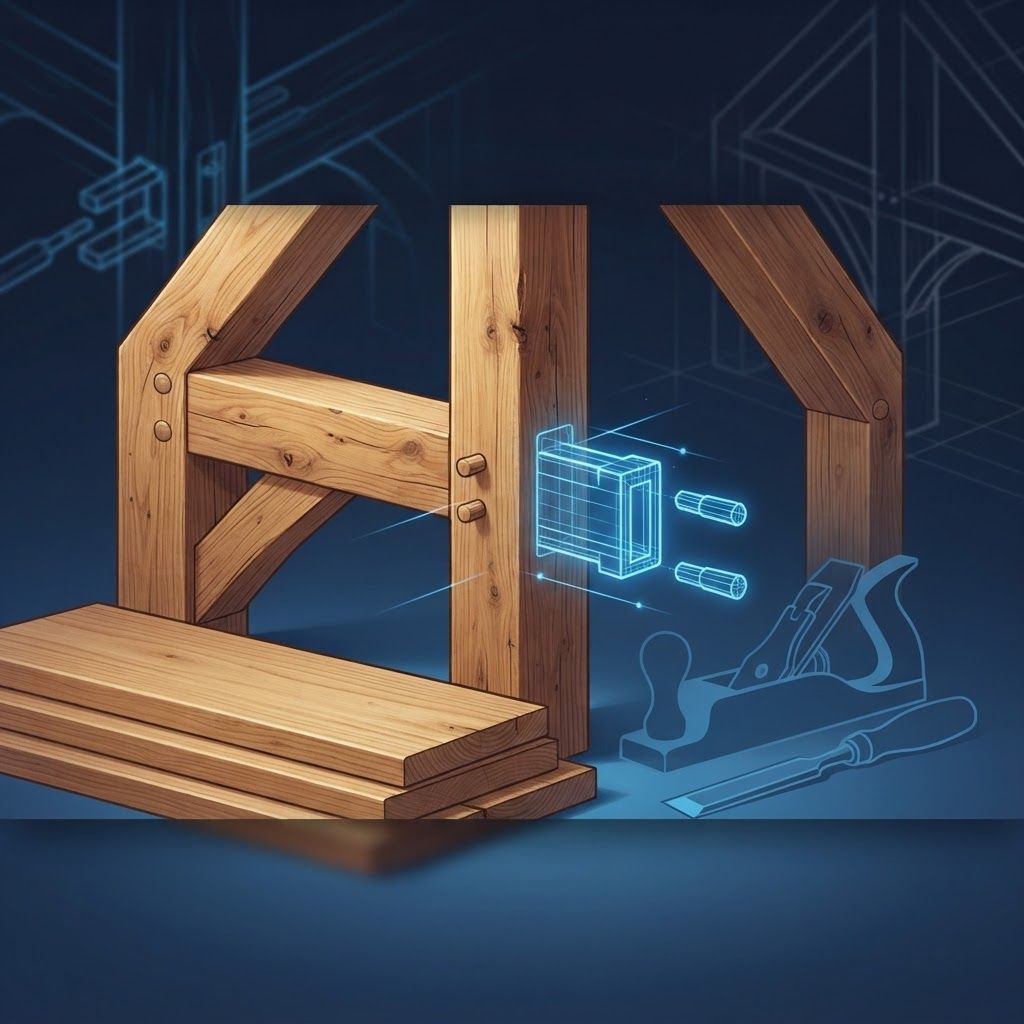
A County Defined by Timber
Herefordshire's identity is inseparable from timber. The county sits at the heart of England's black-and-white building tradition, with villages such as Pembridge, Weobley, Eardisland and Dilwyn preserving some of the finest medieval and Tudor timber-framed buildings in the country. That heritage never disappeared. It evolved into a living industry of framing yards, joinery workshops, sawmills and skilled site carpenters that continues to serve both restoration and contemporary construction.
As a result, carpentry in Herefordshire covers an unusually wide range. On one end sits historic frame repair using green oak, mortise and tenon joints, oak pegs and scarf splices. On the other sit modern first-fix roofing carpentry, engineered joists, structural insulated panels, staircase manufacture and precision cabinetmaking. Very few counties offer this depth of capability in one place.
Understanding the Different Types of Carpentry
Clients often use one word for several distinct trades. Structural or first-fix carpentry covers floor joists, roof trusses, cut roofs, stud partitions and timber frame erection. Second-fix carpentry covers doors, skirting, architrave, staircases, built-in storage and window installation. Joinery refers to workshop manufacture of components such as sash windows, doors, staircases and furniture. Heritage or framing carpentry is a specialist discipline dealing with historic timber structures.
Matching the trade to the task matters. A superb finish carpenter is not necessarily equipped to splice a decayed oak sill beam in a listed cottage, and a framing carpenter may not produce the immaculate mitres a client expects in a new kitchen. The best Herefordshire firms are clear about where their strengths lie.
The Top 10 Carpentry Services in Herefordshire
1. Border Oak. The county's flagship timber business designs, manufactures and erects oak frames from its Herefordshire workshops. Its carpenters combine traditional jointing with modern engineering, producing frames for new homes, extensions, garden buildings and garages.
2. Heritage timber-frame repair specialists. A small group of highly skilled framing carpenters across the black-and-white villages undertakes structural repair of medieval and Tudor buildings, including sill beam replacement, post splicing, brace renewal and wattle and daub panel restoration. This is craft work of national importance.
3. Bespoke joinery workshops in Hereford. Purpose-built workshops manufacture sash and casement windows, panelled doors, staircases, orangeries and shop fronts to order. Their advantage is control over timber selection, moisture content and machining accuracy, producing components that outperform mass-market alternatives.
4. Kitchen and furniture cabinetmakers. Herefordshire supports a strong cluster of cabinetmakers producing handmade kitchens, bookcases, wardrobes and freestanding furniture in oak, ash, walnut and painted tulipwood. Many work directly with clients from design through installation.
5. Site carpentry contractors for new build. Teams specialising in first-fix carpentry serve housebuilders and main contractors across the county, erecting timber frames, cut roofs, floor decks and partitions to programme. Their throughput and accuracy are central to build quality on residential developments.
6. Barn conversion and structural timber specialists. Contractors focused on converting Herefordshire's agricultural buildings handle structural strengthening of existing frames, new intermediate floors, oak trusses, large glazed openings and exposed timber detailing that becomes the visual centrepiece of the finished home.
7. Staircase manufacturers and installers. Specialist stair makers produce straight, winder, spiral and cantilevered staircases in timber and mixed materials, working to Building Regulations Part K requirements on rise, going and balustrade design.
8. Garden building, garage and outbuilding carpenters. With demand for home offices, studios and workshops still strong, firms building insulated garden rooms, oak-framed carports, stables and cart sheds are busy across the county, offering everything from kit assembly to fully bespoke design.
9. Flooring and timber restoration specialists. Craftspeople laying and restoring solid oak, engineered board, parquet and reclaimed floorboards serve both period property owners and new-build clients. Restoration work includes sanding, gap filling, patching and traditional finishing with oils and waxes.
10. Local independent carpenters and joiners. Across Leominster, Ledbury, Ross-on-Wye, Bromyard and Kington, experienced self-employed carpenters handle everyday work: hanging doors, fitting skirting, building decking, loft conversions, repairing windows and constructing storage. For most homeowners these are the practical everyday choice, and reputations travel quickly in small communities.
Industry Trends in Carpentry and Timber
Timber's low embodied carbon has pushed it back to the centre of sustainable construction, and Herefordshire is well placed to benefit. Cross-laminated timber, glulam beams and engineered joists are increasingly specified alongside traditional oak, and hybrid frames combining green oak with structural insulated panels deliver both character and high thermal performance.
Local sourcing is another trend. Herefordshire and neighbouring Welsh counties have working sawmills, and demand for locally milled oak, ash, larch and douglas fir has grown among clients who want traceable materials. Ash dieback has ironically increased availability of ash timber, some of which is being used well in furniture and joinery.
Skills supply remains the sector's biggest constraint. Heritage framing and fine joinery both require years of training, and apprenticeship capacity is limited. This is why the best workshops in the county often have waiting lists measured in months rather than weeks.
How to Commission Carpentry Work Well
Be precise about the finish you expect. Provide drawings, sketches or reference images, and agree timber species, moisture content, finish type and tolerances in writing. For joinery, ask whether components are factory finished, which generally produces a better and more durable result than site painting.
For heritage work, engage a carpenter with documented conservation experience and, where the building is listed, ensure the repair method is agreed with the conservation officer before work starts. Minimal intervention using like-for-like materials is almost always the correct approach.
Check insurance and, for structural carpentry, confirm that engineered elements are supported by calculations where required. Finally, understand lead times. Bespoke joinery cannot be rushed, and pressuring a workshop to compress manufacturing is the most reliable way to compromise quality.
Conclusion
Herefordshire's carpentry sector is a genuine asset, blending centuries-old framing traditions with modern engineered timber capability. Whether the task is repairing a Tudor frame near Weobley, fitting a handmade kitchen in Hereford or erecting a new oak-framed extension, the county offers craftspeople whose skills are difficult to find elsewhere. Selecting the right specialism, and allowing enough time, produces results that will still look right in fifty years.
Want your brand featured in front of decision-makers? Publish a guest post or get a link insertion in our guides through AAMAX's guest post and link insertion service.
Helpful Links
 SponsoredAAMAX — Full-Service Digital Agency
Write for Us
Share your expertise with our readers. We welcome guest contributions from industry specialists.
Pitch your idea