

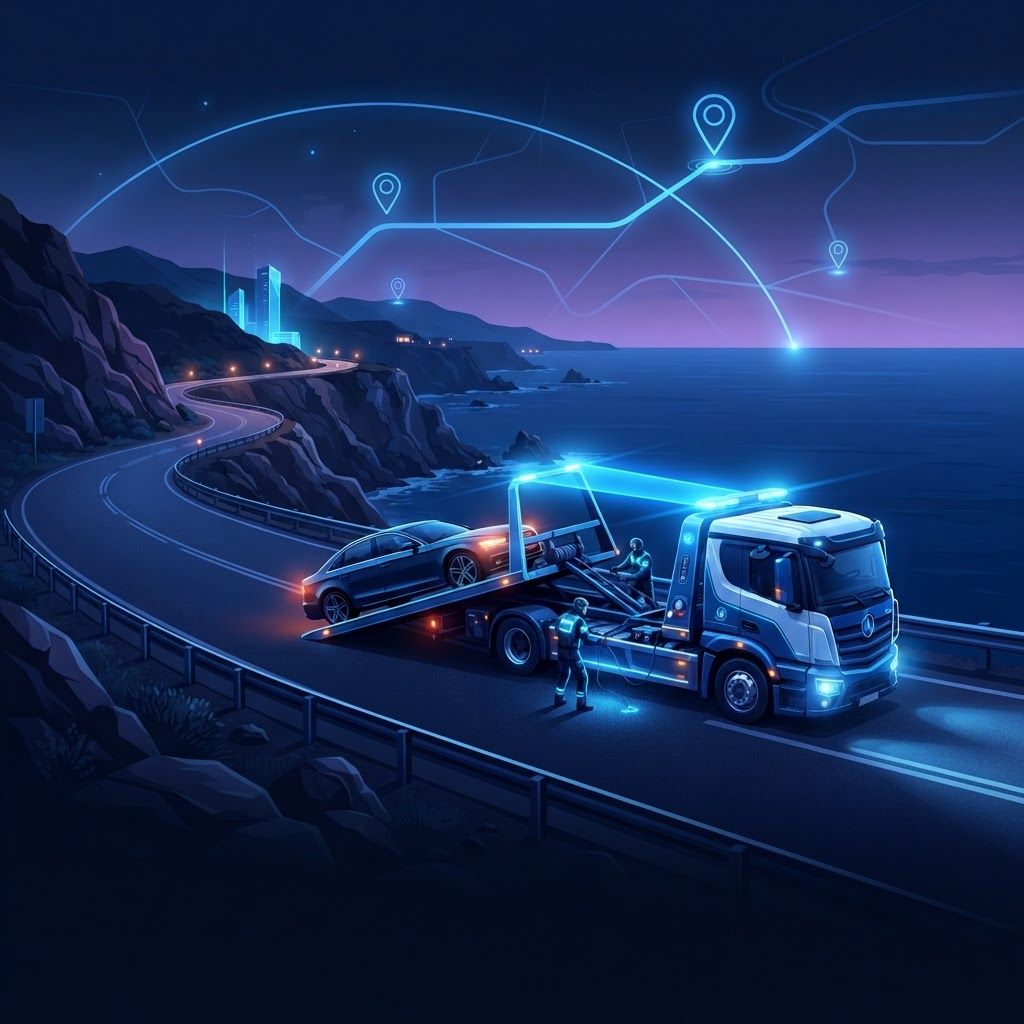
Recovery Demands Across the Tendring District
Vehicle recovery in Tendring is shaped by a road network that ranges from the busy A120 corridor into Harwich and the A133 into Clacton-on-Sea, through to single-track lanes around St Osyth, Little Clacton, Great Oakley and Wrabness. Add a substantial seasonal population increase during summer, significant port and freight traffic, marina and boatyard activity at Brightlingsea and Walton, and a large number of older vehicles in daily use, and the result is a district with genuinely varied recovery needs.
Providers here have to handle everything from a flat battery in a Clacton supermarket car park to an accident recovery on the A120, a stranded caravan at a coastal holiday park, a farm vehicle immobilised on soft ground, or an electric vehicle that cannot be towed conventionally at all. Understanding which provider handles which scenario saves time and money when you are standing at the roadside.
National Breakdown Organisations
Membership-based national providers remain the most common first call. Their advantages are broad coverage, a single point of contact, roadside repair capability that resolves a meaningful share of callouts without any towing at all, and onward travel or accommodation provisions on comprehensive policies.
In practice, national organisations subcontract a large proportion of work in districts like Tendring to local recovery operators, which means the actual vehicle and driver attending is often the same local business you could have called directly. The value of membership lies in the cost certainty and the ancillary benefits rather than in exclusive access to recovery capability.
Independent Local Recovery Operators
Independent operators form the practical backbone of recovery in the district. Their strength is response time and local knowledge. An operator based in or near Tendring knows which lanes cannot accommodate a large flatbed, where estuary roads flood on a spring tide, how to reach vehicles on beach access tracks, and which routes avoid the summer congestion along the seafront.
Independents also offer flexibility that larger organisations cannot match: negotiating a direct price for a specific job, transporting a non-member's vehicle to a chosen garage rather than a network-approved one, and handling unusual loads. For anyone without breakdown membership, keeping the number of a trusted local operator saved is genuinely worthwhile.
Flatbed and Tilt-Tray Recovery
Flatbed recovery has become the default method for good reason. Loading the entire vehicle onto a tilting bed eliminates drivetrain rotation, which is essential for all-wheel-drive vehicles, automatic transmissions, low-slung sports cars, classic vehicles and electric vehicles. It also avoids the ground-clearance problems that spectacle-lift towing creates on lowered or damaged cars.
Flatbed transport is the correct choice for accident-damaged vehicles, seized engines, gearbox failures and anything where the wheels cannot turn freely. Most modern recovery fleets in the district are flatbed-led as a result.
Spectacle Lift and Conventional Towing
Wheel-lift or spectacle-lift recovery, where the front or rear wheels are raised and the vehicle is towed on its remaining wheels, still has a place. It is faster to deploy, works well in tight urban spaces such as Clacton and Harwich town centres, and is cost-effective for short-distance moves of front-wheel-drive manual vehicles. It is not suitable for four-wheel-drive vehicles, most automatics or electric vehicles, and a competent operator will tell you so.
Heavy Recovery for Commercial Vehicles
Harwich's port operations and the district's haulage and agricultural activity generate demand for heavy recovery capability. This is a specialist field requiring rotator-equipped vehicles, substantial winching capacity, load-shifting expertise and trained crews able to work safely alongside live traffic under police and highways coordination.
Heavy recovery operators also handle overturned vehicles, jackknifed articulated units, plant machinery and load transfers where a damaged trailer's cargo must be moved to another vehicle. Response involves formal risk assessment and traffic management rather than a simple hook-up.
Accident and Insurance Recovery
Post-collision recovery involves considerations beyond moving the vehicle. Operators must make the scene safe, contain fluid spills, clear debris from the carriageway, and manage vehicle storage in secure compounds pending insurance assessment. Insurers and accident management companies maintain approved operator networks, and using an approved provider generally simplifies claims and avoids disputes over storage charges.
Drivers should be aware that storage fees accrue daily, so authorising onward movement promptly matters financially. Photograph vehicle condition before handover and keep all paperwork.
Electric and Hybrid Vehicle Recovery
Electric vehicle recovery is now a distinct discipline. High-voltage systems require operators trained to isolate power safely, recognise thermal runaway warning signs, and follow manufacturer-specific procedures. Almost all electric vehicles must be transported on a flatbed, as towing with driven wheels on the ground can damage the motor and inverter through unintended regeneration.
Operators serving this segment invest in flatbed capacity, non-conductive equipment, thermal monitoring and specialist training. As electric vehicle numbers in Essex continue rising, this capability has moved from optional to essential, and it is worth confirming when arranging recovery.
Motorcycle Recovery
Given how popular motorcycling is across Tendring's coastal and rural roads, motorcycle-specific recovery matters. Proper motorcycle transport requires a wheel chock, correct soft-strap technique that avoids suspension damage, and often a ramp or trailer designed for the purpose. Recovery operators who understand motorcycles avoid the fork and frame damage that improper strapping causes.
Off-Road, Soft Ground and Coastal Extraction
Tendring's geography produces recovery scenarios other districts rarely see. Vehicles become stuck on soft sand near beach access points, on waterlogged farm tracks after heavy rain, and on estuary causeways caught by rising tides. Extraction in these conditions demands winching expertise, appropriate anchor points, ground-protection equipment and sound judgement about when a job requires a second vehicle.
Coastal extraction is also time-critical. Salt water immersion causes rapid and severe damage to electrical systems and body cavities, so speed of response directly affects whether a vehicle is economically repairable.
Vehicle Transport and Non-Emergency Movement
Not all towing is emergency work. Enclosed and open transport services move classic cars to shows, transfer purchased vehicles between locations, deliver project cars to restoration workshops, and shift non-runners for trade customers. Harwich's ferry links also generate demand for transport of vehicles arriving from or departing to the continent.
How to Choose and What to Expect on Cost
Several factors distinguish good operators. Confirm they hold appropriate goods-in-transit and public liability insurance, and that their vehicles are correctly licensed. Ask for a clear price structure before agreeing: recovery is usually priced on a callout fee plus mileage, with surcharges for out-of-hours, bank holidays, winching and storage. Get an estimated arrival time and a contact number for the driver. Check whether the operator holds recognised industry accreditation.
Roadside safety comes first. Move to a safe location away from traffic, use hazard lights and a warning triangle where appropriate, wear a high-visibility item, and on faster roads wait behind a barrier rather than in or beside the vehicle.
Industry Trends
Electrification is driving fleet investment towards flatbed and specialist handling equipment. Digital dispatch, GPS tracking and customer-facing arrival updates have raised service expectations significantly. And roadside repair capability continues to grow, with operators carrying diagnostic tools, jump-start packs, tyre inflation kits and fuel, resolving many incidents without recovery at all.
Final Thoughts
Tendring's recovery sector is well developed, spanning national breakdown networks, capable independents, heavy recovery specialists and electric-vehicle-ready operators. Keep a trusted local number saved, understand what your breakdown cover actually includes, and confirm flatbed capability if you drive an automatic, four-wheel-drive or electric vehicle. Preparation turns a stressful roadside wait into a straightforward one.
Want your brand featured in front of decision-makers? Publish a guest post or get a link insertion in our guides through AAMAX's guest post and link insertion service.
Helpful Links
 SponsoredAAMAX — Full-Service Digital Agency
Write for Us
Share your expertise with our readers. We welcome guest contributions from industry specialists.
Pitch your idea

