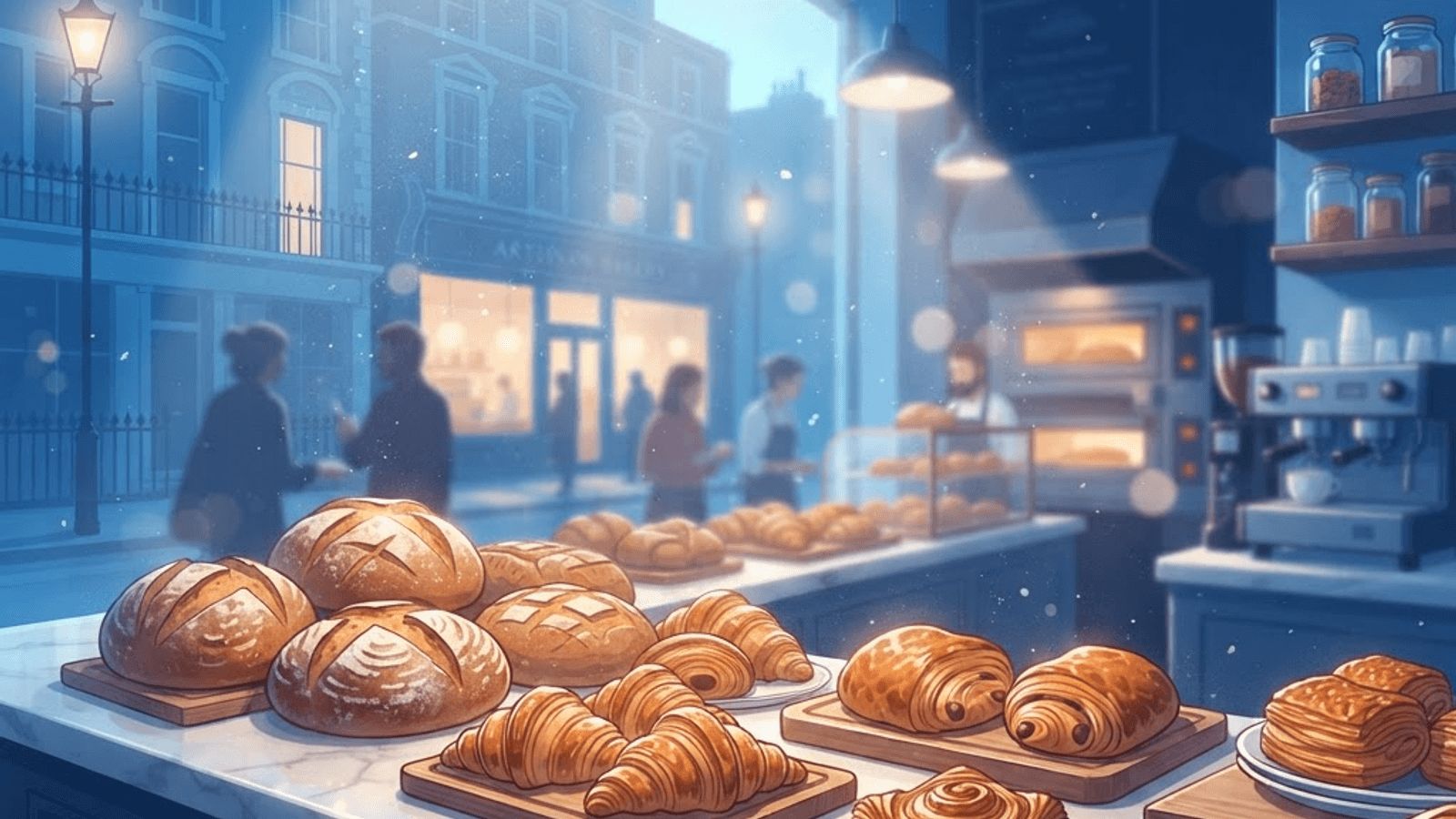
Islington's Bakery Culture
Few London boroughs take bread as seriously as Islington. The area's combination of high foot traffic along Upper Street and Essex Road, a residential population willing to pay for quality, and a long tradition of independent food retail has produced an unusually dense concentration of serious bakeries. Walk from Angel to Highbury Fields on a Saturday morning and you will pass queues outside shopfronts no wider than a front door, each with its own devoted following.
What distinguishes the borough's baking scene is technical ambition. Many Islington bakeries work with naturally leavened doughs fermented for eighteen hours or more, mill or source heritage grain, and bake in deck ovens that produce the deep caramelised crust that industrial production cannot replicate. Others focus on laminated pastry, where the discipline lies in temperature control and the patience to rest dough properly between folds. The variety means the borough supports both the bread purist and the person who simply wants an exceptional almond croissant.
Understanding What You Are Buying
The word bakery covers several very different businesses. A craft bread bakery builds its identity around fermentation, flour selection and crust development, typically offering a small range of loaves that change with the seasons. A patisserie concentrates on laminated pastries, tarts and enriched doughs where precision and finishing matter most. A bakery cafe combines a retail counter with seating and a coffee programme, functioning as much as a neighbourhood gathering place as a food shop. Continental and specialist bakeries bring specific traditions, from Italian and French to Middle Eastern and Eastern European. Finally, wholesale bakeries supply restaurants and delicatessens and often maintain a modest shopfront that offers exceptional value.
Knowing which category you want makes choosing far easier. Below are ten Islington bakeries that represent the best of each approach.
1. Dusty Knuckle Bakery
Dusty Knuckle has become one of the most talked-about bakeries in north London, and its influence reaches well into Islington through both its own counter and the delicatessens and cafes that stock its bread. The signature product is a thick-crusted, deeply fermented sourdough with an open, custardy crumb that has set a benchmark locally. Equally significant is the social mission woven through the business: the bakery runs a training programme for young people facing barriers to employment, giving genuine substance to a phrase that many food businesses use loosely. The sandwiches, built on the same bread, have a following of their own.
2. Sunshine Bakery
Sunshine Bakery has built a strong local reputation on Islington's residential streets by keeping the range tight and the quality consistent. The focus is on naturally leavened loaves, buttery pastries and a rotating selection of cakes that lean traditional rather than fashionable. It functions as a genuine neighbourhood bakery, the kind where staff recognise regulars and the morning bread sells out by early afternoon. For anyone who values reliability over novelty, it is a dependable choice.
3. Ottolenghi Islington
The Upper Street branch of Ottolenghi is arguably the most recognisable food destination in the borough, and its pastry counter deserves attention independently of the restaurant. The window display of towering meringues, glazed tarts and generously filled cakes has become a local landmark. What sets the baking apart is the flavour vocabulary: rose, pistachio, cardamom, orange blossom and sumac appear alongside classic patisserie technique, producing pastries that feel distinctly Mediterranean and Middle Eastern rather than purely French. Prices reflect the ambition, but the execution is consistently precise.
4. Little Bread Pedlar
Little Bread Pedlar supplies many of the better cafes and restaurants across north and east London, and its wholesale pedigree shows in the consistency of the product. The croissants and pain au chocolat are exemplary examples of lamination, with visible honeycomb structure and a shatter-crisp exterior. The sourdough range is more restrained than some competitors, favouring a balanced acidity that works well as everyday eating bread rather than a statement loaf. It is a strong option for anyone who prefers refinement to drama.
5. Gail's Bakery
Gail's occupies an interesting position in Islington. It is a substantial chain, which purists sometimes hold against it, but the baking standard is genuinely high and the accessibility is a real asset. Loaves are baked through the day rather than in a single morning batch, meaning fresh bread is available late. The range is broad, covering seeded sourdough, rye, focaccia, brioche and a consistently good range of pastries and seasonal buns. For families and for anyone who needs a bakery that is open when they are, it fills an important gap that the smaller independents cannot.
6. Paul Rothe and Son Style Traditional Bakers and Delicatessens
Islington retains a handful of long-established traditional bakers and delicatessen counters, often family-run across two or three generations. These businesses rarely appear in food media but serve their communities with exceptional value: proper bloomers, crusty rolls, iced buns, Chelsea buns and fruit loaves made to recipes that have not changed in decades. They also tend to be the places where you can still buy a single roll without ceremony. For anyone nostalgic for the British bakery tradition before the sourdough revolution, they are quietly essential.
7. Italian Bakeries Around Highbury and Holloway
Islington's Italian community has left a lasting culinary imprint, and the borough supports several bakeries and pasticcerie specialising in Italian breads and sweets. Expect focaccia with a properly oily, dimpled surface, pane pugliese with a thick chewy crust, cornetti that are softer and sweeter than French croissants, and cases of sfogliatelle, cannoli and ricotta tarts. Around religious holidays these bakeries produce panettone, colomba and other seasonal specialities that outclass anything mass-produced. They are also usually the best place in the borough to buy pizza by the slice cut with scissors.
8. Turkish and Middle Eastern Bakeries on Green Lanes and Holloway Road
The northern and eastern reaches of Islington and its immediate borders host outstanding Turkish, Kurdish and Middle Eastern bakeries. The defining product is pide and lavash bread pulled hot from stone or wood-fired ovens, often sold for a fraction of what artisan sourdough costs and every bit as skilfully made. Alongside the breads sit trays of baklava, kunefe and semolina cakes soaked in syrup, along with savoury borek layered with cheese or spinach. These bakeries typically operate long hours and represent some of the best value food in the borough.
9. Specialist Gluten-Free and Vegan Bakeries
Demand for allergen-conscious baking has grown steadily, and Islington now supports dedicated gluten-free and plant-based bakeries as well as mainstream bakeries with well-developed free-from ranges. The technical challenge is considerable, since gluten provides the structure that makes bread rise and pastry flake. The better operators solve it with blends of rice, buckwheat, teff and starch flours plus careful hydration, producing loaves and cakes that stand on their own merits rather than as compromises. Dedicated premises also matter for anyone with coeliac disease, since cross-contamination in a shared bakery is a genuine risk.
10. Farmers Market and Weekend Bakery Stalls
Islington's weekend markets, including the long-running farmers market near Angel and various street food gatherings, host bakery stalls run by small producers who bake overnight for a single trading day. Because these bakers have no retail overheads, they often experiment more freely: ancient grain loaves, wild yeast rye, sourdough doughnuts and regional European specialities appear regularly. Arriving early is essential, but the reward is bread and pastry made in genuinely small batches by the person who hands it to you.
What to Look For in a Great Bakery
A few practical signals separate serious bakeries from ordinary ones. Look at the crust: deep colour and audible crackle indicate proper baking rather than a cautious short bake. Examine the crumb structure, where irregular open holes suggest slow natural fermentation. Ask about flour, since bakeries proud of their sourcing will name the mill. Check whether pastries look properly layered in cross-section rather than uniformly dense. Note the daily rhythm too, because a bakery that sells out is one that bakes to demand rather than holding stock. Finally, be sceptical of enormous ranges. A bakery producing forty different items rarely excels at any of them.
Trends in the Islington Baking Scene
Several shifts are visible across the borough. Heritage and regional British grain is increasingly specified by name, reflecting interest in flavour and in shorter supply chains. Longer, cooler fermentation has become standard among craft bakeries, improving both flavour and digestibility. Waste reduction is now a visible priority, with day-old bread finding its way into puddings, croutons and discounted evening bags. Savoury pastry has grown substantially as bakeries chase lunchtime trade. And coffee programmes have improved sharply, meaning a good bakery is increasingly also a good place to drink an espresso.
Final Thoughts
Islington's bakeries reward exploration. The borough supports genuine craft bread, ambitious patisserie, deeply rooted continental traditions and unpretentious value baking, often within a few minutes of each other. Rather than settling on one, treat the area as a network: one bakery for weekday loaves, another for weekend pastries, a market stall for something unfamiliar. That approach not only eats better, it also sustains the independent businesses that give the borough its distinctive character.
Want your brand featured in front of decision-makers? Publish a guest post or get a link insertion in our guides through AAMAX's guest post and link insertion service.
Helpful Links
 SponsoredAAMAX — Full-Service Digital Agency
Write for Us
Share your expertise with our readers. We welcome guest contributions from industry specialists.
Pitch your idea