

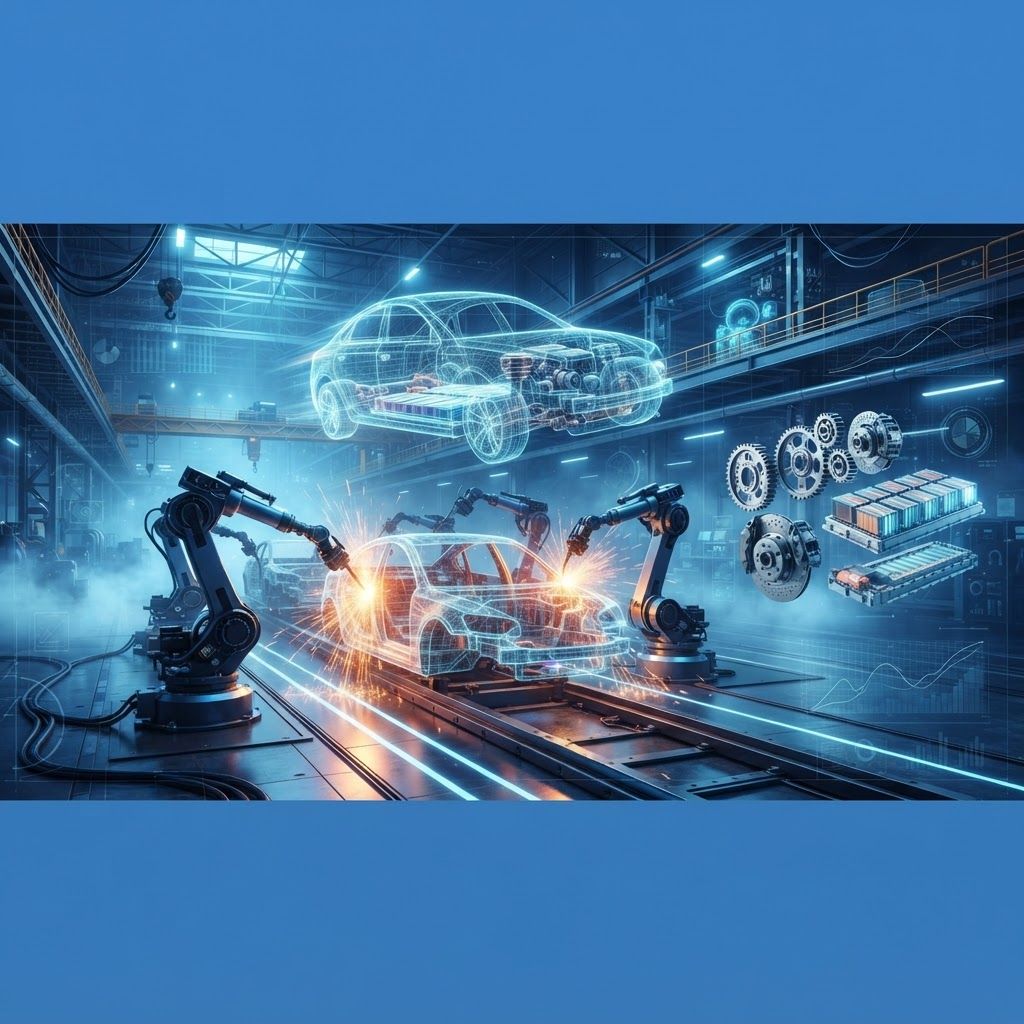
Warrington's Place in the North West Automotive Economy
The North West is one of the United Kingdom's most important automotive regions, anchored by major vehicle assembly plants at Halewood and Ellesmere Port and supported by an extensive tier one and tier two supply network. Warrington sits almost exactly in the middle of that network. Its motorway connectivity, availability of industrial floorspace and skilled engineering workforce have made it a natural home for component manufacturers, precision machining businesses, tooling specialists and commercial vehicle converters.
Local automotive manufacturing in Warrington is less about building complete cars and more about the components, sub-assemblies, tooling and specialist vehicles that keep the wider industry moving. That focus has proved resilient. While vehicle assembly volumes fluctuate with global demand, component and engineering businesses can diversify across customers, sectors and export markets.
What Defines a Strong Automotive Manufacturer
Automotive is among the most demanding manufacturing environments. Buyers should expect suppliers to hold IATF 16949 certification, the sector-specific quality management standard, alongside ISO 14001 for environmental management. Beyond paperwork, the practical markers of capability are production part approval process discipline, statistical process control on critical dimensions, robust traceability from raw material to finished part, and a measured defect rate expressed in parts per million rather than percentages.
Equally important is engineering engagement. The best suppliers contribute to design for manufacture early, proposing changes that reduce cost or improve reliability before tooling is committed. In a sector where a tooling investment can run into six figures, that early input is where real value is created.
The Top 10 Automotive Manufacturers in Warrington
Unipart Group operations in the region combine logistics, manufacturing and supply chain engineering, supporting vehicle makers with sequenced delivery and sub-assembly. Their strength is process discipline, and they are frequently cited as a benchmark for lean manufacturing practice in the United Kingdom.
Gestamp is a major producer of metal body structures and chassis components, working extensively in hot and cold stamping. For the North West supply chain its relevance is structural: body-in-white components are heavy and expensive to transport, so regional production is essential.
Sertec Group specialises in pressings and assemblies, serving both traditional and electric vehicle programmes. Its investment in battery enclosure and structural component capability illustrates how established pressing businesses are repositioning for electrification.
Magna Exteriors produces exterior systems, closures and modules, and its regional presence supports nearby assembly plants with just-in-time supply. Warrington-based engineering and machining businesses frequently sit in its second-tier supply network.
Kirkstall Precision Engineering style machining specialists in the Warrington area handle CNC turned and milled components to tight tolerances. These firms are the quiet backbone of the sector, producing the shafts, housings and fittings that larger assemblers integrate.
Bri-Stor Systems represents the commercial vehicle conversion side of the market, fitting out vans for utilities, telecoms and service fleets. With Warrington's concentration of logistics and field service operators, demand for professional racking, lighting and power conversion is consistently strong.
Cartwright Group manufactures commercial vehicle bodies, trailers and temperature-controlled units. Its proximity to the region's distribution corridors makes it a natural partner for Warrington's warehousing and food logistics operators.
Vantage Point Engineering and comparable local tooling houses design and build press tools, jigs and fixtures. Tooling capability is a genuine regional asset because it allows manufacturers to iterate quickly without exporting design work overseas.
Delphi Technologies operations in the North West focus on powertrain electronics, fuel systems and vehicle electrification components. Their engineering presence supports the transition from combustion calibration work towards power electronics and thermal management.
Warrington-based independent automotive engineering consultancies complete the picture, offering prototype build, homologation support, durability testing and low-volume specialist vehicle manufacture. These businesses serve niche manufacturers, motorsport teams and start-ups developing new mobility products.
Electrification and the Local Supply Chain
The shift to electric vehicles is the most significant change the sector has faced in a century, and it affects Warrington suppliers unevenly. Businesses producing engine, exhaust and fuel system components face declining demand and must diversify. Conversely, firms with pressing, welding, thermal management, precision machining, wiring and enclosure capability are finding new opportunities in battery packs, e-axles, power electronics housings and cooling systems.
Battery manufacturing investment in the wider region is creating second-order demand for automation equipment, cleanroom-grade assembly, precision fixturing and materials handling. Warrington's machinery and engineering businesses are well placed to capture that work, provided they invest in the relevant process knowledge.
Lightweighting is a parallel trend. Aluminium, high-strength steel and composite structures require different joining technologies, driving demand for suppliers competent in structural adhesives, self-piercing rivets and friction stir welding rather than traditional spot welding alone.
Selecting the Right Manufacturing Partner
Begin with a capability audit rather than a price request. Confirm the supplier's process capability indices on features comparable to yours, review their measurement systems and inspect their calibration records. Ask how they handle non-conforming material and how quickly containment is implemented when a defect escapes.
Then assess financial and operational resilience. Automotive programmes run for years, and a supplier failure mid-programme is enormously disruptive. Reviewing filed accounts, understanding customer concentration and confirming business continuity planning are all reasonable due diligence steps.
Finally, invest in the relationship. Warrington's automotive engineering community is tightly connected, and suppliers reward customers who provide stable forecasts, pay promptly and involve them early in design. That collaborative posture consistently produces better parts at lower total cost than adversarial procurement, and it positions both parties to adapt as the industry continues its rapid transformation.
Want your brand featured in front of decision-makers? Publish a guest post or get a link insertion in our guides through AAMAX's guest post and link insertion service.
Helpful Links
 SponsoredAAMAX — Full-Service Digital Agency
Write for Us
Share your expertise with our readers. We welcome guest contributions from industry specialists.
Pitch your idea

