

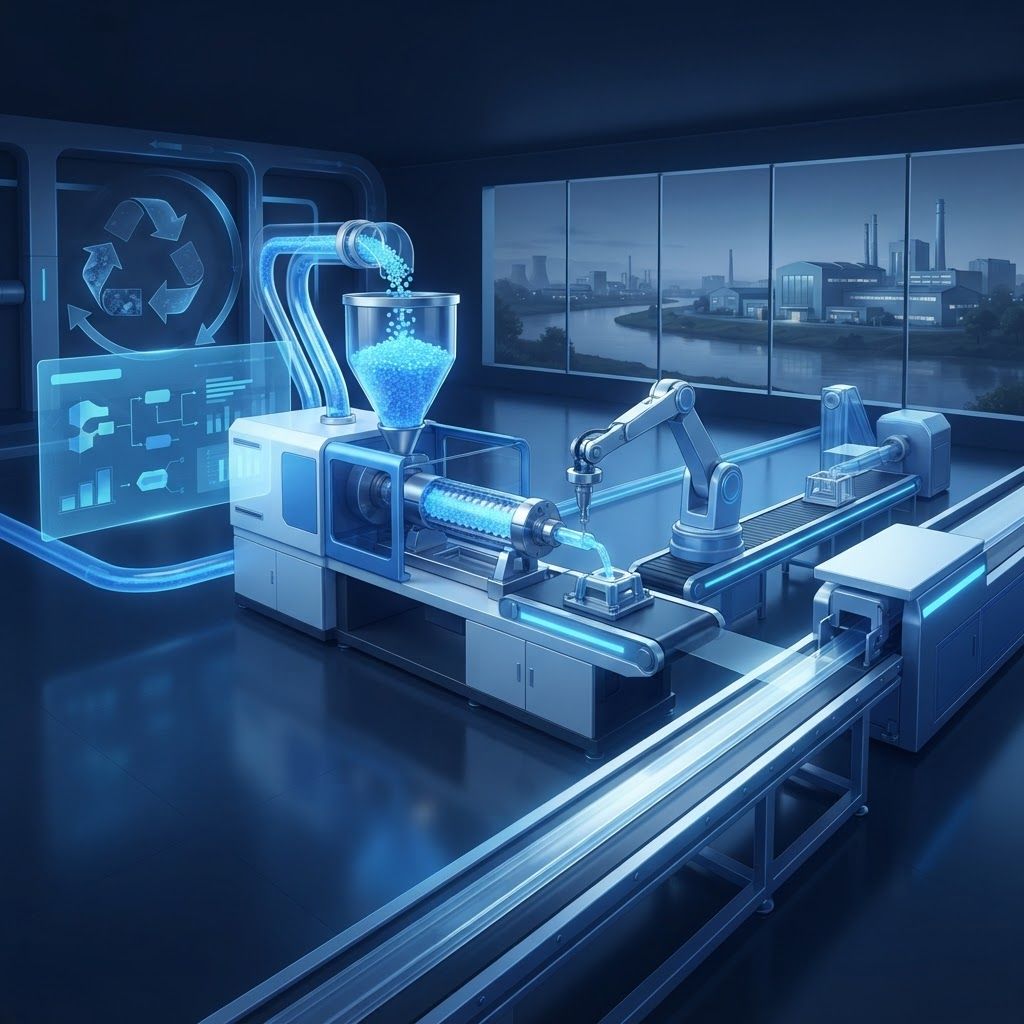
Plastics as Industrial Infrastructure
Plastics manufacturing rarely attracts attention, yet it underpins almost every other industry in North Tyneside. Offshore and subsea engineering relies on engineering polymers for buoyancy, insulation, bearings and protective components. Food producers need packaging. Construction needs pipes, ducting, membranes and cladding. Electronics needs housings and insulation. Healthcare needs sterile disposables. Automotive needs mouldings and trim.
The borough industrial estates host moulders, fabricators, converters and distributors serving these markets, alongside recycling and reprocessing operations that have grown substantially as waste regulations tightened. Combined with the wider Tyne and Wear polymer supply chain, this gives local manufacturers reasonable access to materials, tooling and technical support.
The Main Manufacturing Processes
Injection moulding produces high volumes of identical parts by injecting molten polymer into a steel tool. It requires significant tooling investment, so it suits established products with predictable demand. Extrusion produces continuous profiles, pipes, sheets and films, common in construction and packaging. Vacuum forming and thermoforming shape heated sheet over a mould, offering lower tooling cost for larger, simpler parts.
Plastic fabrication involves cutting, machining, bending and welding sheet and rod to produce tanks, guards, ducting, enclosures and equipment, ideal for one off and low volume industrial work. Rotational moulding creates large hollow items such as tanks. Composite fabrication using glass reinforced plastic produces marine, water treatment and architectural components. And increasingly, additive manufacturing produces prototypes and low volume functional parts.
The Top 10 Plastic Manufacturers Serving North Tyneside
1. Trelleborg Offshore and Subsea Polymer Specialists
Engineering polymer and elastomer specialists supply buoyancy modules, cable protection, bend restrictors and thermal insulation to the offshore energy sector, drawing directly on the Tyne subsea engineering cluster.
2. Tyneside Injection Moulding Companies
Moulders across the borough and wider region produce components for automotive, electrical, consumer and industrial customers, offering tool design and management, material selection advice and assembly services alongside moulding.
3. Industrial Plastic Fabricators
Fabrication specialists build tanks, bunds, ducting, machine guards, chemical handling equipment and enclosures from engineering thermoplastics. This work serves water treatment, chemical, food and engineering clients where corrosion resistance beats metal.
4. Polypipe and Construction Plastics Suppliers
Manufacturers of drainage, plumbing, ventilation and water management systems supply the borough substantial construction and housing sector, with growing emphasis on recycled content and surface water management products.
5. Packaging Manufacturers and Converters
Regional packaging producers manufacture rigid containers, films, trays and protective packaging for food producers, distributors and manufacturers, increasingly redesigning products for recyclability and reduced material use.
6. Glass Reinforced Plastic and Composite Fabricators
Composite specialists produce marine components, tanks, covers, walkways and architectural panels. Their materials offer high strength to weight ratio and corrosion resistance, valuable in coastal and marine applications.
7. Biffa Polymers and Regional Plastic Recyclers
Recycling and reprocessing operations collect, sort, wash and pelletise waste plastic into usable feedstock. Their role has become central as recycled content requirements and packaging taxes reshape material choices.
8. Vacuum Forming and Thermoforming Specialists
Thermoformers produce larger parts, machine panels, trays, point of sale displays and covers at lower tooling cost than injection moulding, making them ideal for medium volume industrial and retail work.
9. Plastic Distributors and Sheet Suppliers
Distributors holding engineering plastic sheet, rod and tube in materials such as polyethylene, polypropylene, acrylic, polycarbonate and nylon supply fabricators and engineers across North Tyneside with cutting and machining services included.
10. Additive Manufacturing and Prototyping Services
Three dimensional printing bureaux support product developers and engineering firms with rapid prototyping, jigs, fixtures and low volume functional parts, dramatically shortening development cycles for local manufacturers.
Sustainability and Regulation
No manufacturing sector faces more scrutiny than plastics, and the industry response has been substantial. The plastic packaging tax created direct financial incentive to incorporate recycled content, driving investment in reprocessing and material qualification. Extended producer responsibility reforms are shifting waste management costs onto producers, which rewards designing for recyclability.
Design for recycling has become a genuine engineering discipline, involving mono material construction rather than mixed laminates, avoiding problematic pigments, reducing part count and enabling easy separation. Lightweighting reduces material use and transport emissions simultaneously.
At the same time, engineers push back sensibly against blanket criticism. In many applications plastics reduce total environmental impact by cutting weight, extending food shelf life, resisting corrosion without coatings and lasting decades in buried infrastructure. The credible position is appropriate material selection and effective circularity rather than avoidance.
How to Choose a Plastics Manufacturing Partner
Match the process to your volume. Injection moulding rarely makes sense below a few thousand parts unless the tool is simple, while fabrication and thermoforming suit low volumes. Discuss material selection openly, including mechanical, chemical, temperature, ultraviolet and food contact requirements.
Ask about tooling ownership, maintenance and storage, as tooling disputes are a common commercial problem. Check quality systems, dimensional inspection capability and whether the manufacturer can provide material certification. For food or medical applications, confirm relevant accreditation and hygiene controls.
Finally, discuss recycled content options and end of life design early, since retrofitting sustainability into a finished design is expensive and usually compromised.
Final Thoughts
Plastics manufacturing in North Tyneside is diverse, technically capable and closely tied to the borough offshore, construction and food sectors. From subsea polymer engineering to fabrication, packaging and recycling, local suppliers can support products from prototype through to volume production. The manufacturers investing in recycled materials, design for recycling and process efficiency are the ones best placed for the regulatory environment ahead.
Want your brand featured in front of decision-makers? Publish a guest post or get a link insertion in our guides through AAMAX's guest post and link insertion service.
Helpful Links
 SponsoredAAMAX — Full-Service Digital Agency
Write for Us
Share your expertise with our readers. We welcome guest contributions from industry specialists.
Pitch your idea

