Dagenham and the British Motor Industry
Few industrial sites in Britain carry the significance of Dagenham. The vast riverside plant established there became one of the largest automotive manufacturing complexes in Europe, employing tens of thousands of people at its height and producing millions of vehicles. It shaped the borough's population, housing, transport and identity for generations, and the industrial disputes that occurred there influenced national employment law.
Vehicle assembly at Dagenham ended, but the site did not close. Engine production continued, and the plant became a major centre for diesel engine manufacturing supplying vehicles built elsewhere. That transition — from complete vehicle assembly to specialised component manufacturing — mirrors what happened across the British automotive industry more broadly, and it explains why the borough's automotive relevance persists in a different form.
The Leading Automotive Manufacturers
Ford Motor Company remains inseparable from Dagenham's identity. Its engine manufacturing operation has continued at the site, producing powertrains for commercial and passenger vehicles, and the company's investment in the location has extended into electrified vehicle components as its product strategy has shifted.
London Electric Vehicle Company manufactures purpose-built electric taxis and light commercial vehicles, and its products are ubiquitous on London streets. Vehicles designed specifically for urban duty cycles represent a genuinely distinct engineering challenge from adapted passenger cars.
Jaguar Land Rover is the largest UK-based vehicle manufacturer, with substantial engineering and production operations and an accelerating transition towards electrified platforms. Its supply chain extends widely across the South East.
BMW Group operates UK manufacturing including engine production and vehicle assembly, and its electric drivetrain investment has reshaped several of its British facilities.
Nissan maintains one of the most productive vehicle plants in Europe, with battery manufacturing developed alongside vehicle assembly — an integration increasingly necessary as electrification advances.
Toyota Manufacturing UK produces vehicles and engines with a manufacturing system widely studied for its approach to quality and continuous improvement.
Alexander Dennis manufactures buses and coaches, including zero-emission models operating in London. Bus manufacturing has been an early beneficiary of electrification because fixed routes and depot charging suit battery technology well.
Wrightbus, Arrival and Tevva complete the group with a focus on commercial vehicle electrification. Wrightbus produces battery electric and hydrogen fuel cell buses. Arrival pursued modular electric van manufacturing using localised assembly. Tevva develops electric and hydrogen-supported heavy goods vehicles aimed at the urban and regional freight duty cycles common across east London.
Manufacturing and Engineering Capabilities
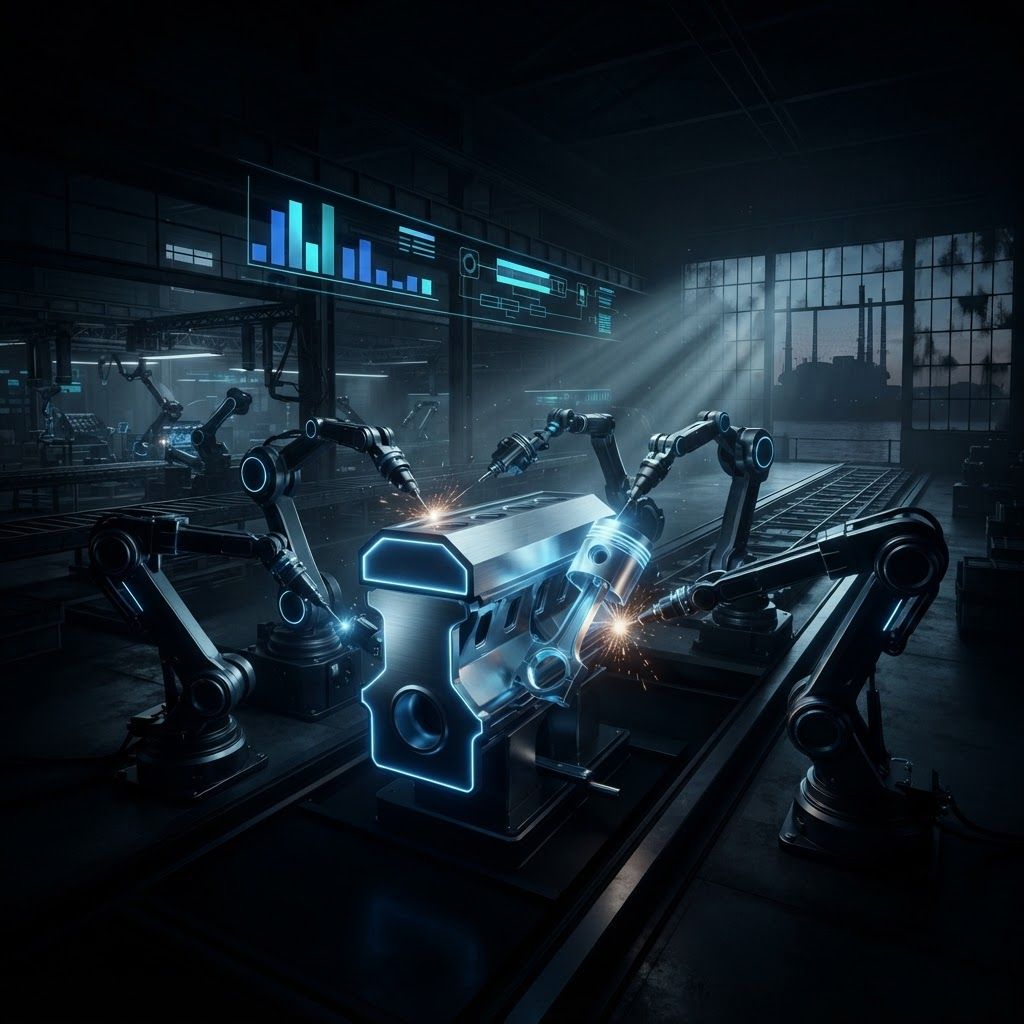
Powertrain manufacturing has been Dagenham's principal contribution in recent decades. Engine production involves precision machining of blocks, heads and crankshafts to tolerances measured in microns, followed by assembly and comprehensive testing. The metrology and process control this demands represents genuinely advanced manufacturing.
Electrification has introduced entirely new manufacturing requirements. Battery pack assembly, electric motor production, power electronics and thermal management systems each need different equipment, skills and safety protocols than internal combustion manufacturing. High-voltage working introduces hazards requiring specific training and infrastructure.
Commercial vehicle manufacturing follows different economics from passenger cars. Lower volumes, greater customer-specific variation and longer service lives favour flexible assembly rather than high-speed automation. This makes it more accessible to smaller manufacturers and specialist converters.
The supply chain surrounding vehicle manufacturing is extensive: pressings, castings, machined components, wiring harnesses, seating, trim, glass, fasteners, coatings and logistics. Much of this activity occurs in industrial estates of exactly the type found across Barking and Dagenham, and it accounts for a large share of automotive employment.
Aftermarket and remanufacturing operations form a further tier. Component remanufacturing — restoring used units to original specification — has both economic and environmental logic, and it is growing as circular economy principles gain traction.
Trends Reshaping Automotive Manufacturing
Electrification is the defining transition. It changes vehicle architecture fundamentally, reduces the component count in powertrains, shifts value towards batteries and power electronics, and requires substantial retooling. For established plants, managing this transition without losing volume during the changeover is the central strategic challenge.
Battery supply chain development has become a national industrial priority. Cell manufacturing capacity, cathode and anode material processing, and battery recycling all need to scale, and locations with grid capacity, industrial land and skilled labour are being actively assessed for these facilities.
Software has become a defining product attribute. Vehicles now depend on extensive software for driver assistance, connectivity and energy management, and over-the-air updating has changed the relationship between manufacturer and vehicle throughout its life. This has drawn software engineering capability into an industry historically dominated by mechanical disciplines.
Urban air quality regulation directly influences product demand. Low emission zone requirements across London have accelerated fleet renewal towards compliant and zero-emission vehicles, creating immediate demand for electric vans, buses and trucks — a market where several UK manufacturers have concentrated.
Skills transition is a substantial challenge and opportunity. Workers with mechanical assembly and machining expertise need additional competence in high-voltage systems, battery handling and electronics diagnostics. For a borough with automotive heritage and established technical education provision, delivering that retraining is a genuine economic opportunity.
Working With Automotive Manufacturers
Suppliers entering automotive supply chains should understand the qualification burden. Sector-specific quality management standards, production part approval processes and rigorous documentation requirements are mandatory rather than negotiable, and preparation typically takes considerable time.
Fleet operators specifying vehicles should evaluate total cost of ownership rather than purchase price. Electric commercial vehicles carry higher capital cost but substantially lower energy and maintenance expenditure, and duty cycle determines whether the arithmetic works.
Charging and depot infrastructure requires early planning. Electrifying a commercial fleet demands grid capacity assessment, charger installation and often significant electrical upgrade work, with lead times that must be programmed alongside vehicle procurement.
Conclusion
Barking and Dagenham's automotive story has shifted from mass vehicle assembly to specialised powertrain manufacturing and, increasingly, to the components and skills that electrification requires. The manufacturers most relevant to the borough combine engineering depth with credible transition strategies towards zero-emission products. The borough's industrial inheritance — skills, land and infrastructure — positions it to remain part of that industry rather than merely remember it.
Want your brand featured in front of decision-makers? Publish a guest post or get a link insertion in our guides through AAMAX's guest post and link insertion service.
Helpful Links
 SponsoredAAMAX — Full-Service Digital Agency
Write for Us
Share your expertise with our readers. We welcome guest contributions from industry specialists.
Pitch your idea