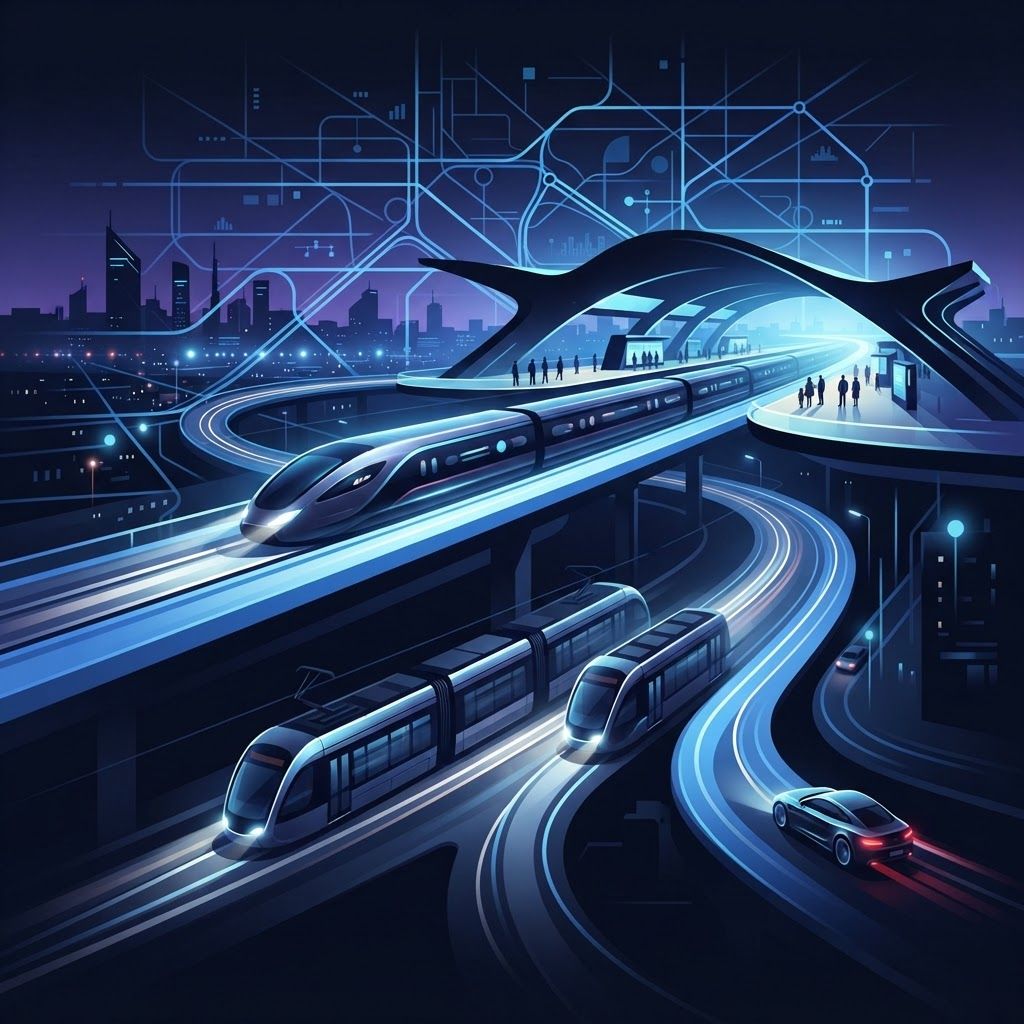
Rail in Rochdale: A Long and Significant History
Rochdale's relationship with the railway goes back to the earliest decades of the network. The Manchester and Leeds Railway reached the town in the 1830s, and the line through the Calder Valley became one of the first trans-Pennine routes in the world. That history is not merely of antiquarian interest, because the geography it established still shapes how the borough travels today.
Modern Rochdale is served by Rochdale railway station, alongside Castleton, Smithy Bridge and Littleborough on the Calder Valley line, and Mills Hill serving the Middleton area. Rochdale station is also a Metrolink terminus, and the tram continues into Rochdale town centre, giving the borough something relatively unusual: a genuine interchange where national rail, light rail and the bus network meet in one place.
How the Railway Is Structured
Understanding rail in Britain requires separating three roles. Infrastructure, meaning track, signalling, bridges and most large stations, is managed by Network Rail. Train services are provided by train operating companies under contracts or concessions. Light rail such as Metrolink operates under a separate regional framework. Passengers experience one journey, but several organisations are responsible for delivering it.
Operators and Bodies Serving Rochdale
Northern
Northern is the principal train operator at Rochdale station and along the Calder Valley line. It provides the local and regional stopping services connecting the borough to Manchester Victoria, Todmorden, Hebden Bridge, Halifax, Bradford and Leeds, as well as westward services towards Manchester and beyond. For most Rochdale rail passengers, Northern is the operator they use daily.
Its strengths are frequency on core corridors and comprehensive coverage of smaller stations that other operators do not serve. Northern has also invested heavily in newer rolling stock, replacing older units with modern trains offering air conditioning, power sockets, improved accessibility and passenger information screens. Its network-wide ticketing, including advance fares and a mobile app with digital tickets, has improved considerably.
Metrolink
Metrolink is Greater Manchester's tram network, and the Rochdale line is one of its most transformative extensions. Trams run from Rochdale town centre and Rochdale railway station through Kingsway Business Park, Newbold, Milnrow, Shaw and Crompton, Oldham and Failsworth into central Manchester. Journey frequency is the headline advantage: trams run at short, regular intervals throughout the day, removing the need to plan around a timetable.
Metrolink is integrated into the wider regional travel framework, with contactless payment, daily and weekly capping and connections to the franchised bus network. For commuters into Manchester, it offers a step-free, high-frequency alternative to driving on congested motorways.
TransPennine Express
TransPennine Express operates longer-distance services across the north of England, linking Manchester with Leeds, York, Newcastle, Hull, Liverpool and Scotland. While its trains do not call at every local Rochdale station, the operator is highly relevant to borough residents making longer journeys, who typically connect via Manchester Victoria or Piccadilly. Its services offer higher-specification rolling stock, reservations, catering on many routes and faster point-to-point timings.
Network Rail
Network Rail owns and maintains the infrastructure through the borough, including the Calder Valley route, Rochdale station buildings and platforms, level crossings and the signalling that governs capacity. Its investment decisions determine how many trains can run and how reliably. Electrification schemes, resignalling, drainage improvements on the Pennine sections and station accessibility upgrades all fall within its remit.
Transport for Greater Manchester
Transport for Greater Manchester coordinates the region's transport strategy, owns the Metrolink network, manages the Bee Network integration programme and works with train operators on local rail improvements. Its long-term ambition is to bring local rail services into the same integrated ticketing and branding framework as bus and tram, which would substantially simplify travel for Rochdale passengers.
Rail Delivery Group and National Rail
The National Rail framework, coordinated through the Rail Delivery Group, provides the shared systems that make cross-operator travel possible: through ticketing, the national timetable, journey planning data and passenger information. When a Rochdale passenger buys a single ticket to a destination requiring three operators, this is the machinery that makes it work.
Rail Freight Operators
Freight companies including the major UK rail haulage operators run services on the routes serving and passing through the borough, moving aggregates, intermodal containers, cement and engineering trains. Rail freight removes substantial lorry mileage from the M62 corridor and is a significant, if less visible, part of the borough's rail activity.
Community Rail Partnerships
Community rail partnerships work along lines including the Calder Valley route, promoting local rail travel, improving station environments through volunteer gardening and art projects, and representing passenger interests to operators. Their impact on station perception and local usage is genuinely measurable.
Heritage Rail Organisations
Within reach of the borough, heritage railways preserve steam and early diesel operation, offering both a visitor attraction and an important link to the region's industrial past. For Rochdale residents interested in railway history, these organisations provide the most direct connection to it.
Trends Shaping Rochdale Rail Travel
Integration is the most important current trend. The extension of Bee Network principles to local rail would give Rochdale passengers a single fare structure and a single point of accountability across tram, bus and train. Contactless capping across modes is already changing travel behaviour.
Capacity is the second theme. The Calder Valley line carries a mixture of local, regional and freight traffic on largely two-track infrastructure, and trans-Pennine capacity improvements would directly benefit Rochdale services. Proposals for electrification and enhanced line speeds remain central to regional transport planning.
Accessibility continues to improve, with step-free access, tactile platform surfaces, better lighting and clearer audio-visual information becoming standard rather than exceptional. Metrolink's fully level boarding has set an expectation that heavy rail stations are progressively working towards.
Practical Advice for Passengers
For commuting into Manchester, compare tram and train honestly. The train is faster to Victoria; the tram is more frequent, serves more intermediate stops and reaches different parts of the city centre. For longer journeys, book advance tickets where travel times are fixed, and check whether a split-ticketing option reduces cost. Always use contactless capping on tram and bus rather than buying individual tickets, and check engineering work notices before weekend travel on the Calder Valley route.
Conclusion
Rochdale enjoys a rail offer that combines a historic main line with a modern tram network, served by operators with distinct and complementary roles. Understanding which organisation does what makes it far easier to plan journeys well and to follow the improvements that will shape travel in the borough over the coming years.
Want your brand featured in front of decision-makers? Publish a guest post or get a link insertion in our guides through AAMAX's guest post and link insertion service.
Helpful Links
 SponsoredAAMAX — Full-Service Digital Agency
Write for Us
Share your expertise with our readers. We welcome guest contributions from industry specialists.
Pitch your idea