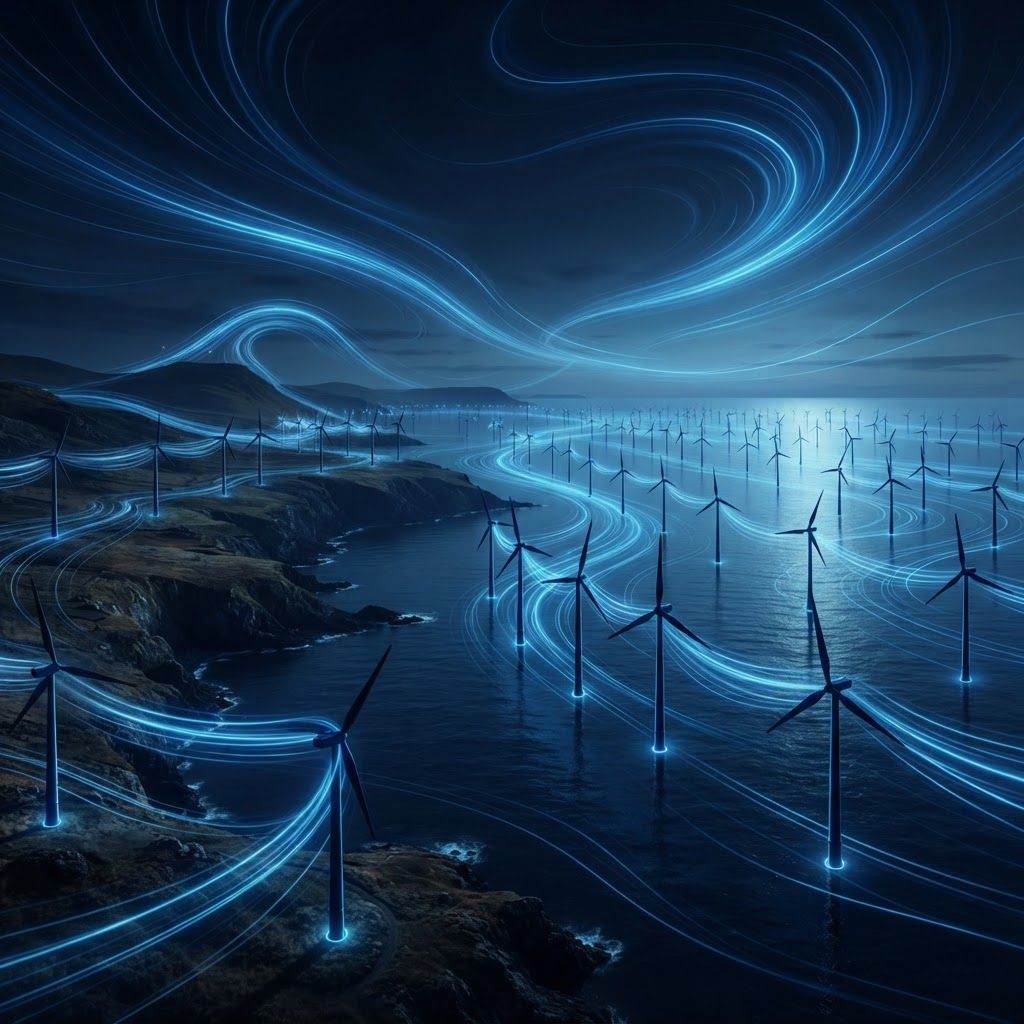
The Regional Wind Opportunity
The north west coast of England hosts some of the most productive wind resource in Europe. Offshore developments in the Irish Sea have transformed the regional energy landscape, and the supporting supply chain extends well inland. West Lancashire sits within that economic footprint, benefiting from both onshore generation opportunities on its exposed flat farmland and from service, manufacturing and skills activity feeding larger offshore projects.
Onshore wind in the borough operates at a different scale from the offshore arrays visible from the coast. Single farm turbines and small clusters provide substantial generation for agricultural operations and rural businesses with significant electricity demand. Cold storage, grain drying, irrigation pumping and livestock housing all consume heavily, and wind generation has the advantage of producing through winter months and overnight when solar does not.
Understanding Wind Energy at Different Scales
Small wind turbines, typically below one hundred kilowatts, serve individual farms and businesses, offsetting on-site consumption. Medium-scale turbines produce enough to export meaningfully and require more substantial planning and grid consideration. Large onshore developments involve multiple turbines and lengthy consenting processes. Offshore wind operates at an entirely different scale, with projects supported by extensive operations, maintenance and logistics chains that create inland employment and supplier opportunities.
Complementary activities matter too. Grid connection engineering, foundation and civil works, blade and component maintenance, technician training and environmental assessment all form part of the sector.
The Top 10 Wind Energy Companies in West Lancashire
1. Coastal Wind Partners
The most established wind developer serving the borough, covering site assessment, planning, construction management and long-term operation of onshore turbines. Its experience across the full project lifecycle is valuable for landowners who need realistic feasibility advice before committing to a lengthy development process.
2. West Lancashire Turbine Services
Providing operations and maintenance for existing turbines, including scheduled servicing, gearbox and generator work, blade inspection and performance optimisation. Availability directly determines revenue for turbine owners, making responsive maintenance commercially significant.
3. Burscough Farm Wind Systems
Specialising in small and medium turbines for agricultural holdings, matching generation capacity to farm consumption patterns. It handles feasibility, wind resource assessment, planning support and installation, and advises on combining wind with solar for more consistent year-round output.
4. Irish Sea Offshore Support Services
Supporting offshore wind operations with logistics, technician services, component handling and supply chain coordination. Its inland base provides the warehousing and workshop capacity that coastal operations require without occupying constrained port space.
5. Skelmersdale Wind Engineering
Delivering engineering and fabrication for wind projects, including structural components, access systems and electrical infrastructure. The borough's manufacturing base has adapted well to supplying the renewable sector, and this company exemplifies that transition.
6. Ormskirk Renewable Planning Consultants
Advising on planning applications for wind development, including environmental impact assessment, noise and shadow flicker modelling, landscape and visual assessment and community consultation. Planning remains the principal hurdle for onshore wind, and specialist support materially improves prospects.
7. Tarleton Grid Connection Specialists
Handling connection applications, network studies, substation works and export arrangements. Grid capacity constraints across the region frequently determine project viability, and early expert engagement prevents wasted development expenditure.
8. Parbold Wind Resource Assessment
Conducting wind measurement, data analysis and energy yield modelling. Accurate resource assessment is the foundation of any credible financial case, and overestimated yield remains the most common cause of disappointing turbine investments.
9. Up Holland Community Wind Projects
Developing community-owned wind schemes with local shareholding and reinvestment of surplus into local initiatives. Community ownership models tend to attract stronger local support and retain financial benefit within the borough.
10. Northway Wind Technician Training
Delivering safety, rescue and technical training for wind technicians, including working at height and turbine-specific competencies. The sector faces persistent skills shortages, and local training provision supports both employment and project delivery capacity.
Considerations for Wind Projects
Resource assessment comes first. Wind speed varies considerably over short distances depending on topography, obstructions and elevation, and energy output scales with the cube of wind speed. A modest difference in average speed produces a large difference in generation, which makes proper measurement essential rather than optional.
Planning requires early and genuine engagement. Visual impact, noise, shadow flicker, ecology particularly regarding bats and birds, and cumulative effects with existing development all feature in assessment. Projects that consult neighbours early and adjust design in response generally fare better than those that treat consultation as a procedural formality.
Grid connection can be the deciding factor. Capacity availability, connection cost and timescales vary substantially by location, and in constrained areas connection charges can exceed turbine costs.
Plan for the full lifecycle. Turbines require ongoing maintenance, insurance and eventual decommissioning, and financial models that ignore these costs overstate returns significantly.
Trends in Wind Energy
Turbine efficiency continues to improve, with larger rotor diameters capturing more energy at lower wind speeds and making previously marginal sites viable. Repowering of older installations with modern machines is increasing, often doubling output from the same site. Hybrid projects combining wind, solar and battery storage are becoming standard, smoothing output and improving grid connection utilisation. Offshore capacity in the Irish Sea continues to expand, sustaining regional supply chain demand. And corporate power purchase agreements are providing revenue certainty that supports project financing.
Final Thoughts
Wind energy in West Lancashire spans farm-scale generation, development and planning expertise, engineering supply, offshore support and technician training. The borough benefits from a strong natural resource and from proximity to major offshore activity. For landowners and rural businesses considering generation, the fundamentals remain unchanged, namely accurate resource measurement, realistic planning expectations, early grid engagement and honest lifecycle costing. Projects built on those foundations continue to perform well over their operating lives.
Want your brand featured in front of decision-makers? Publish a guest post or get a link insertion in our guides through AAMAX's guest post and link insertion service.
Helpful Links
 SponsoredAAMAX — Full-Service Digital Agency
Write for Us
Share your expertise with our readers. We welcome guest contributions from industry specialists.
Pitch your idea