

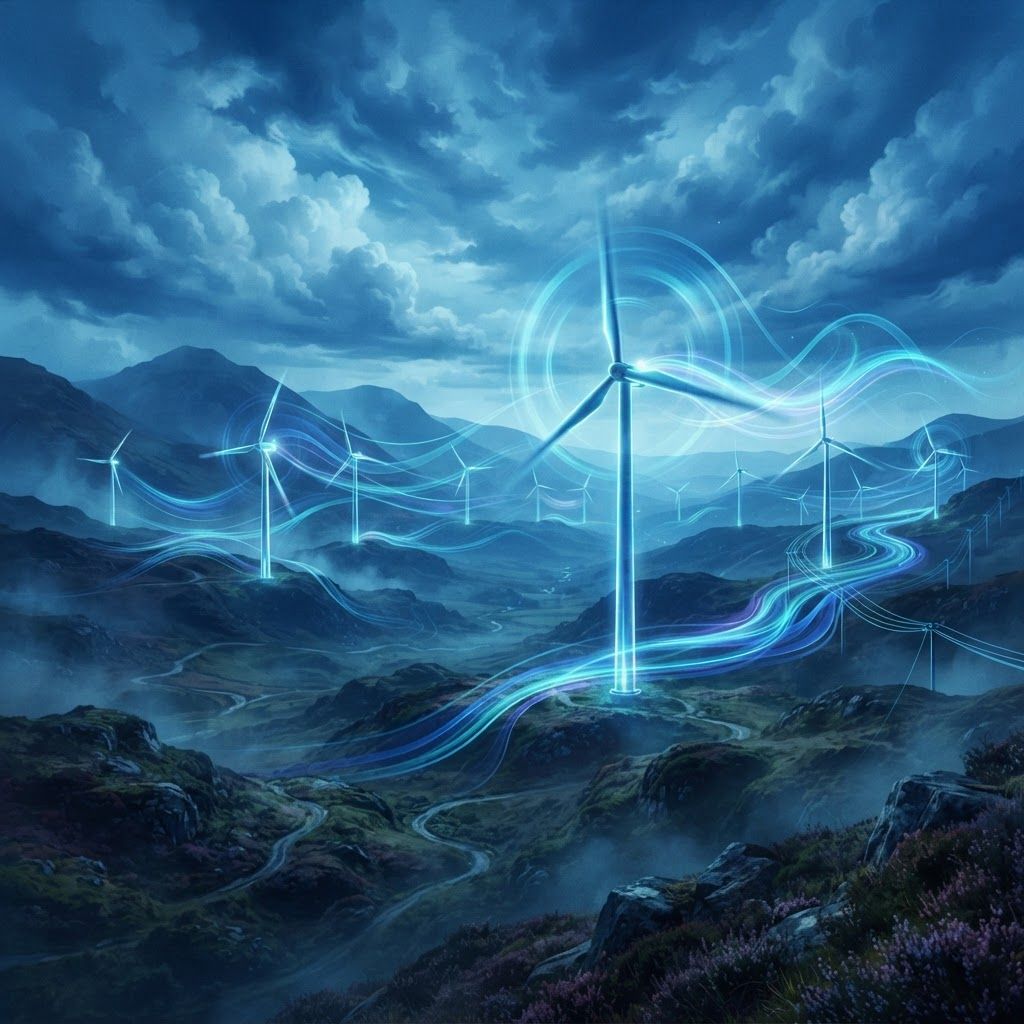
Wind Power and the Powys Uplands
The uplands of Powys offer some of the strongest and most consistent wind resource in Wales. Exposed plateau country across the Cambrian Mountains, combined with proximity to grid infrastructure and relatively low population density, has made the county a focus of onshore wind development since the industry's earliest days in Britain. Wind farms across Montgomeryshire, Radnorshire and the Brecon uplands now generate a substantial quantity of electricity, and mid-Wales remains central to Welsh renewable ambitions.
Wind development in Powys has never been uncontroversial. The landscape is a major economic asset in its own right through tourism, and debates about visual impact, cumulative development, access road construction, peat disturbance and transmission infrastructure have been vigorous. What has emerged is a more mature industry that engages earlier with communities, offers meaningful benefit funds and local ownership stakes, and pays closer attention to landscape and ecological sensitivity.
The Structure of the Wind Industry
Developers identify sites, secure land agreements, undertake environmental assessment, obtain consent and arrange grid connection. Consenting for larger schemes in Wales is handled through national infrastructure processes, while smaller schemes go through local planning. Construction contractors handle civils, foundations, access tracks, cabling and turbine erection, work that can bring substantial temporary employment to rural areas.
Operators run the assets across a typical twenty-five to thirty-five year life, managing generation, compliance, landowner relationships and community funds. Operations and maintenance providers service turbines, including blade inspection and repair, gearbox and generator work and increasingly drone-based inspection. Repowering specialists replace ageing turbines with fewer, larger, more productive machines on established sites. Finally, small and medium wind providers serve farms and rural businesses with single turbines.
The Top 10 Wind Energy Companies in Powys
1. Bute Energy. A Welsh developer with one of the largest onshore wind pipelines in the country, Bute Energy has advanced multiple energy park proposals across mid-Wales alongside associated grid infrastructure. Its emphasis on Welsh ownership, community funds and local supply chain participation has made it a prominent name in the county.
2. RWE. One of the largest renewable generators operating in Wales, RWE manages significant onshore wind capacity with long-term operational expertise, established maintenance regimes and substantial experience of working with rural landowners and communities.
3. Vattenfall. The international energy company operates Welsh onshore wind assets and brings considerable technical and financial capability to development and operation, with structured community benefit programmes attached to its sites.
4. Renewable Energy Systems. A developer, constructor and asset manager with a long UK track record, RES has been involved in mid-Wales wind projects and offers full lifecycle capability from feasibility through to long-term operations.
5. Statkraft. Active in UK onshore renewables and grid services, Statkraft develops and operates wind and associated flexibility assets, and works with landowners on long-term project agreements in mid-Wales.
6. Coriolis Energy and mid-Wales project developers. Specialist onshore wind developers focused on Welsh and border sites undertake the detailed feasibility, landscape assessment, ecology surveys and community consultation that precede any application.
7. Dulas. The Machynlleth-based renewable engineering company has long experience in wind resource assessment, feasibility and small to medium scale turbine projects, providing genuinely local technical expertise within the county.
8. Small and farm-scale wind specialists. Companies supplying and installing single turbines for farms and rural businesses handle wind resource measurement, planning applications, grid connection and installation. For high-consumption agricultural operations in exposed locations, a well-sited turbine can transform energy costs.
9. Wind turbine operations and maintenance contractors. A growing cluster of technical service providers supports the mid-Wales fleet with scheduled servicing, blade repair, high-voltage work, remote monitoring and emergency response. These roles represent some of the best-paid technical employment in rural Powys.
10. Community wind and cooperative energy organisations. Community-owned turbine projects in Wales demonstrate an alternative model where local shareholders own the asset and surpluses fund community priorities. Several Welsh cooperatives support Powys groups in developing these schemes.
Current Trends in Powys Wind
Grid infrastructure is the dominant issue. Mid-Wales has limited transmission capacity relative to its generation potential, and proposals for new overhead lines and substations have prompted extensive public debate about landscape impact and the case for undergrounding. Resolution of this question will shape the next decade of development in the county.
Repowering is increasingly relevant as the earliest Powys wind farms approach the end of their original design life. Replacing many small turbines with fewer, taller and far more productive machines can increase output several-fold on the same footprint, though taller structures raise fresh landscape questions.
Local ownership requirements have strengthened under Welsh policy, with expectations that new renewable projects include an element of local or shared ownership. This changes the economics and the community relationship in a meaningful way.
Colocation with battery storage is now standard practice in new projects, smoothing output and providing grid services. Ecology and peatland protection have also risen in prominence, with careful hydrological design required on sensitive upland sites.
Considerations for Landowners
Landowners approached about hosting turbines or associated infrastructure should take independent advice before signing anything. Option agreements can tie land for many years before a project even proceeds. Key points include the length of the option and lease, rent structure and review mechanism, access and cable easements, decommissioning obligations and security for reinstatement, restrictions on the remaining land, and the tax and agricultural relief implications of non-agricultural income. Engaging a rural surveyor and an agricultural solicitor at the outset is invariably worthwhile.
Final Thoughts
Wind energy is embedded in the Powys economy and landscape, providing generation capacity, landowner income, community funding and skilled technical employment. The companies listed here range from major international operators to local engineering firms and community cooperatives, reflecting an industry that is at once global in capital and distinctly local in impact.
Want your brand featured in front of decision-makers? Publish a guest post or get a link insertion in our guides through AAMAX's guest post and link insertion service.
Helpful Links
 SponsoredAAMAX — Full-Service Digital Agency
Write for Us
Share your expertise with our readers. We welcome guest contributions from industry specialists.
Pitch your idea

