

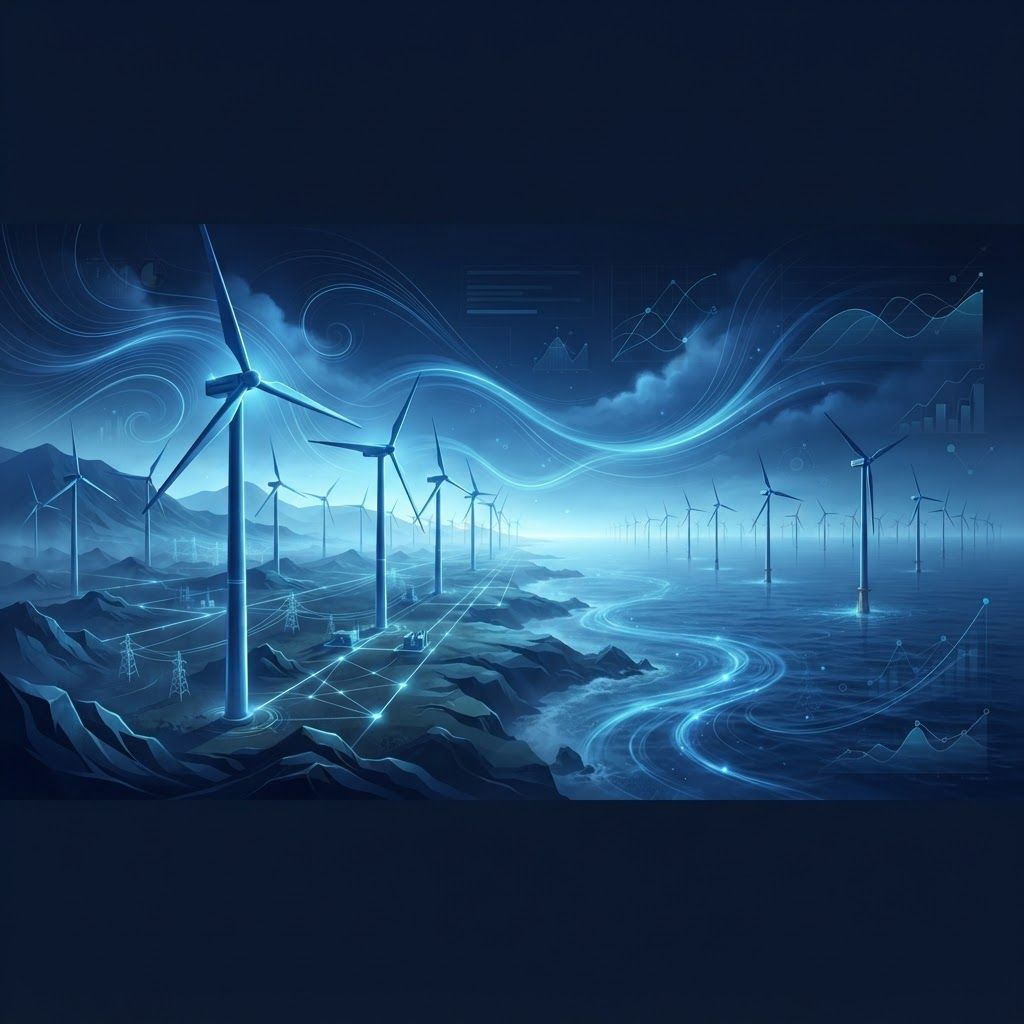
Wind Power and the Humber: A Strategic Partnership
The southern North Sea has become one of the most important offshore wind regions on earth, and North Lincolnshire sits directly at its landward edge. The combination of shallow water, consistent wind resource, favourable seabed conditions and proximity to major industrial electricity demand has produced a concentration of wind generation capacity that would have seemed implausible two decades ago. Onshore, Lincolnshire's flat, exposed agricultural landscape has hosted turbines for far longer, providing landowners with diversified income and the grid with locally generated power.
For North Lincolnshire specifically, wind energy is not merely an environmental story but an industrial one. Turbine components are among the largest manufactured objects moved by sea, and handling them requires deep-water quays, enormous laydown areas and heavy-lift capability. The Humber possesses all three. That has drawn manufacturing, marshalling, installation and long-term maintenance activity to the estuary, creating skilled employment across engineering, marine operations and logistics throughout the district.
1. Ørsted
Ørsted is the dominant name in East Coast offshore wind and operates some of the largest wind farms in the world from bases serving the Humber region. Its East Coast operations and maintenance facilities coordinate technician deployment, vessel movements and component logistics across multiple offshore sites. The company's commitment to long-term operational presence, rather than construction-only involvement, has made it a durable employer and a significant driver of technician training provision across northern Lincolnshire.
2. RWE
RWE holds an extensive renewable portfolio with substantial offshore and onshore wind interests relevant to the region. The company operates wind assets across the United Kingdom and continues to develop new capacity, including large offshore projects with connections and support arrangements that draw on Humber infrastructure. Its scale allows sophisticated asset management, and its parallel interests in hydrogen and flexible generation position it well for an integrated energy system where wind output feeds electrolysis during periods of surplus.
3. Siemens Gamesa Renewable Energy
Siemens Gamesa's Humber-region operations represent one of the clearest examples of offshore wind generating genuine domestic industrial capability. Blade manufacturing and turbine service activity in the area supports advanced manufacturing employment and draws on a supply chain of engineering, fabrication and precision component businesses across North Lincolnshire and the wider region. The presence of turbine manufacturing close to installation sites reduces transport risk for components that are extraordinarily difficult to move over land.
4. Able UK
Able UK is foundational to offshore wind delivery on the Humber through its marine energy park and heavy-duty quayside facilities. The company provides the land, quay strength and logistics capability required to marshal, assemble and load out towers, blades, nacelles and foundations. Offshore wind construction is fundamentally constrained by port capability, and facilities of this specification are scarce nationally, which gives Able's role outsized strategic importance to the entire regional value chain.
5. Equinor
Equinor is a major offshore wind developer with significant interests off the East Coast and is simultaneously central to Humber hydrogen and carbon capture planning. The company's integrated view of the energy system, linking offshore generation with hydrogen production and industrial supply, is particularly relevant to North Lincolnshire because it offers a pathway for using surplus wind generation productively rather than curtailing it. Its offshore engineering heritage brings substantial technical depth to project delivery.
6. Triton Knoll Offshore Wind Farm Operations
Triton Knoll represents a significant East Coast offshore development whose operations and maintenance activity supports employment across northern Lincolnshire. Projects of this kind demonstrate the long-tail economic value of offshore wind: after construction concludes, decades of inspection, blade repair, subsea cable monitoring, vessel chartering and warehousing follow. These operational roles are typically higher skilled and more stable than construction employment, and they anchor supply chain businesses locally.
7. Hornsea Project Operations
The Hornsea developments off the Yorkshire and Lincolnshire coast constitute some of the largest offshore wind capacity globally, and their operational support draws heavily on Humber-region infrastructure and workforce. The scale of these projects has driven investment in specialist vessels, technician training facilities and component warehousing. For North Lincolnshire engineering firms, supplying into projects of this magnitude has provided the volume needed to justify capability investment.
8. Vestas
Vestas is one of the world's leading turbine manufacturers with substantial service operations across the United Kingdom, including onshore wind assets in Lincolnshire. The company's service division maintains turbine fleets throughout their operating lives, providing technician employment and parts logistics activity. For onshore wind owners across North Lincolnshire farmland, access to manufacturer-backed service arrangements materially affects long-term availability and revenue.
9. Banks Renewables
Banks Renewables develops and operates onshore wind and solar projects across northern England, with a model emphasising community benefit and local engagement. Its approach of offering community funds and local electricity discount arrangements addresses one of onshore wind's persistent challenges: securing genuine local support. For North Lincolnshire parishes considering onshore development, developers with a demonstrated community engagement record tend to encounter smoother planning pathways.
10. Specialist Regional Engineering and Marine Services Firms
Surrounding the major developers is a substantial ecosystem of North Lincolnshire and Humber engineering, fabrication, electrical, inspection and marine services businesses. These firms fabricate secondary steelwork, supply hydraulic and electrical components, provide rope-access and inspection services, operate crew transfer support and deliver specialist heavy haulage. Their collective contribution is what allows major projects to be delivered locally rather than relying wholly on imported capability, and they represent some of the most secure skilled employment in the district.
Onshore Wind Across North Lincolnshire
Onshore wind has a longer local history than offshore. The district's flat, exposed farmland delivers good wind resource with minimal terrain complexity, and turbines coexist with arable and livestock farming with limited land take. For farm businesses, turbine rent or shared revenue arrangements provide income uncorrelated with commodity prices and weather-dependent harvests, which is a genuine risk management benefit.
Development does require careful handling. Landscape and visual impact, residential amenity, noise assessment, aviation safeguarding given the region's airfields, and ecological considerations around bird and bat populations all feature in planning determination. Repowering older sites with fewer, larger and more efficient turbines has become an important theme, often increasing output substantially while reducing turbine count.
Skills, Training and Careers
Wind energy has become a significant career pathway across northern Lincolnshire. Offshore wind technicians require electrical and mechanical competence, working-at-height and sea survival certification, and hydraulic and composite repair skills. These roles command strong wages and offer long-term security given decades-long asset lives.
Beyond technicians, the industry employs marine coordinators, vessel crew, high-voltage engineers, project managers, environmental specialists, geotechnical engineers, planners and logistics professionals. Regional colleges and training providers have developed specific provision, and apprenticeship routes into the sector have expanded considerably. For a district historically dependent on heavy industry, this represents a meaningful diversification of skilled employment.
Selecting a Wind Energy Partner
For landowners, the critical questions concern the developer's track record on comparable projects, its approach to grid connection and realistic connection timing, the structure and duration of proposed lease or option terms, decommissioning security arrangements, and community engagement approach. Legal review of option agreements is essential, since these documents can bind land for decades and contain provisions on access, rent review, extension rights and restrictions on adjacent development.
For supply chain businesses, the questions concern prequalification requirements, payment terms, health and safety expectations and the volume commitments realistically available. Offshore wind procurement operates to demanding standards, and firms entering the sector should expect substantial compliance and certification investment.
Challenges and Outlook
Grid capacity remains the sector's most pressing constraint, with transmission reinforcement lagging generation ambition and causing both connection delays and curtailment. Supply chain inflation has affected project economics, particularly for fixed-price arrangements agreed in different cost conditions. Skills availability constrains delivery pace, especially in high-voltage electrical work and specialist marine trades. Planning and consenting timelines for both onshore and offshore projects remain lengthy.
Nonetheless the trajectory is strongly positive. Turbine capacity continues to increase, floating foundation technology opens deeper water, and the coupling of wind generation with hydrogen production offers a route to using output that would otherwise be curtailed. For North Lincolnshire, positioned at the meeting point of offshore generation and industrial demand, the strategic advantages are durable.
Final Thoughts
Wind energy has transformed from a marginal technology into a cornerstone of both the national electricity system and North Lincolnshire's industrial economy. The companies profiled here span global developers, turbine manufacturers, port and logistics enablers and the regional engineering firms that make delivery possible. Whether you are a landowner evaluating a proposal, a business seeking supply chain entry, or a worker considering a career move, the wind sector in this district offers unusually strong long-term fundamentals.
Want your brand featured in front of decision-makers? Publish a guest post or get a link insertion in our guides through AAMAX's guest post and link insertion service.
Helpful Links
 SponsoredAAMAX — Full-Service Digital Agency
Write for Us
Share your expertise with our readers. We welcome guest contributions from industry specialists.
Pitch your idea

