

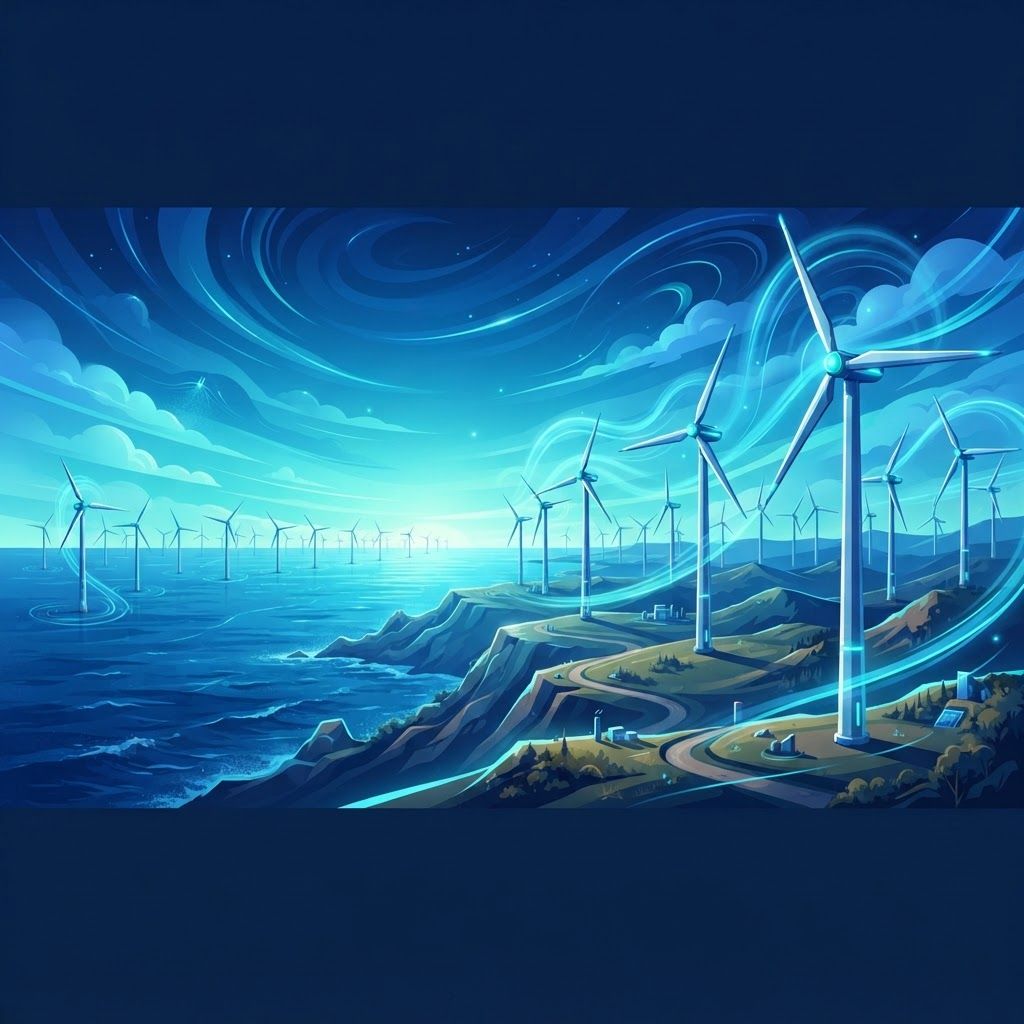
Wind Power and the Antrim Landscape
The Antrim Hills rise steeply behind the east coast, creating exposed upland terrain with exceptional wind speeds. Combined with a coastline facing the North Channel, Mid and East Antrim possesses natural conditions that make wind generation not merely viable but genuinely world class. Capacity factors achieved at well-sited Northern Ireland wind farms compare favourably with almost anywhere globally.
Wind has consequently become the backbone of Northern Ireland's renewable electricity generation, providing the majority of renewable output. The borough contributes both through installed generation capacity and through the engineering and service businesses that support the industry across the region.
The Wind Sector Explained
Utility-scale wind farms comprise multiple large turbines connected to the transmission or distribution network, developed by specialist companies and typically financed over long operating lives. Development involves site identification, wind resource assessment, environmental impact assessment, planning consent, grid connection and construction, frequently spanning many years before a single unit is generated.
Single and small cluster turbines serve farms, industrial sites and rural businesses, offsetting on-site consumption. This segment grew substantially during earlier support schemes and continues where consumption profiles justify investment.
Operations and maintenance represents a substantial ongoing industry. Turbines require scheduled servicing, blade inspection and repair, gearbox and generator maintenance, and increasingly sophisticated condition monitoring. Repowering, replacing older turbines with fewer, larger and far more productive machines on existing sites, has become a significant growth area as first-generation installations reach end of design life.
Ten Companies in the Wind Sector
1. B9 Energy has specialised in wind farm operations and maintenance across Northern Ireland for many years, managing substantial installed capacity and providing the technical continuity that long-lived assets require.
2. RES Group develops, constructs and manages wind projects internationally with a long-standing Northern Ireland presence, bringing engineering depth and access to project finance.
3. SSE Renewables owns and operates significant wind generation across the island of Ireland, combining development capability with the balance sheet strength that large projects demand.
4. Energia Group holds a substantial renewable generation portfolio including onshore wind, integrating generation with its supply business to serve customers with renewable electricity.
5. ESB operates generation assets across the island and participates in wind development, contributing cross-border operational expertise.
6. Simple Power built a portfolio of single-turbine installations hosted on farms and rural sites, a distributed model that shared generation revenue directly with landowners across rural Antrim.
7. Gaelectric developed wind projects alongside its work on energy storage, and played an important role in advancing the Larne salt cavern storage concept that complements variable wind output.
8. Harland and Wolff has pursued renewable energy fabrication and offshore wind support work, offering heavy engineering and quayside capability of direct relevance to the sector's infrastructure needs.
9. Specialist blade and turbine service contractors operating across Northern Ireland provide rope access inspection, blade repair, lightning protection and structural works. This technically demanding niche has created skilled employment throughout the region.
10. Local civil engineering and electrical contractors across Mid and East Antrim deliver access tracks, foundations, substations and cabling for wind projects. These firms capture a meaningful share of construction value within the borough economy.
Industry Trends and Challenges
Turbine technology continues to advance rapidly. Modern machines feature far larger rotors and taller towers, capturing more energy at lower wind speeds and improving output consistency. This makes repowering existing sites attractive, frequently doubling or tripling generation from fewer visible structures.
Grid constraint has become the sector's dominant challenge. Periods of high wind combined with limited network capacity or low demand result in curtailment, where generation is reduced despite resource availability. Storage, interconnection and demand flexibility all form part of the response.
Route to market has shifted from subsidy schemes towards corporate power purchase agreements and merchant exposure. Large energy users contracting directly with wind generators provide long-term price certainty for both sides and have become a primary enabler of new development.
Community benefit arrangements have matured considerably, with developers providing annual funds supporting local projects and, in some cases, offering shared ownership opportunities. Meaningful early engagement now shapes project design rather than following it.
Considerations for Landowners and Communities
Landowners approached regarding turbine siting should obtain independent legal and valuation advice before signing option agreements, as these documents can tie land up for many years. Understanding rent structures, decommissioning obligations and impacts on wider farming operations is essential.
Communities engaging with proposals benefit from focusing on specifics: turbine dimensions, visibility from particular locations, noise assessment methodology, shadow flicker, construction traffic routing and ecological mitigation. Detailed, evidence-based responses carry considerably more weight in planning processes than generalised objection.
Businesses considering on-site wind should commission proper resource assessment rather than relying on general regional data, since local topography creates significant variation over short distances.
Final Thoughts
Wind energy is embedded in the economy and landscape of Mid and East Antrim, supported by outstanding natural resources and a skilled engineering workforce. As older sites are repowered and storage capacity expands, the borough is well positioned to remain central to Northern Ireland's renewable generation for decades to come.
Want your brand featured in front of decision-makers? Publish a guest post or get a link insertion in our guides through AAMAX's guest post and link insertion service.
Helpful Links
 SponsoredAAMAX — Full-Service Digital Agency
Write for Us
Share your expertise with our readers. We welcome guest contributions from industry specialists.
Pitch your idea

