

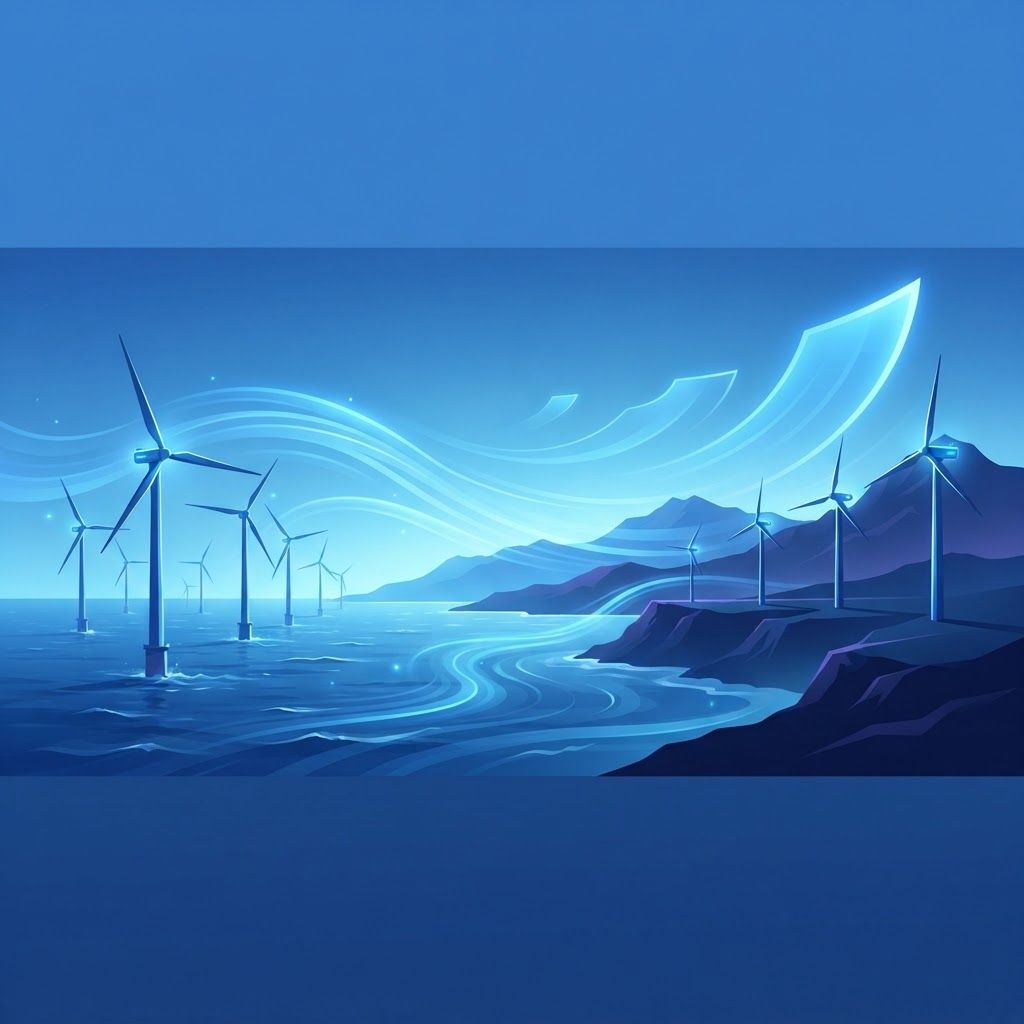
Wind Energy and the Gwynedd Landscape
Gwynedd sits at the meeting point of strong Atlantic weather systems and mountainous terrain, producing exceptional wind resources on the coast, offshore in the Irish Sea and across upland areas. Yet the county also contains Eryri National Park and some of the most protected landscapes in Wales, which constrains onshore development significantly.
The result is a distinctive pattern. Large-scale onshore wind farms are limited within the county itself, while offshore development in the Irish Sea has become the dominant growth story, and small community or farm-scale turbines provide localised generation where landscape impact is acceptable. Understanding this division is essential to understanding wind energy here.
The Offshore Opportunity
The Irish Sea hosts substantial existing offshore wind capacity and a strong pipeline of new development, including floating wind projects in the Celtic Sea further south. For North Wales, the economic significance lies less in generation ownership and more in the supply chain: port facilities, fabrication, vessel services, cabling, operations and maintenance bases, survey work, environmental monitoring and the skilled workforce required to sustain them.
Gwynedd businesses in engineering, marine services, logistics, accommodation and professional services all have routes into this supply chain. Contracts frequently require quality accreditations, health and safety certification and demonstrated capability, which is why local skills programmes have expanded alongside the projects.
The Top 10 Wind Energy Companies and Organisations Relevant to Gwynedd
1. RWE
One of the largest operators of offshore wind in the Irish Sea region, with significant existing capacity and development activity. Its operations and maintenance requirements generate long-term regional employment and supply chain demand.
2. Ørsted
A major offshore wind developer and operator with substantial presence in the Irish Sea, involved in projects that shape the North Wales renewable landscape and associated port and service activity.
3. Bute Energy and Green GEN Cymru
Developers advancing onshore wind and associated grid infrastructure across Wales, working with landowners and communities on projects and transmission connections that affect the wider Welsh energy network.
4. Menter Môn
Leading marine and renewable energy initiatives in North West Wales, the organisation connects community benefit, innovation and energy development, including work that intersects with offshore and marine renewables.
5. Community Wind Initiatives Across Gwynedd
Community-owned single turbines and small clusters operate in suitable locations, with income supporting local projects. These schemes demonstrate the model that has made Welsh community energy notable across the United Kingdom.
6. Small and Medium Wind Turbine Installers
Specialist installers supply and maintain farm-scale and small commercial turbines for properties with strong wind resources and suitable planning circumstances, often alongside solar and battery systems.
7. Wind Farm Operations and Maintenance Contractors
Technical service companies providing blade inspection, gearbox servicing, electrical maintenance and condition monitoring support both onshore and offshore assets, employing technicians across the region.
8. Marine and Port Service Providers
Vessel operators, survey companies, cable specialists and port logistics businesses serving Irish Sea offshore projects represent one of the most significant economic opportunities for coastal North Wales.
9. Environmental and Planning Consultancies
Consultants delivering environmental impact assessment, ornithological and marine mammal surveys, landscape and visual assessment, and community consultation are essential to every project and draw on regional ecological expertise.
10. Skills and Training Providers for the Wind Sector
Colleges and specialist training centres in North Wales deliver working at height, sea survival, offshore safety and turbine technician qualifications, creating the workforce pipeline that offshore developers require.
Planning Constraints in Gwynedd
Onshore wind proposals face rigorous assessment. Eryri National Park has the highest level of landscape protection, and development within or affecting its setting is heavily restricted. Elsewhere, planning authorities assess landscape and visual impact, cumulative effects with existing turbines, noise, shadow flicker, ecology particularly regarding birds and bats, archaeology, and impact on tourism. Welsh national policy has identified priority areas for renewable development, and proposals within those areas generally face a more favourable policy context.
Community engagement is not merely procedural. Projects with genuine local benefit, ideally including ownership stakes, encounter markedly less opposition than externally imposed developments.
Grid Connection and Infrastructure
As with all renewables in rural North Wales, grid capacity constrains what can be built. Transmission reinforcement projects are contentious because new overhead lines carry their own landscape impact. Solutions under discussion include undergrounding in sensitive areas, co-located storage and demand-side connections that use generation locally. Any developer should treat connection feasibility as a first-stage question rather than a later detail.
Floating Offshore Wind and the Future
Floating turbines can be deployed in deeper water than fixed foundations allow, opening substantial new capacity in the Celtic and Irish Seas. This technology requires large port facilities for assembly and significant fabrication capability, and Welsh ports are positioning for that role. For Gwynedd, the opportunity lies in supply chain participation and in the skilled employment that long-term operations and maintenance contracts provide.
Community Benefit and Local Ownership
Welsh policy encourages community benefit funds and local ownership stakes in renewable projects. These arrangements direct a share of revenue into local priorities, from energy efficiency schemes to Welsh language and youth initiatives. Communities negotiating with developers should seek clarity on fund value, duration, governance and whether an equity stake is available, as shared ownership delivers substantially more long-term value than a fixed annual payment.
Final Thoughts
Wind energy in Gwynedd is defined by a balance between exceptional natural resource and exceptional landscape value. The offshore sector offers the largest economic prize, particularly through supply chain and skills, while onshore development succeeds where scale is modest, siting is careful and communities hold a genuine stake in the outcome.
Want your brand featured in front of decision-makers? Publish a guest post or get a link insertion in our guides through AAMAX's guest post and link insertion service.
Helpful Links
 SponsoredAAMAX — Full-Service Digital Agency
Write for Us
Share your expertise with our readers. We welcome guest contributions from industry specialists.
Pitch your idea

