

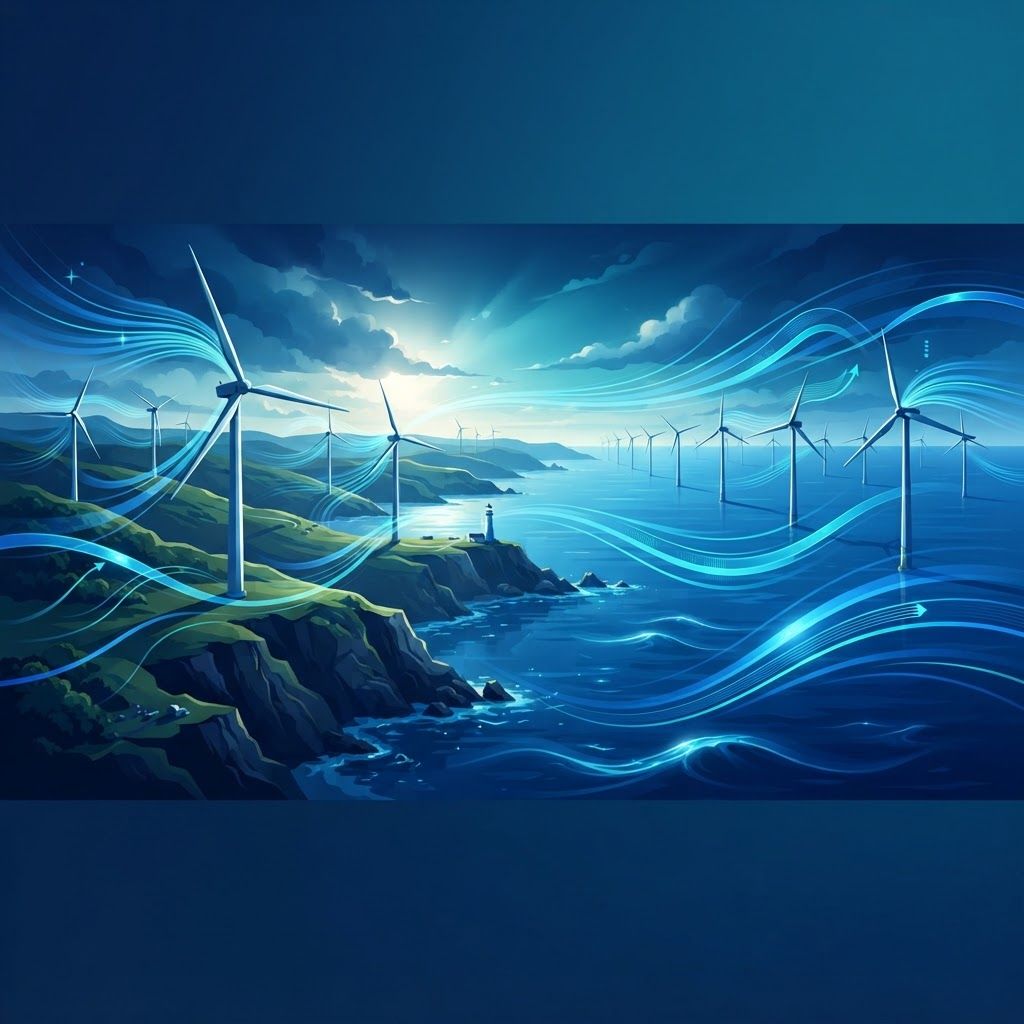
Wind and the South West Opportunity
Wind has become the largest source of renewable electricity in the United Kingdom, and the next phase of growth points directly towards the South West. The Celtic Sea, off the coasts of Devon, Cornwall and Wales, has been identified as a major zone for floating offshore wind, with substantial capacity planned over the coming years.
What makes this significant for Exeter is that floating wind requires a different industrial base from fixed-bottom offshore projects. Platforms must be assembled in port, towed to site and maintained from regional bases. That creates demand for engineering, marine services, professional advice, logistics and skilled labour across the South West, with Exeter well positioned as the region's commercial centre.
Ten Organisations Connected to Wind Energy Around Exeter
Regen conducts influential analysis of wind deployment, grid capacity and energy system integration across the South West, and convenes the industry, public sector and community stakeholders shaping regional strategy.
Met Office provides the meteorological science underpinning wind resource assessment, generation forecasting and extreme weather risk analysis, capabilities that are directly commercially relevant to wind operators nationally and internationally.
National Grid Electricity Distribution manages the network across the South West, and its reinforcement programmes determine how much wind generation can physically connect in the region.
University of Exeter contributes research in renewable energy engineering, marine environments, materials and energy systems, alongside training the engineers and analysts the sector requires.
Ashfords advises on energy projects including land agreements, consenting, construction contracts, power purchase agreements and project finance for wind developments.
Michelmores supports landowners and developers on the property, planning and agricultural aspects of onshore wind, including option agreements and lease structures.
Offshore wind developers active in the Celtic Sea are progressing floating projects that will draw heavily on South West supply chains and regional professional services.
Marine and port service operators across Devon and Cornwall provide the vessel support, survey capability and logistics that offshore wind construction and maintenance demand.
Onshore wind operators and asset managers in Devon run existing turbines, handling performance optimisation, maintenance scheduling and repowering assessments.
Community wind initiatives across the South West demonstrate locally owned generation, distributing returns within communities and building durable public support for development.
Onshore Wind in Devon
Onshore wind is the cheapest form of new electricity generation available in the United Kingdom, yet English deployment slowed dramatically under restrictive planning policy that effectively allowed single objections to block schemes. Policy reform has improved the position, and interest in new development has revived.
Devon hosts existing turbines, largely single machines and small clusters on farms and estates. Many are approaching the age where repowering becomes attractive, replacing older turbines with fewer, larger and far more productive machines on sites with proven resource and existing grid connections.
For landowners, wind offers substantial long-term income, though the development process is lengthy and the proportion of projects reaching construction remains modest.
Floating Offshore Wind and the Celtic Sea
Water depths off the South West coast exceed what fixed foundations can economically reach, making floating platforms the enabling technology. Turbines are mounted on buoyant structures moored to the seabed, allowing deployment in deeper water with stronger and more consistent wind.
The industrial implications are considerable. Floating platforms are large and are assembled in port rather than at sea, requiring substantial quayside facilities and creating concentrated manufacturing and assembly employment. Operations and maintenance bases then provide long-term regional jobs.
For Exeter businesses, the opportunities extend well beyond marine engineering into legal and financial services, environmental consultancy, data analysis, accommodation, training and logistics.
Grid Connection and System Integration
Connecting large volumes of wind generation in the South West requires significant network investment. Existing infrastructure was designed to import power into the region rather than export it, and reinforcement is essential.
Curtailment, where generation is constrained because the network cannot accept it, already occurs elsewhere in the country and represents wasted clean energy and lost revenue. Addressing this involves transmission upgrades, storage deployment, demand flexibility and potentially hydrogen production to absorb surplus generation locally.
Environmental and Community Considerations
Wind development raises genuine environmental questions that responsible developers address through assessment. Ornithological surveys, bat activity monitoring, landscape and visual impact assessment, noise modelling and, for offshore projects, marine mammal and fisheries impacts all form part of consenting.
Community engagement determines outcomes as much as technical merit. Projects that consult early, adapt designs in response to feedback and offer meaningful community benefit funds or shared ownership achieve markedly better acceptance than those presented as fait accompli.
Skills and Employment
Wind energy requires a broad skills base: mechanical and electrical engineers, turbine technicians, marine crew, project managers, environmental scientists, data analysts and commercial specialists. Technician roles in particular offer well-paid careers accessible through apprenticeship rather than degree routes.
Exeter College, the university and regional training providers have been expanding relevant provision, and the sector's growth trajectory suggests sustained demand. Transferable skills from marine, defence and oil and gas backgrounds are particularly valued.
The Economics of Wind
Wind generation costs have fallen dramatically, though recent supply chain inflation and higher financing costs have pushed prices up from their lowest points. Contracts for difference provide revenue certainty for large projects, while corporate power purchase agreements allow businesses to buy renewable electricity directly at fixed long-term prices.
For large Exeter energy users, these agreements offer both price stability and credible decarbonisation evidence, which increasingly matters for reporting and procurement requirements.
Looking Forward
Wind will remain central to decarbonising electricity, and the South West's role is set to grow substantially through Celtic Sea development. For Exeter, the opportunity lies less in hosting turbines than in providing the expertise, services and skilled people that a major regional industry requires. Organisations positioning themselves now, whether in engineering, professional services or training, are likely to benefit considerably over the coming decade.
Want your brand featured in front of decision-makers? Publish a guest post or get a link insertion in our guides through AAMAX's guest post and link insertion service.
Helpful Links
 SponsoredAAMAX — Full-Service Digital Agency
Write for Us
Share your expertise with our readers. We welcome guest contributions from industry specialists.
Pitch your idea

