

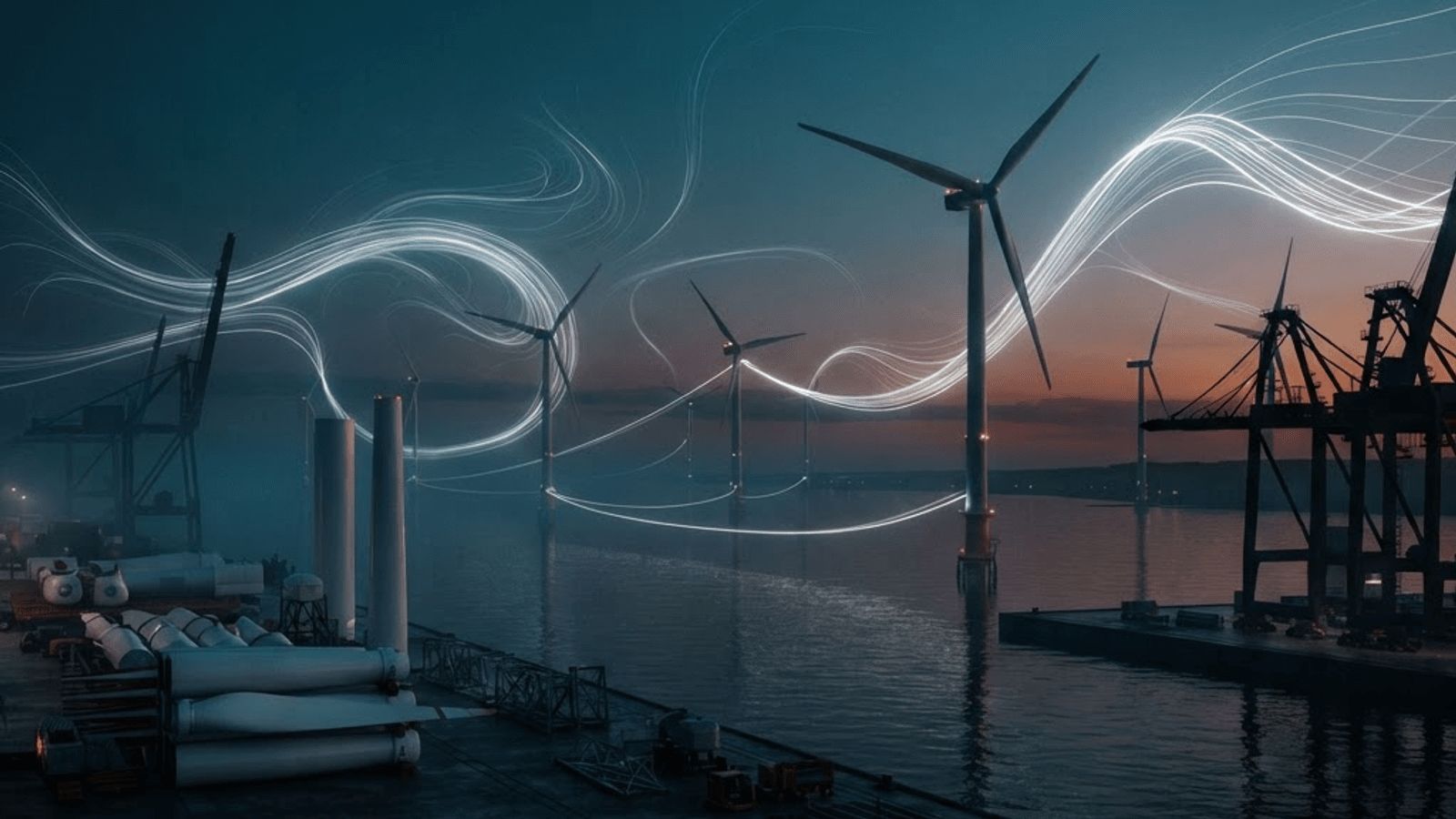
Dundee's Strategic Position in Wind Energy
Wind is the defining renewable technology of the Scottish east coast, and Dundee occupies an unusually favourable position within it. The city has a working deep-water port with direct access to the North Sea, no lock restrictions, substantial adjacent laydown land, and rail and motorway connections inland. For offshore wind developers, those characteristics are decisive. Turbine components are enormous, heavy, and awkward, and the number of UK ports capable of marshalling them is limited.
Over the past decade Forth Ports has invested significantly in strengthening quays at Dundee, increasing bearing capacity and creating space suitable for storing monopiles, transition pieces, blades, and nacelles. That investment positioned the city to compete for construction and operations work associated with Scottish offshore projects, and to attract manufacturing and fabrication interest from international suppliers.
Offshore, Onshore and the Supply Chain
It is worth distinguishing the different parts of the wind sector. Offshore wind dominates the economics and involves ports, vessels, foundations, cables, and long-term operations and maintenance. Onshore wind across Angus, Perthshire, and Fife creates demand for civil engineering, electrical contracting, and environmental consultancy. Small-scale wind serves farms and rural businesses. Dundee companies contribute across all three, and many of the most valuable local businesses are suppliers rather than developers.
The Top 10 Wind Energy Companies in Dundee City
1. Port of Dundee (Forth Ports)
The anchor of the city's wind sector. Forth Ports has developed Dundee as a dedicated renewables hub with reinforced heavy-lift quayside, extensive open storage, and the ability to handle the largest current generation of turbine components. It has also created an energy park designed for fabrication and assembly tenants, making it the single most important enabler of wind activity in Tayside.
2. Michelin Scotland Innovation Parc
MSIP provides industrial-scale premises and engineering support for companies working in decarbonisation, including wind supply chain manufacturing, composite work, and hydrogen production linked to wind generation. Its skills academy also trains technicians for renewable engineering roles, addressing one of the sector's main constraints.
3. GE Vernova and International Turbine Suppliers Operating at Dundee
Global turbine and foundation suppliers have used Dundee as a marshalling, storage, and pre-assembly base for Scottish offshore projects. Their presence brings advanced logistics practice, safety standards, and technician employment to the city, and drives demand for local fabrication, transport, and inspection services.
4. Bilfinger UK
Bilfinger has a long-standing engineering presence in Tayside and provides mechanical, electrical, and asset integrity services that transfer directly from oil and gas into offshore wind. Its capability in inspection, maintenance, and rope access work is exactly what wind farm operators require once assets move from construction into a twenty-five year operating life.
5. Cornerstone Maintenance and Industrial Services Contractors
Industrial maintenance contractors based in and around the Dundee docks area provide fabrication, welding, coatings, and mechanical support for wind components. These businesses rarely appear in headlines but are essential for repairs, modifications, and refurbishment of foundations, platforms, and access structures.
6. Tayside Marine and Vessel Support Operators
Offshore wind construction and maintenance depend on crew transfer, survey, and support vessels. Marine operators and agency services working from the Tay provide pilotage, mooring, bunkering, and logistics coordination, forming a critical link between quayside and offshore site.
7. Absolute Solar and Wind
For farms, estates, and rural businesses across Angus and Perthshire within Dundee's commercial reach, dual-technology renewable specialists design and install small and medium wind turbines alongside solar. They handle feasibility, wind resource assessment, planning support, and grid connection applications, which are the hardest parts of a small wind project.
8. Environmental and Ecology Consultancies in Dundee
Wind projects cannot progress without ornithological surveys, habitat assessment, noise modelling, and landscape and visual impact analysis. Consultancies operating from Dundee support developers across eastern Scotland with this evidence, and their work often determines whether a scheme is consented at all.
9. University of Dundee Engineering and Energy Law Groups
The university contributes offshore geotechnical research, particularly around foundation behaviour in marine sediments, alongside internationally recognised work in energy law and policy. This combination of technical and regulatory expertise is directly relevant to wind developers navigating consent, leasing, and grid frameworks.
10. Dundee and Angus College Renewable Engineering Training
Skills supply is a genuine bottleneck for wind energy. The college delivers engineering, electrical, and mechanical training that feeds technician roles in turbine maintenance and offshore support, and works with employers to align qualifications with sector requirements.
Industry Trends to Watch
Three developments will shape Dundee's wind sector. First, floating offshore wind opens deeper water sites and requires substantial quayside assembly space, which favours ports with heavy-lift capability. Second, the shift from construction to long-term operations creates durable local employment in maintenance rather than short project peaks. Third, integration of wind with hydrogen production and industrial electrification is being actively explored at sites such as MSIP, potentially creating demand for wind power beyond the electricity grid.
Working With Wind Companies
Businesses seeking to enter the supply chain should focus on accreditation, health and safety systems, and offshore-specific certification, since developer prequalification is demanding. Landowners considering onshore turbines should commission independent wind resource assessment before committing to any supplier. Public bodies and investors should look at port capability and skills pipelines as the real indicators of regional strength.
Conclusion
Dundee's wind energy strength lies less in owning turbines than in enabling them. Port infrastructure, industrial premises, engineering contractors, marine services, consultancy, research, and training combine to make the city a functioning part of Scotland's offshore wind economy, with the long-term operations phase likely to deliver its most stable benefits.
Want your brand featured in front of decision-makers? Publish a guest post or get a link insertion in our guides through AAMAX's guest post and link insertion service.
Helpful Links
 SponsoredAAMAX — Full-Service Digital Agency
Write for Us
Share your expertise with our readers. We welcome guest contributions from industry specialists.
Pitch your idea

