

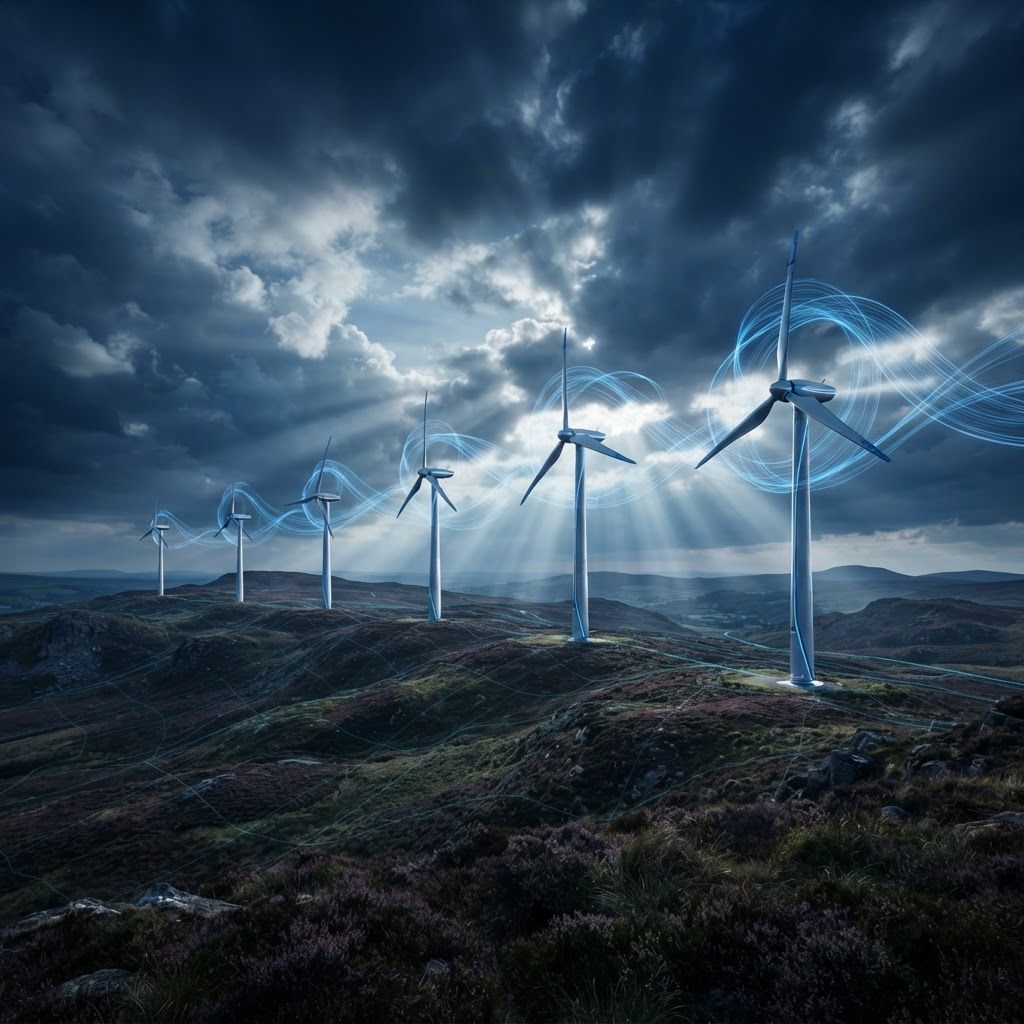
Wind Resource in Carmarthenshire
Carmarthenshire benefits from a genuinely strong wind resource, particularly across its northern and eastern uplands where elevation and exposure to prevailing south-westerly airflow produce consistent wind speeds. The county's position on the western side of Britain means weather systems arrive largely unobstructed from the Atlantic, delivering the sustained conditions that wind generation requires.
This resource has attracted development at multiple scales over three decades. Early schemes established the technical viability, and successive generations of larger, more efficient turbines have significantly improved energy yield per site. Alongside commercial development, a substantial number of smaller turbines serve individual farms and businesses, providing on-site generation that reduces exposure to grid electricity prices.
Types of Wind Development
Commercial wind farms comprise multiple large turbines connected to the distribution or transmission network, developed by specialist companies and typically financed through long-term power purchase agreements or government support mechanisms. These projects involve extensive assessment, community consultation and infrastructure works including access tracks, crane hardstandings, cabling and substation compounds.
Single and small-cluster turbines serve agricultural and commercial sites, sized to match on-site demand. These installations are considerably simpler to consent and connect, and their economics rest primarily on displacing purchased electricity rather than export revenue. Repowering is an emerging category, where ageing turbines on established sites are replaced with modern machines that generate substantially more energy from the same footprint.
Community wind projects, part-owned by local cooperatives or trusts, have a strong tradition in Wales. These schemes return surplus revenue to local funds supporting community facilities, energy efficiency measures and local initiatives, which materially changes public perception of development.
The Development Process
Wind projects follow a long and structured path. Site identification considers wind resource, grid proximity, landscape designations, ecological sensitivity, aviation and radar constraints, road access for abnormal loads and land availability. Landowner agreements follow, usually through exclusivity and option arrangements leading to long leases.
Assessment work includes on-site wind monitoring, often via mast or lidar for at least twelve months, ornithological surveys covering breeding and wintering birds, bat activity monitoring, peat and hydrology studies which are particularly important on upland Welsh sites, archaeological assessment, noise modelling against recognised guidance, shadow flicker analysis and landscape and visual impact assessment supported by photomontages.
Planning applications for larger schemes may be determined by Welsh Government under developments of national significance procedures, while smaller schemes are decided by Carmarthenshire County Council. Grid connection applications proceed in parallel, and connection availability frequently determines project timing more than planning does.
Construction and Operations
Construction requires civil engineering capability for tracks and foundations, electrical contracting for cabling and substations, and specialist lifting for turbine erection. Abnormal load logistics through rural Welsh roads demand detailed route surveys and coordination with highways authorities.
Once operational, wind assets require scheduled maintenance, blade inspection increasingly conducted by drone, gearbox and generator condition monitoring, high-voltage electrical maintenance and performance analysis to identify underperformance. Operations and maintenance contracts vary in scope, and asset owners should understand availability guarantees, response times and the treatment of major component failure.
Local Supply Chain and Skills
Wind development supports a broader local economy than turbine supply alone. Civil contractors, quarry operators supplying aggregate, electrical engineers, environmental consultants, surveyors, transport specialists, security providers and accommodation businesses all benefit. Carmarthenshire's proximity to the port infrastructure of south Wales and to Swansea's engineering base strengthens this position.
Skills development has become a strategic priority. Local colleges and training providers offer wind turbine technician pathways covering working at height, rescue, electrical safety and mechanical maintenance, creating career routes for young people within the county rather than requiring relocation.
Assessing Wind Energy Companies
For landowners approached about hosting turbines, the priorities are clear. Establish the developer's track record of consented and constructed projects rather than accepting general claims. Understand the option and lease terms in detail, including duration, rent structure, minimum payments, decommissioning obligations, restoration bonds and restrictions on your own land use. Independent legal and agronomic advice is essential before signature.
For businesses considering their own turbine, evaluate the specialist's technical process: was a genuine wind assessment undertaken, or was output estimated from a national database? Are yield projections presented with uncertainty ranges? What maintenance provision is included, and what happens when the manufacturer's warranty expires? Reputable operators present conservative projections and discuss risk openly.
Community Relations and Public Concerns
Wind development attracts legitimate local scrutiny concerning landscape change, noise, ecology, construction traffic and property values. Developers who engage early, share assessment findings transparently, respond to concerns substantively and offer meaningful community benefit tend to secure smoother consent and better long-term relationships. Those who treat consultation as a procedural formality generally encounter sustained opposition.
Final Thoughts
Wind energy remains one of the most cost-effective low-carbon generation technologies available, and Carmarthenshire's resource is genuinely valuable. Whether hosting, developing or investing, engage experienced specialists, secure independent advice on agreements and insist on transparent technical assessment. Well-sited wind projects deliver decades of clean generation and durable local economic benefit.
Want your brand featured in front of decision-makers? Publish a guest post or get a link insertion in our guides through AAMAX's guest post and link insertion service.
Helpful Links
 SponsoredAAMAX — Full-Service Digital Agency
Write for Us
Share your expertise with our readers. We welcome guest contributions from industry specialists.
Pitch your idea

