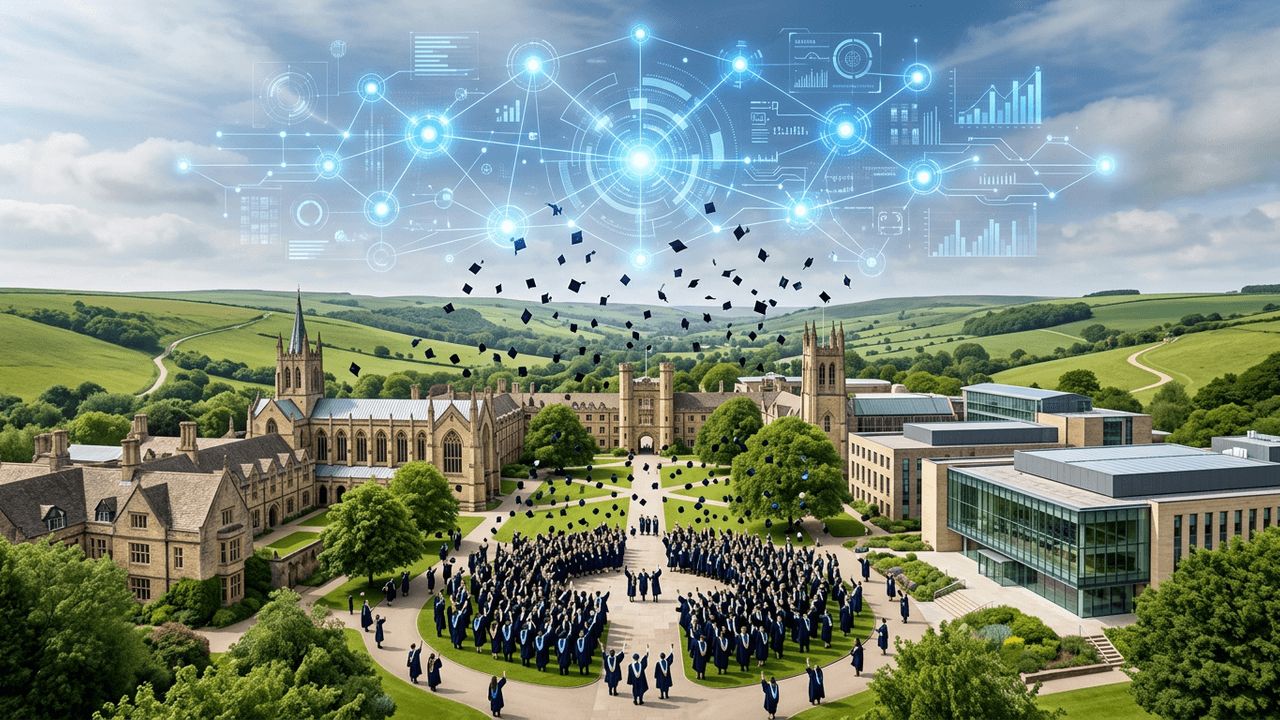
Higher Education in Herefordshire
Herefordshire occupies an unusual position in English higher education. For most of its modern history the county had no university of its own, meaning ambitious students routinely left for Birmingham, Bristol, Cardiff or further afield. That changed with the establishment of a new engineering-focused institution in Hereford, one of the most significant additions to the UK higher education landscape in decades.
Today the county's higher education offer combines a genuinely innovative local university, specialist creative and land-based provision, university-level courses delivered through further education colleges, and easy access to major institutions in neighbouring regions. For students weighing options, this creates real choice: study locally with strong industry links, or use Herefordshire's excellent rail connections to reach larger campuses.
Why Local Higher Education Matters
Rural counties experience persistent graduate outflow. When students leave for university, many never return, which drains skills from local employers and weakens the regional economy. Herefordshire's higher education strategy directly addresses this by building provision that is tied to actual local industry needs — engineering, food technology, land management, creative practice and health care.
Studying locally also reduces cost dramatically. Living at home or in lower-cost accommodation, with no relocation expense, changes the financial calculation of a degree substantially, particularly for students from families where higher education is a new step.
The Ten Leading Higher Education Options
1. New Model Institute for Technology and Engineering
Based in Hereford, NMITE is the county's flagship higher education institution and one of the most distinctive engineering providers in the UK. It has rejected the traditional lecture-and-exam model in favour of intensive, project-based, challenge-led learning delivered in partnership with employers. Its accelerated degree structure, absence of conventional examinations and emphasis on real industrial problems make it genuinely different, and it has attracted national attention for rethinking how engineers are educated.
2. Hereford College of Arts
Delivering higher education courses in art, design, ceramics, photography, illustration, jewellery, textiles and performing arts, Hereford College of Arts offers degree-level study in a specialist studio environment. Its small cohorts, individual tutor relationships and workshop culture provide an experience closer to a traditional art school than a large multi-faculty university, and its graduates progress into creative industries and postgraduate study.
3. Centre for Automotive and Cyber Security
Hereford's specialist cyber and automotive security education, developed in connection with NMITE and the county's defence and security cluster, addresses a high-demand national skills gap. Its relevance to employers in secure systems, connected vehicles and industrial cybersecurity gives graduates strong employment prospects.
4. Kington Centre for Advanced Timber Technology
This specialist provision focuses on timber engineering, sustainable construction and modern methods of building. Given the county's forestry resources and the construction industry's shift towards low-carbon materials, it represents a forward-looking niche with genuine national significance.
5. Royal Agricultural University Provision
Serving students from Herefordshire's substantial farming community, the Royal Agricultural University offers degrees in agriculture, agribusiness, rural land management, food production and environmental science. Its reputation within the land-based sector is long-established, and its graduates are highly employable across the rural economy.
6. Harper Adams University
A leading specialist land-based university within reach of north Herefordshire, Harper Adams delivers agriculture, agricultural engineering, food technology, veterinary nursing and rural business degrees. It is widely regarded as the UK's premier agricultural university, with exceptional employment rates and strong industry integration — highly relevant for Herefordshire's farming and food processing economy.
7. University of Worcester
The closest full-scale university for east Herefordshire, offering strong provision in nursing, midwifery, teacher education, sport science, business and psychology. Its accessible entry routes, commutable location from Ledbury and Bromyard, and reputation for supportive teaching make it a practical choice for many county students.
8. University of Gloucestershire
Serving south Herefordshire and the Ross-on-Wye area, the University of Gloucestershire offers business, creative industries, sport, education and environmental courses. Its Cheltenham and Gloucester campuses are reachable for commuting students, and it has particular strength in creative and media disciplines.
9. Cardiff and South Wales Universities
Direct rail links from Hereford make Cardiff University and other South Wales institutions genuinely accessible. Cardiff offers research-intensive provision across medicine, law, journalism, engineering and the sciences, giving Herefordshire students access to a major Russell Group institution without an eastward move.
10. Higher Education Delivered Through Local Colleges
Foundation degrees, higher national qualifications and degree apprenticeships delivered through Herefordshire's further education providers allow students to reach higher-level qualifications while living and working locally. This route is increasingly important for adult learners, career changers and employees upskilling within Herefordshire businesses.
Trends in Higher Education
Degree apprenticeships are transforming access. Students earn while studying, employers shape the curriculum, and graduates emerge with both a degree and substantial workplace experience. In Herefordshire, where employers value practical capability highly, this model fits the local culture well.
Challenge-based and project-led learning, pioneered locally by NMITE, is influencing thinking well beyond the county. Rather than teaching theory first and applying it later, students tackle authentic industrial problems from the outset, developing teamwork, communication and problem-framing skills alongside technical knowledge.
Sustainability and green technology thread through nearly all growth areas: renewable engineering, sustainable construction, regenerative agriculture and environmental management. Herefordshire's rural setting gives students living laboratories for this work.
Choosing the Right Path
Consider what you want from the experience. A large university offers scale, societies, research depth and a conventional student community. A specialist institution like NMITE or Hereford College of Arts offers immersion, close staff contact and unusually direct industry exposure, but a smaller social environment.
Weigh finances carefully. Studying locally can reduce total costs by a substantial margin. Assess employability honestly by looking at where graduates actually work. And visit — the atmosphere of a small, intense studio or workshop environment is something you can only judge in person.
Final Thoughts
Herefordshire has moved from having no university to hosting one of the most talked-about engineering institutions in the country, alongside distinctive arts and technical provision. Combined with excellent access to established universities in Worcester, Gloucestershire, Cardiff and the specialist land-based sector, students in the county now have a genuinely credible range of choices — including the option to build a professional career without ever leaving Herefordshire.
Want your brand featured in front of decision-makers? Publish a guest post or get a link insertion in our guides through AAMAX's guest post and link insertion service.
Helpful Links
 SponsoredAAMAX — Full-Service Digital Agency
Write for Us
Share your expertise with our readers. We welcome guest contributions from industry specialists.
Pitch your idea